What element is being fused in the core of a star?
The question of what element is undergoing fusion at the heart of a star is not static; it depends entirely on the star’s current age, its initial mass, and the resulting core temperature and pressure. For the vast majority of a star’s life, especially for stars like our Sun, the element being fused in the core is hydrogen. This process, often called hydrogen burning, is what defines a star's main sequence existence. [2][5][9] This initial fusion is the engine that provides the outward pressure necessary to counteract the inward crush of gravity, maintaining hydrostatic equilibrium. [2][4]
# Hydrogen Burning
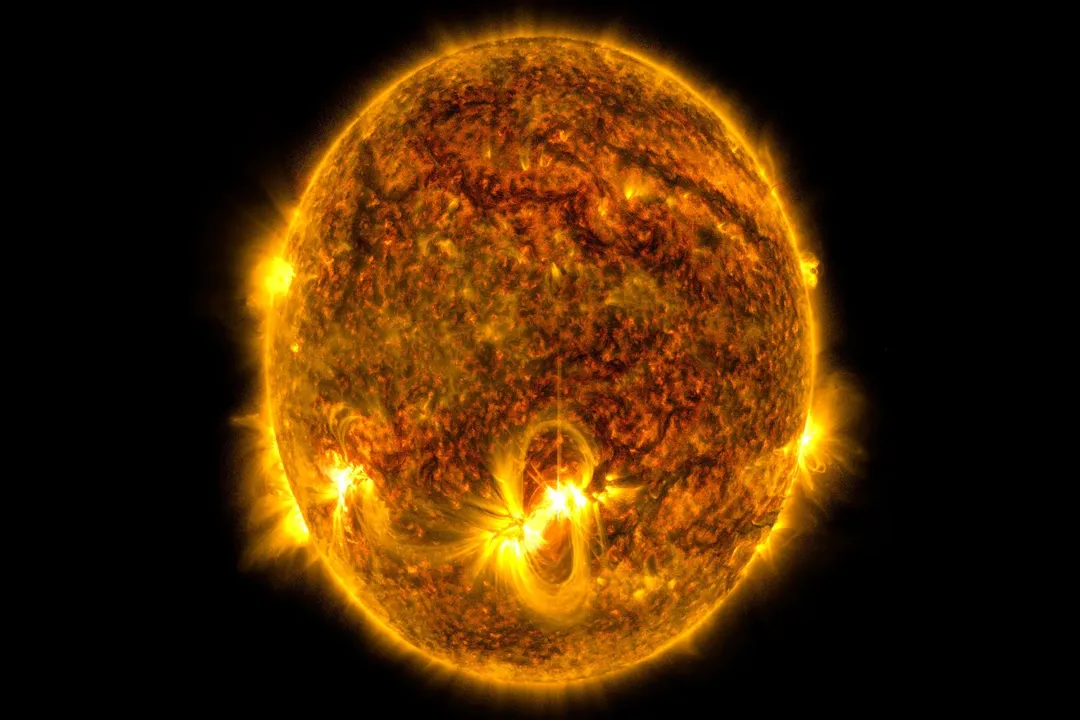
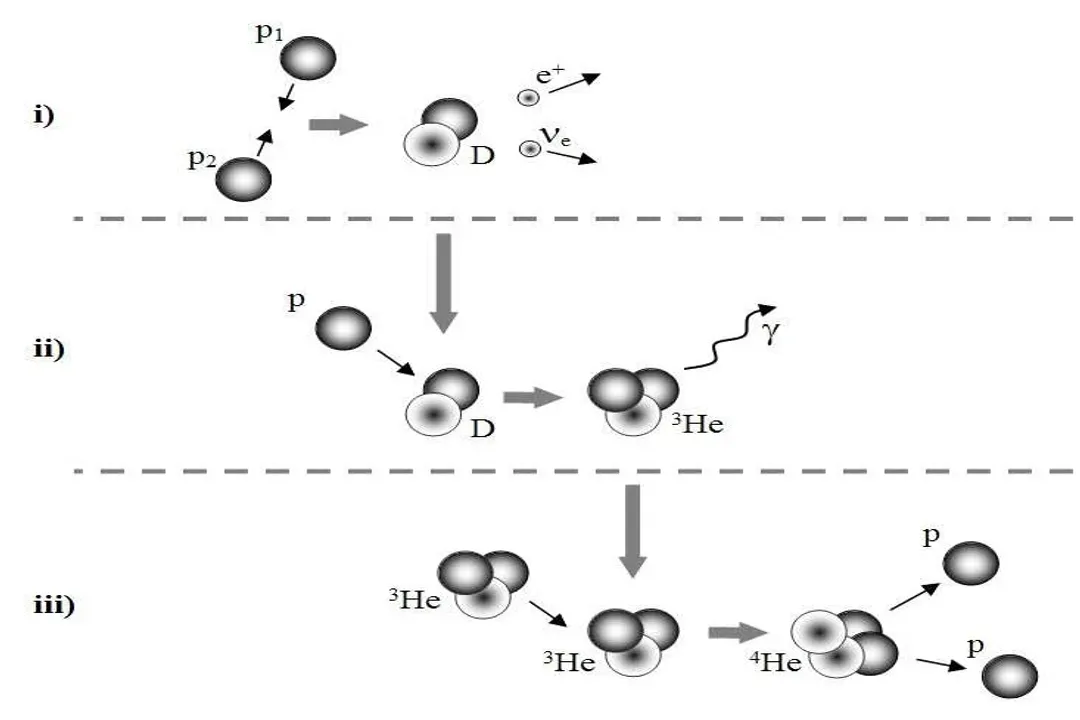
In the core of any main-sequence star, intense heat and pressure force hydrogen nuclei (protons) close enough together to overcome their mutual electrical repulsion and fuse. [4][5] For stars roughly the mass of the Sun or less, this happens primarily through the proton-proton chain reaction. [4] This chain reaction effectively converts four hydrogen nuclei into one nucleus of helium, releasing a significant amount of energy in the process. [4][5]
In larger, hotter stars, a different mechanism dominates the hydrogen fusion process: the CNO cycle (Carbon-Nitrogen-Oxygen cycle). [4] While the starting material is still hydrogen and the end product is still helium, this cycle uses carbon, nitrogen, and oxygen isotopes as catalysts to speed up the conversion rate. [4] Regardless of the specific pathway, the defining characteristic of a star on the main sequence is that it is fusing hydrogen into helium in its center. [9] This phase lasts for billions of years for smaller stars, but only a few million years for the most massive ones. [8]
# Stellar Mass Determines Fate
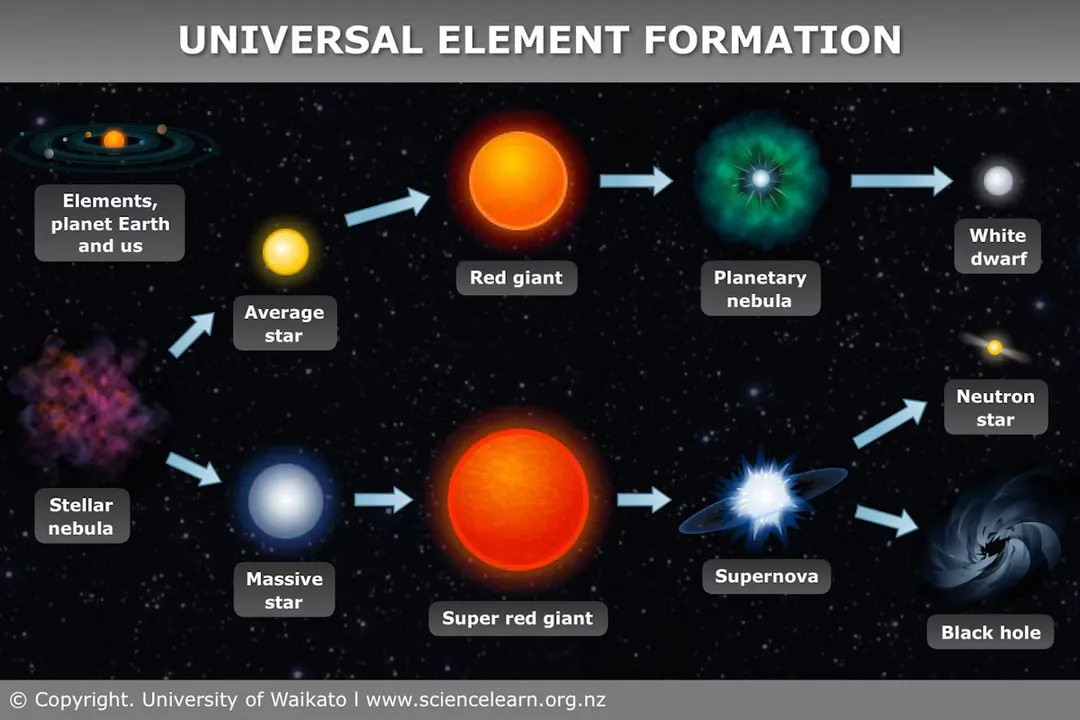
The trajectory of a star’s life, and consequently, what elements are fused later on, is dictated by its initial mass. [1][8] Low-mass stars, those up to about eight times the Sun's mass, do not generate enough core pressure to ignite subsequent fusion stages after the hydrogen supply is exhausted. [8] Once the core hydrogen turns into helium, these stars might contract and heat up enough to begin fusing the helium into heavier elements, but their ability to progress further is limited. [1][8]
Massive stars, however, have a far more dramatic and complex internal structure where the fusion chain continues long after the initial hydrogen fuel is spent. When the hydrogen in the core is depleted, the core contracts and heats up, eventually reaching the temperature required to fuse the accumulated helium. [9]
# Helium Ignition
When the helium core temperature reaches approximately 100 million Kelvin, [1] the next major fusion reaction begins: the triple-alpha process. [1][4] In this process, three helium nuclei (alpha particles) fuse together to create a nucleus of carbon (), often involving an intermediate step where two helium nuclei briefly form an unstable beryllium isotope before capturing a third helium nucleus. [4][7]
The conditions required to initiate helium fusion are substantially more demanding than those for hydrogen fusion. To put this into perspective, the core of the Sun, currently fusing hydrogen, operates at around $15$ million Kelvin. [1] Moving from hydrogen burning to helium burning represents an increase in core temperature by an order of magnitude, demanding much greater gravitational compression to achieve the necessary kinetic energy among the nuclei. [8]
# Successive Core Stages
For stars significantly more massive than the Sun—those exceeding about eight solar masses—gravity continues to win the long battle against outward pressure even after helium is exhausted. [8] The exhaustion of helium leads to the formation of a carbon-oxygen core, which contracts and heats until the next threshold is met.
This process repeats in layers, building up heavier and heavier elements in successive shells surrounding the inert core, though the core itself is always where the heaviest current fusion is taking place. [1][6] After carbon fusion, which typically happens at core temperatures around $600$ million Kelvin, the following elements are fused sequentially in the core:
- Neon fusion, which begins around $1.2$ billion Kelvin. [1]
- Oxygen fusion, requiring temperatures nearing $1.5$ billion Kelvin. [1]
- Silicon fusion, which occurs at extreme temperatures around $2.7$ to $3.5$ billion Kelvin. [1][7]
These later stages occur rapidly. While the hydrogen burning phase can last for eons, the silicon burning phase in a massive star's core might last only a few days or even just a single day before reaching the final stage. [1]
# Iron Formation
The final product of this intense, gravitationally-driven fusion sequence is iron (). [1][7][9] Iron represents a unique endpoint in stellar nucleosynthesis because it possesses the highest nuclear binding energy per nucleon of all elements. [1]
This means that fusing elements lighter than iron releases energy (exothermic), which powers the star. [1][9] However, fusing iron, or elements heavier than iron, requires an input of energy (endothermic). [1] Once the core is converted to iron, there is no further thermo-nuclear fuel source that can generate the necessary outward pressure to fight gravity. [9] The star has reached its energetic dead end. [1]
As the iron core builds up, it silently accumulates mass without releasing heat, causing gravity to take over completely. This rapid collapse is what triggers the star's dramatic demise, often resulting in a Type II supernova explosion, which is ironically the event that creates all the elements heavier than iron. [1][9]
# Layered Nucleosynthesis
It is helpful to visualize the interior of a massive, dying star not as a simple uniform furnace, but as a series of concentric shells, much like an onion. [6] In the moments before core collapse, the star is structured with the heaviest element at the center, surrounded by shells where lighter elements are still actively fusing. For example, you might find an inert iron core, surrounded by a silicon-fusing shell, then an oxygen shell, then a neon shell, and so on, with hydrogen fusion occurring in the outermost layers. [1][6] The element being fused in the core is always the heaviest one whose ignition temperature has been reached. This sequential layering is a direct consequence of the increasing energy required to fuse progressively heavier nuclei. [8]
The distinction between a low-mass star's fate and a high-mass star's fate boils down to this temperature ceiling. A star like the Sun simply never generates the necessary pressure to get past helium fusion to carbon fusion, leaving it to gently contract into a white dwarf composed mostly of carbon and oxygen, a remnant of its brief period of helium burning. [8] Conversely, the ability of massive stars to hit those multi-billion Kelvin thresholds allows them to churn through the periodic table all the way to iron, setting the stage for one of the universe's most energetic events. [1]
Related Questions
#Citations
Stellar nucleosynthesis - Wikipedia
Star Basics - NASA Science
If heavier elements 'sink' towards the core of a star, why does fusion ...
Star Life Cycle - ASPIRE
Nuclear Fusion in Stars - Universe Today
Universal element formation - Science Learning Hub
What is the order of the fusion of elements in a star's core? - Quora
Nuclear Fusion in Protostars | ASTRO 801
Star - Fusion, Lifecycle, Evolution | Britannica