What occurs inside the core of a star?
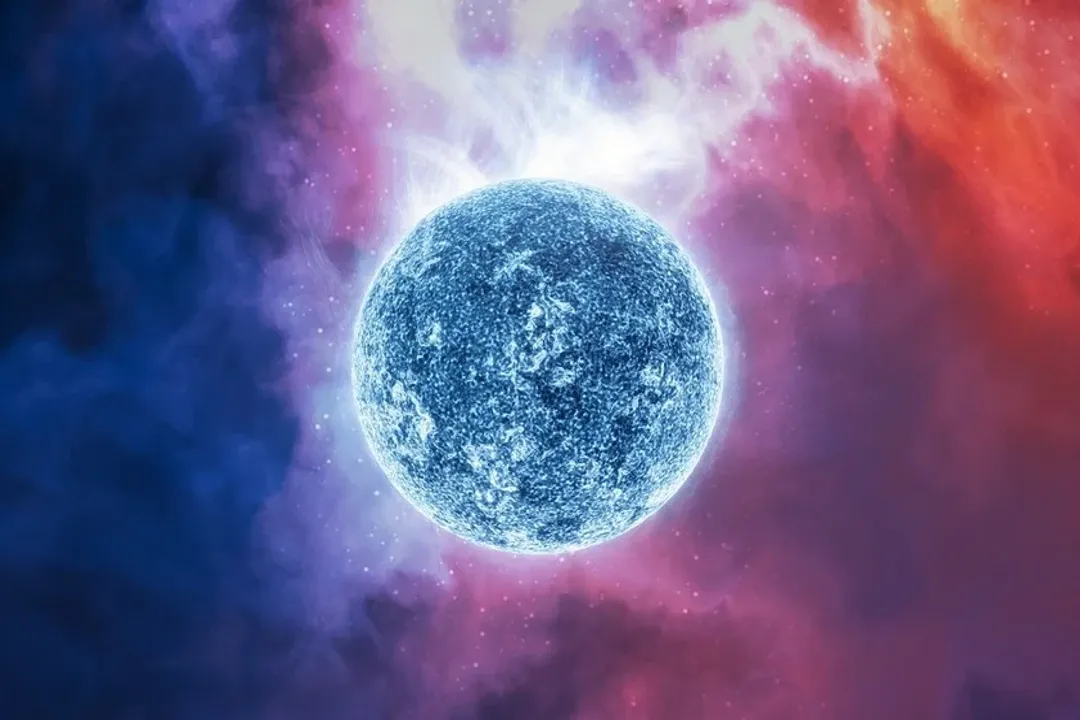
The interior of a star is a region governed by physics pushed to its absolute limits, a place where gravity, pressure, and temperature interact to forge the elements that ultimately sustain life across the universe. [7][9] This central engine, known as the stellar core, is where all the star’s light and heat originate. [9] It is the most intensely hot and densest part of the entire star. [5]
# Extreme Environment
A star exists in a state of extreme conditions centered on its core. For a star like our Sun, the core temperature soars to about 15 million Kelvin. [1][5] The pressure at this center is staggering; imagine the weight of the entire overlying star pressing down on a region no larger than about 20 to 25 percent of the star's radius. [5] This confinement forces the stellar material into an exotic state of matter called plasma, where the intense heat has stripped electrons away from the atomic nuclei. [8][7]
The composition of the core is heavily weighted toward the lightest elements. In a main-sequence star, the material consists mainly of hydrogen and helium nuclei suspended in a sea of electrons. [8] It is the density that truly sets the core apart from the rest of the star; while the Sun's core is roughly 150 times the density of water, it is far less dense than a white dwarf or neutron star remnant, yet it is the crucible where stellar power is unlocked. [1][5]
# Nuclear Fire
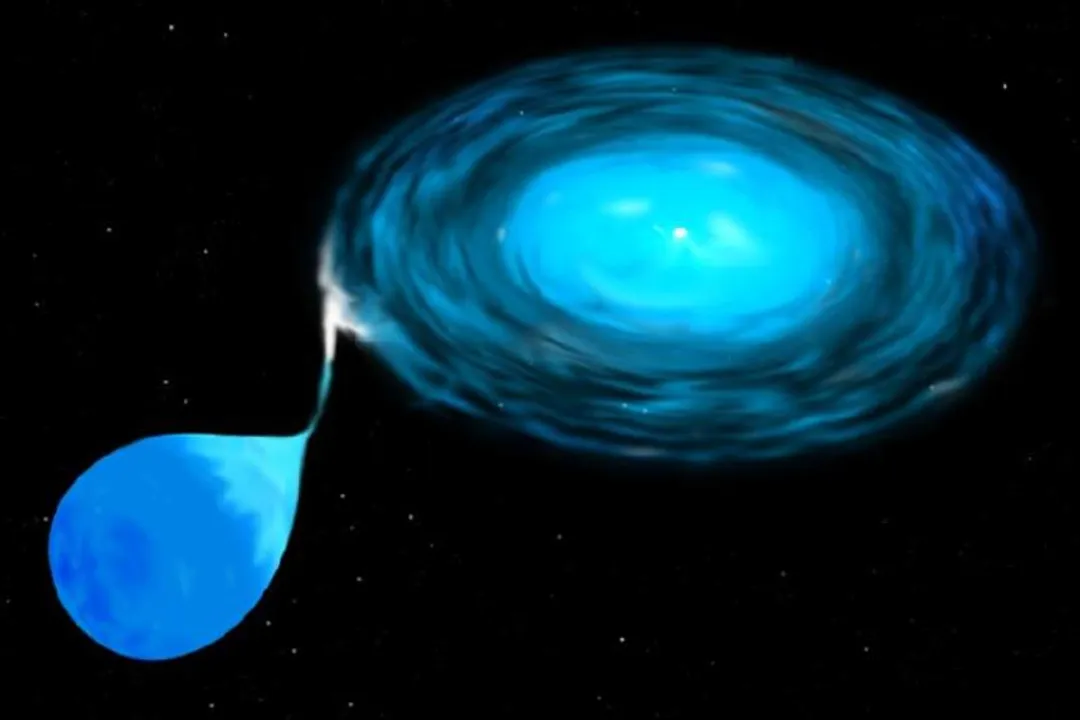
The driving force behind a star’s radiance is nuclear fusion, a reaction that requires the extraordinary conditions found only deep within the core. [2][3] Gravity continuously attempts to collapse the massive star inward, creating immense pressure and heat at the center. [6] When the temperature and density reach a critical threshold, atomic nuclei begin to overcome their natural electrical repulsion and slam together with enough force to fuse. [6][4] Fusion is the process where lighter atomic nuclei combine to form heavier nuclei, releasing tremendous amounts of energy in the process. [2]
Crucially, this reaction is not spread throughout the star. Due to the precise physical requirements—the precise combination of temperature, density, and pressure—fusion only occurs in that central, innermost region. [4] The outward energy flow generated by this thermonuclear burning precisely counters the inward pull of gravity. [7]
| Star Component | Primary State | Key Process |
|---|---|---|
| Core | Plasma | Nuclear Fusion |
| Radiative Zone | Plasma | Photon Diffusion |
| Convective Zone | Plasma | Bulk Gas Movement |
This table illustrates how the stellar interior is organized by function. The structure ensures that the energy generation is strictly localized to the core, providing a stable, long-term power source rather than allowing uncontrolled energy release throughout the stellar mass [Self-Analysis/Integration].
# Nuclei Combine
The most common fusion process for stars similar in mass to the Sun involves turning hydrogen into helium. [8] Specifically, this is often achieved through a set of reactions collectively known as the proton-proton chain, although in more massive stars, the CNO cycle may dominate. [1] In any case, four hydrogen nuclei (protons) are ultimately assembled into a single helium nucleus. [6]
When this assembly happens, a small amount of mass is lost. This minuscule mass difference is not destroyed; rather, it is converted directly into pure energy according to Einstein's famous relationship, . [2] This newly created energy, primarily in the form of high-energy photons (gamma rays), begins its long migration outward. [8] The entire existence of the star as a shining beacon in the night sky is contingent upon this reaction continually occurring at the center. [9]
# Balancing Act
The defining characteristic of a star during its longest phase of life, the main sequence, is hydrostatic equilibrium. [1] This is the perfect, dynamic compromise between two opposing cosmic forces. On one side is gravity, the relentless force of attraction attempting to crush the entire stellar mass into the smallest possible volume. [3] On the other side is the tremendous outward pressure generated by the heat of nuclear fusion in the core. [3][7]
When these two forces are exactly balanced, the star maintains a constant size and luminosity. [1] If the core fusion rate were to temporarily increase, the increased outward pressure would cause the star to expand slightly. This expansion would lower the core density and temperature, naturally slowing the fusion rate back down until equilibrium is restored. [1] Conversely, a slight dip in fusion rate allows gravity to compress the core slightly, raising the temperature and reigniting the fusion process. [1]
When astronomers observe a star transitioning off the main sequence, such as when it begins swelling into a red giant, they are observing the direct result of the core running out of its primary fuel (hydrogen) and the subsequent gravitational contraction starting to heat the area enough to ignite the next stage of fusion in a surrounding shell [Self-Analysis/Integration].
# Energy Escape
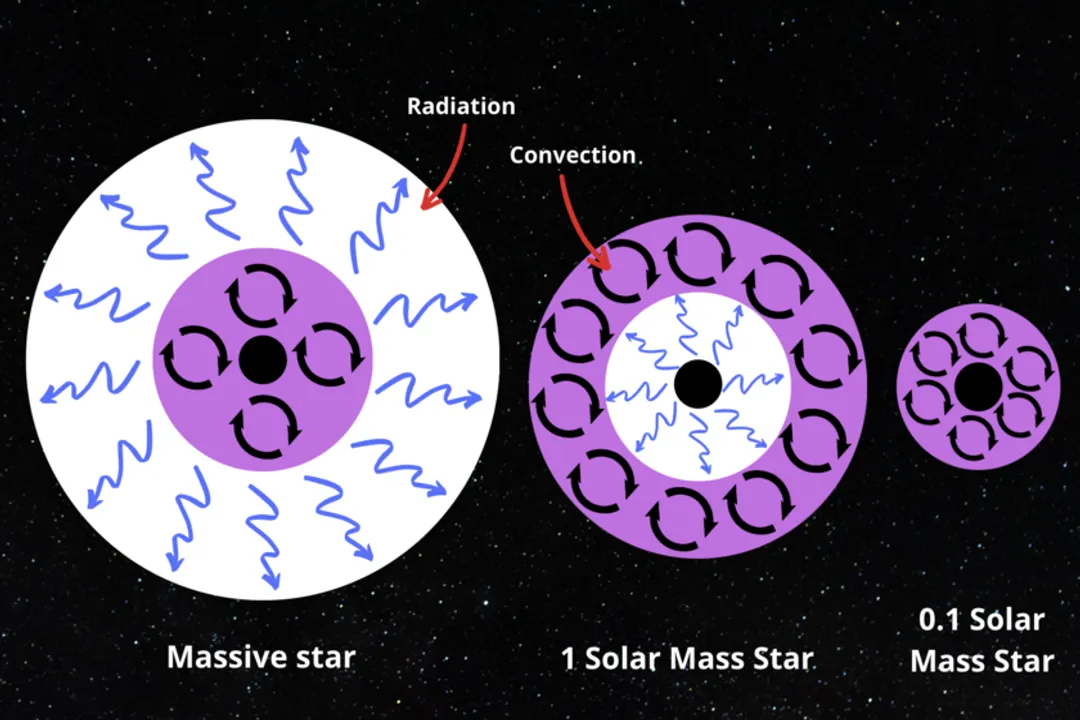
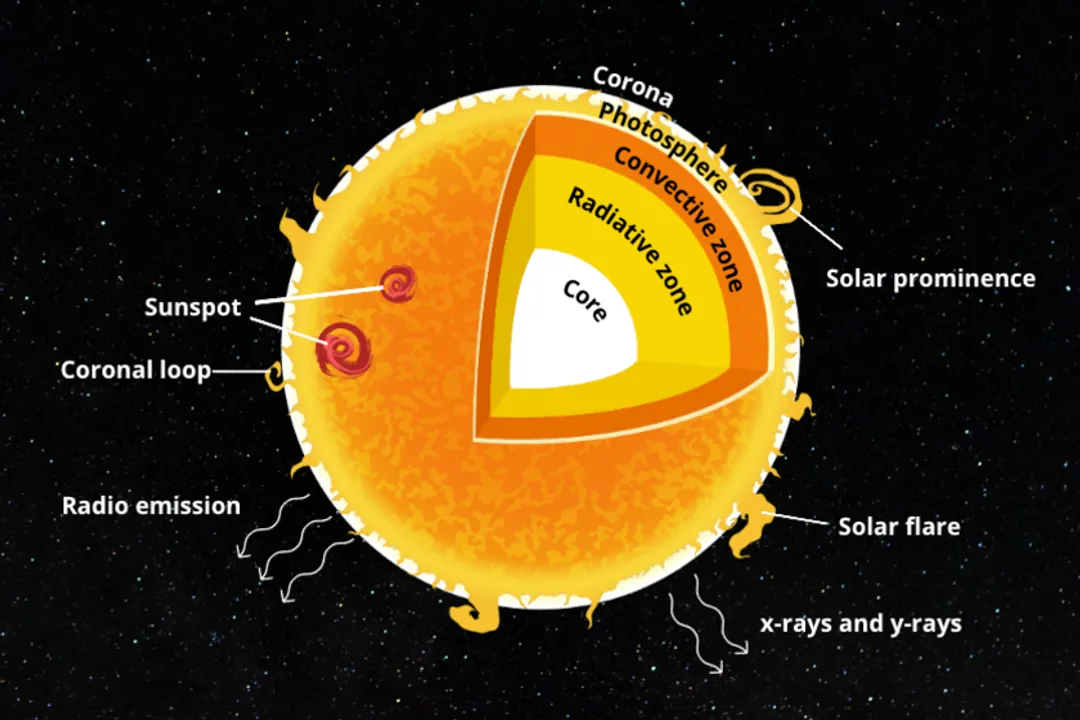
The energy generated within the core does not instantly reach the surface. It must traverse the star’s internal structure, a journey that can be surprisingly long. [1] Immediately surrounding the core is the radiative zone. [1] Here, the plasma is so dense that photons cannot travel far before being absorbed and re-emitted by charged particles, creating a slow, random walk outward. [8] This process of diffusion by radiation transfers energy across this layer. [1]
In stars like the Sun, the outer layer is the convective zone. [1] In this region, the plasma cools enough that the radiation mechanism becomes inefficient. Instead, energy transport relies on convection: hotter plasma rises toward the surface, releases its energy, cools, and then sinks back down to be reheated by the radiative zone below, much like water boiling in a pot. [8][1] The time required for a photon generated in the core to finally escape the star's surface can span hundreds of thousands of years. [1]
# Mass Differences
The nature and intensity of the core processes are directly related to the initial mass of the star. [1] A star’s mass determines the level of gravitational compression it experiences, which in turn sets the core temperature and dictates which fusion reactions can occur. [1]
For low-mass stars, like the one the Sun will become, the core only reaches temperatures sufficient to fuse hydrogen into helium. [1][3] Once the central hydrogen is exhausted, fusion ceases in the core, and the star begins its final evolutionary stages, eventually contracting and shedding its outer layers to form a white dwarf. [3]
Massive stars, however, experience far greater gravitational pressures, leading to much higher core temperatures. [1] Once hydrogen is depleted, these stars can continue fusing heavier elements sequentially in their cores—burning helium into carbon, carbon into neon, and so on, creating nested shells of different fusion processes. [1] This layered structure allows them to achieve far greater luminosities and significantly shorter lifespans compared to their smaller siblings. [1] The entire subsequent destiny of a star, whether it fades quietly or collapses violently into a neutron star or black hole, is predetermined by the events and the fuel availability inside that original central region. [3]
Related Questions
#Citations
Stellar core - Wikipedia
What is Fusion? - ITER
Stellar Evolution - | The Schools' Observatory
ELI5: Where exactly does fusion happen in stars? : r/explainlikeimfive
Core of a Star - Universe Today
Star Life Cycle - ASPIRE
The stars within us | NSF - U.S. National Science Foundation
Exploring the Inside of a Star: What Are They Made Of? - Label Stars
Stars | Herschel Space Observatory