Does fusion occur in the core of a red giant?
The life of a star is a continuous struggle against gravity, managed by the delicate balance between the inward crush of mass and the outward push of energy generated by nuclear fusion. When a star like our Sun leaves its stable adolescence on the main sequence, this balance tips dramatically, ushering it into the swollen, luminous, yet dying phase known as the red giant. The crucial question about this stage concerns the very heart of the star: what exactly is happening inside that dense, contracting core? It is not a period of rest; rather, it is a dramatic physical transformation governed by pressures and temperatures far exceeding those of its youth.
# Main Sequence End
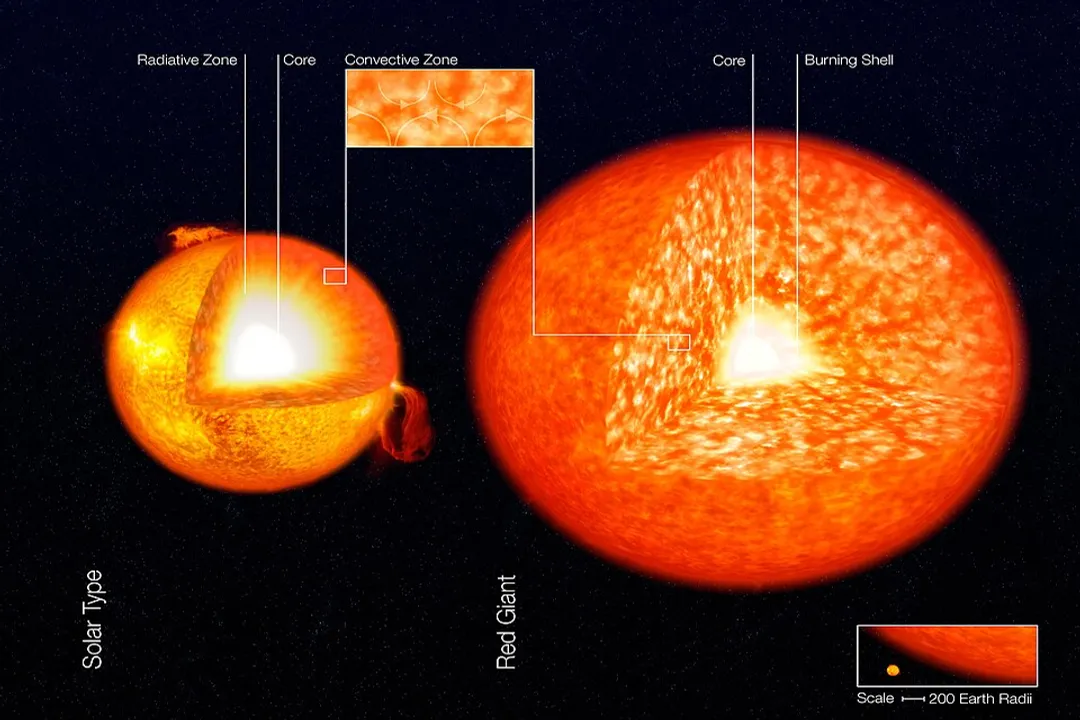
A star spends the vast majority of its existence fusing hydrogen into helium deep within its core. This process provides the thermal pressure necessary to support the star's enormous weight against gravitational collapse [cite: libretexts]. When the hydrogen fuel supply in the stellar center is depleted, the fusion engine stalls in that region [cite: wiki][cite: nasa]. With no internal energy generation left to counteract gravity, the inert helium "ash" at the center begins to contract violently [cite: reddit].
This gravitational collapse is not immediately fatal to the star's overall structure. As the core shrinks, the immense pressure and friction cause it to heat up drastically [cite: libretexts]. This rising temperature provides an unexpected benefit: it ignites the leftover hydrogen fuel situated in a shell surrounding the inert core [cite: science-campus]. This shell hydrogen burning is far more intense than the previous core burning because the contracting core acts as a tremendously efficient furnace, pushing the outer layers of the star outward [cite: stackexchange]. The result is the defining characteristic of a red giant: the star bloats, its radius swelling perhaps hundreds of times its main-sequence size, while its surface cools, shifting its light toward the red end of the spectrum [cite: esa].
# Inert Core
During this initial expansion phase of the red giant, the core itself is not actively fusing anything yet. It is composed almost entirely of dense, hot, non-fusing helium [cite: quora]. This helium ash cannot fuse under the conditions present immediately after core hydrogen depletion; it is simply too cool [cite: ohio-state]. The fate of the star hinges entirely on the continuing contraction of this helium center. The weight of the overlying layers relentlessly compresses the core, driving its temperature and density higher and higher, waiting for the threshold required for the next stage of fusion.
If we look at a star similar to the Sun, the contracting helium core becomes so compressed that the electrons within it are squeezed so tightly together that they resist further compression—a phenomenon known as electron degeneracy pressure [cite: reddit]. This pressure, which is independent of temperature, eventually halts the collapse before the helium can ignite in stars below a certain mass threshold, leading to a distinct physical event.
# Helium Ignition
The core fusion, the event that determines the star's survival into old age, does occur, but it requires reaching extreme conditions. For the helium core to begin generating energy again, the temperature must climb to approximately $100$ million Kelvin ($10^8$ K) [cite: ohio-state][cite: quora]. At this phenomenal temperature, helium nuclei can overcome their mutual electrical repulsion and fuse together in a process called the triple-alpha process [cite: ohio-state]. This process combines three helium nuclei (alpha particles) to form a single nucleus of carbon, with some carbon subsequently fusing with another helium nucleus to form oxygen [cite: quora].
This ignition marks the transition from the first red giant phase (sometimes called the Red Giant Branch or RGB) to the next stable configuration. The energy released by this new core fusion restarts the internal pressure, halting the core's contraction and establishing a new hydrostatic equilibrium [cite: ohio-state].
# Pressure Dynamics
The mechanism of this ignition highlights a key difference between the main sequence and the red giant core. On the main sequence, fusion is regulated by thermal pressure: if the core gets slightly hotter, the increased energy output pushes the core out slightly, cooling it and reducing the fusion rate, thus self-regulating the process [cite: ohio-state]. However, when the helium core of a solar-mass star first ignites, it does so while supported by electron degeneracy pressure, which is temperature-independent [cite: reddit].
This creates a dangerous feedback loop. Since the pressure doesn't immediately respond to temperature changes, the onset of helium fusion releases a massive, runaway surge of energy. For stars around one solar mass, this causes a near-instantaneous explosion known as the helium flash, where the entire core ignites almost simultaneously [cite: ohio-state]. Only after this explosive event does the core heat up sufficiently for the thermal pressure to take over, allowing the star to settle into a new, less luminous, but stable phase supported by core helium fusion. Stars more massive than the Sun avoid this flash because their cores never become degenerate enough before reaching the ignition temperature, allowing their core fusion to begin smoothly.
# Post-Core Burning
Once helium fusion stabilizes in the core, the star moves off the Red Giant Branch and settles onto what stellar evolutionists call the horizontal branch [cite: ohio-state]. During this period, the star is now fusing helium into carbon and oxygen in its core, while the hydrogen shell fusion continues in a layer above it [cite: wiki]. This new energy source allows the star to contract slightly from its maximum red giant size and shine more steadily for a significant period, often millions of years, until the helium fuel in the core is exhausted [cite: ohio-state].
When the helium in the core finally runs out, the star faces its next existential crisis. It will develop an inert carbon/oxygen core, surrounded by a helium-fusing shell, which in turn is surrounded by a hydrogen-fusing shell [cite: ohio-state]. This structure results in the star expanding once more, even larger than before, becoming an Asymptotic Giant Branch (AGB) star. The processes inside the core during this final stage—inert carbon/oxygen—are different again, as the temperature required to ignite carbon fusion ($600$ million K) is far beyond what the contracting carbon/oxygen core of a solar-mass star can achieve before the outer layers are expelled as a planetary nebula.
# A Sense of Scale
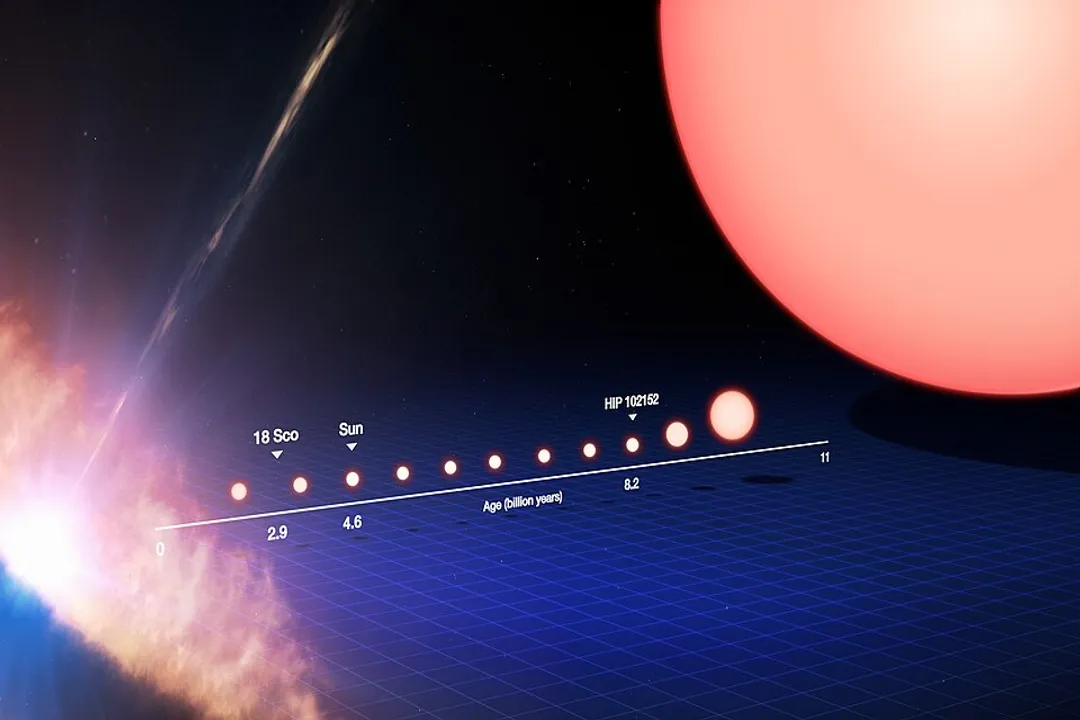
To put the expansion into perspective, consider the Sun's future as a red giant. When it fully expands, its outer layers are predicted to swell past the current orbit of Mercury and possibly reach Venus [cite: esa]. For a general reader, this implies that if our solar system were placed at the center of a star like Arcturus (a red giant), the star's photosphere—the visible surface—would engulf the orbits of at least three of the four inner planets, effectively erasing Mercury and Venus completely and likely scorching Mars [cite: wiki, based on general descriptions of giant star radii]. This massive change in physical dimension is entirely driven by the shift in where the main fusion reaction takes place—from the center to a shell, and then, critically, the re-ignition of fusion in the center itself. The core's fusion status dictates the entire visible performance of the star.
Related Questions
#Citations
Lecture 15: Red Giants
Red Giant - ESA/Hubble
Red giant - Wikipedia
The Sun's core will fuse helium when it becomes a red giant? - Reddit
What happens to fusion in a red giant? - Quora
Chapter 6: Aging Into Gianthood - NASA Science
Why do stars become red giants? - Astronomy Stack Exchange
22.1: Evolution from the Main Sequence to Red Giants
Red Giants |Stellar Evolution | Astronomy - The Science Campus