How the star will become a red giant after the main sequence phase?
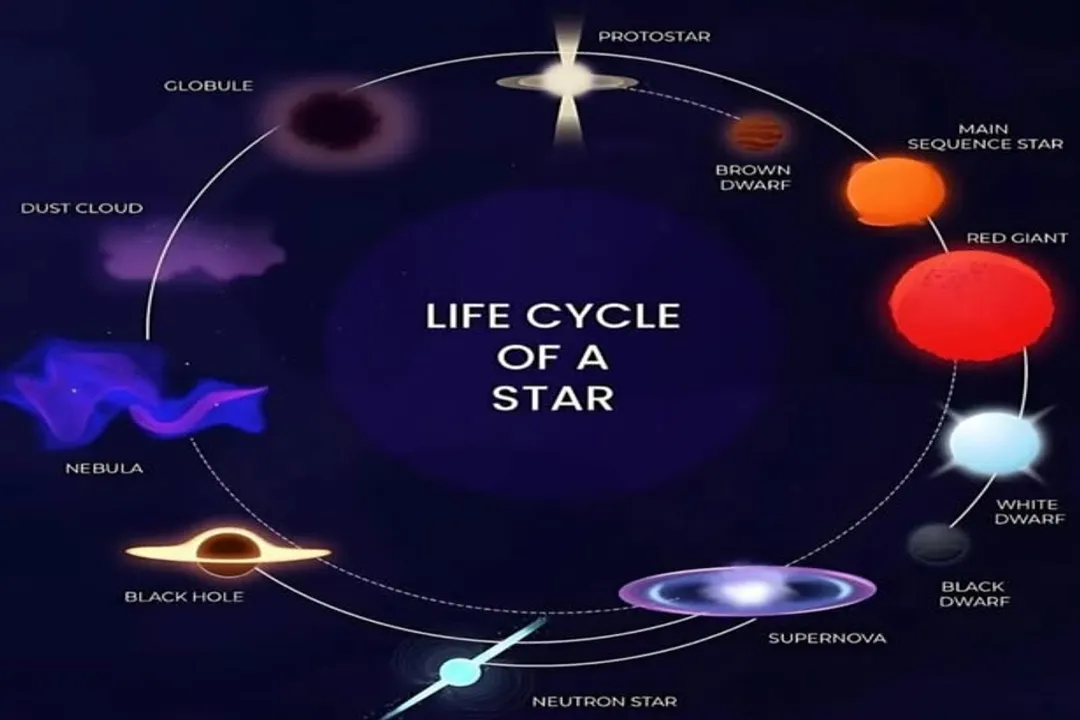
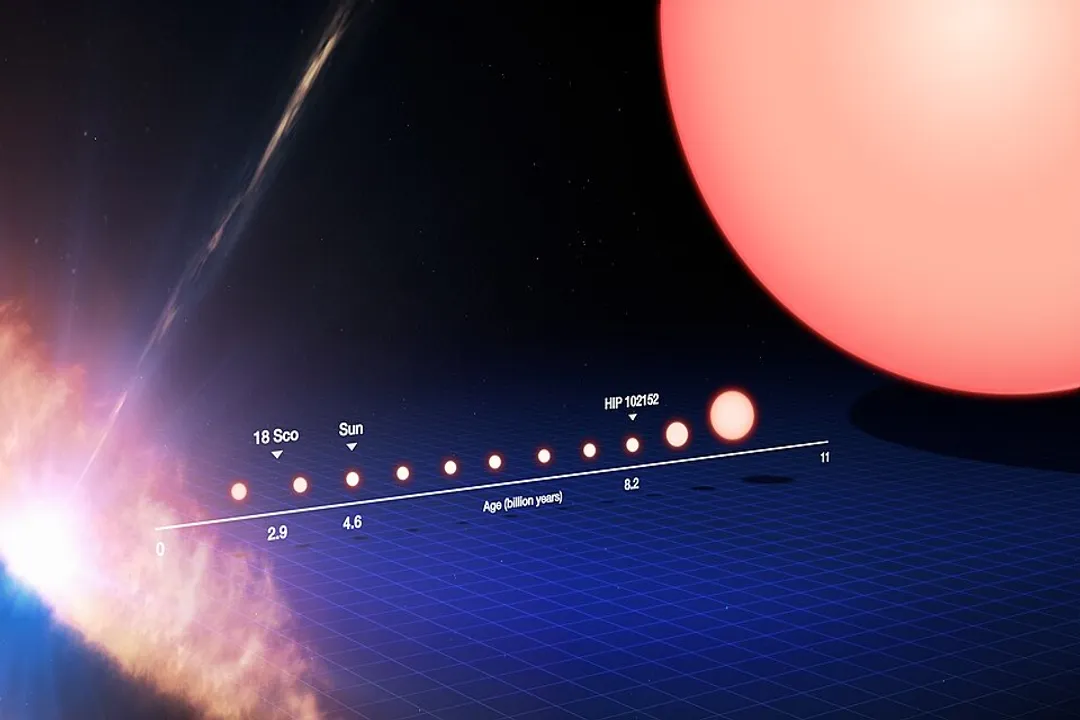
The transformation of a star from its stable main sequence existence into a swollen, luminous red giant marks one of the most dramatic chapters in its life story, a process governed entirely by the inexorable laws of gravity and nuclear physics. [2][3] For stars like our Sun, which spend the vast majority of their active lives fusing hydrogen into helium in their core, this change begins subtly when the primary fuel supply begins to dwindle. [2] The main sequence is a period of hydrostatic equilibrium, where the outward pressure generated by core fusion perfectly balances the inward crushing force of the star's own gravity. [3][6]
# Fuel Exhaustion
The stable life of a star on the main sequence relies on maintaining a steady stream of energy generation in its very center. [6] This energy comes from thermonuclear fusion, where hydrogen nuclei combine to form helium nuclei. [3] As time passes, this hydrogen fuel in the core is steadily converted into an inert, non-fusing ash of helium. [1][3]
For a star like the Sun, this process can continue for billions of years, but eventually, the hydrogen supply in the core is completely exhausted. [1][2] Once the core is composed almost entirely of helium, the fusion reaction in that central region ceases because the temperature and pressure are no longer sufficient to overcome the repulsive forces between helium nuclei and initiate helium fusion (the triple-alpha process). [1][3] At this point, the core can no longer generate the outward thermal pressure required to counteract gravity. [3][6]
# Core Collapse
With the primary energy source gone from the center, gravity immediately takes over, and the inert helium core begins to contract. [1][3] This contraction is not slow; it is a rapid gravitational collapse driven by the star’s immense mass. [2] As the core material is compressed, its density and temperature soar to extreme levels. [6]
This gravitational compression releases gravitational potential energy, which is converted into thermal energy, heating up the layers surrounding the now-inert core. [3] Crucially, this process heats the shell of material just outside the core—a layer that still contains plenty of fresh hydrogen—to the point where hydrogen fusion can ignite there. [1][2] This marks the beginning of the post-main sequence phase, transitioning the star into a subgiant phase as it begins to swell slightly. [1]
# Shell Burning Ignition
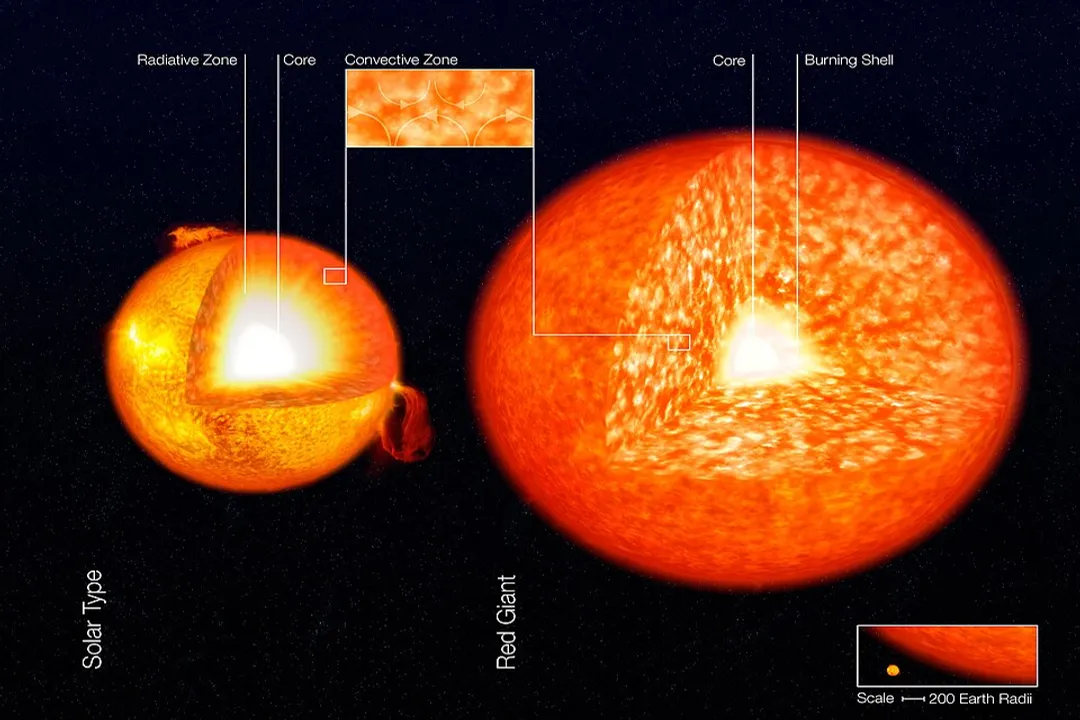
The ignition of hydrogen fusion in this shell—known as hydrogen shell burning—is the engine that drives the star toward its red giant phase. [2][3] The energy output from this shell fusion is actually higher than what the star was producing when it was fusing hydrogen throughout its entire core during the main sequence phase. [1][6]
This burst of increased energy generation creates a tremendously powerful outward pressure. [3] Since this new fusion is occurring in a thin layer surrounding a compact, inert core, the energy has nowhere to go but outward, pushing the star's extensive outer layers far into space. [2] It is this runaway energy production from the shell that causes the spectacular expansion. [1]
# Giant Expansion
As the outer layers are pushed outward by the intense pressure from the shell fusion, the star undergoes a massive physical transformation. [2][6]
- Size Increase: The star expands enormously, potentially increasing its radius by a factor of hundreds. [1][6] For our Sun, this expansion is predicted to swell past the orbit of Mercury and possibly Venus, engulfing the inner solar system. [5]
- Surface Cooling: While the core is getting hotter due to contraction, the outer layers are moving so far away from the core’s influence that they expand rapidly and cool down considerably. [3] As the surface temperature drops, the star’s peak radiation shifts toward longer wavelengths, making it appear distinctly red. [1][6] This is how the star earns the name red giant. [6]
- Luminosity Spike: Despite the cooler surface temperature, the immense increase in surface area—the star becomes vastly larger—causes the total energy radiated (luminosity) to increase significantly, often by a factor of several thousand times the original main sequence luminosity. [1][2]
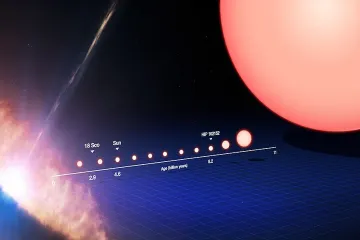
If we consider the Sun's expected path, we can see this massive change in scale. Its current radius is about . When it becomes a red giant, its radius is projected to exceed . [5] To put this in perspective for an observer on Earth, this increase in size means the star's angular diameter, as seen from our planet, would appear dozens of times larger in the sky, transforming from a distinct point of light into a massive, glowing disk that dominates the heavens, even before considering the increase in brightness. This expansion is a direct consequence of the energy suddenly being generated in a shell, rather than uniformly throughout the core. [3]
# Stellar Mass Influence
The exact path and fate following the red giant stage depend heavily on the star's initial mass, although the initial transition described above is common to most stars above a certain low-mass threshold. [1] Stars less massive than about $0.5$ solar masses (like red dwarfs) are thought to burn their hydrogen so slowly that they never become true red giants, instead just fading away slowly after their main sequence phase. [1]
For stars in the Sun's mass range (up to about $8$ solar masses), the ascent up the Red Giant Branch (RGB) leads to the core continuing to contract until it reaches temperatures high enough—around $100$ million Kelvin—to ignite helium fusion via the triple-alpha process. [1][3]
# The Helium Flash
In low-to-intermediate mass stars, the dense, inert helium core is supported by electron degeneracy pressure, a quantum mechanical effect that prevents further compression regardless of temperature. [1][3] When helium fusion finally ignites, it does so explosively across the entire core in a runaway event known as the Helium Flash. [1] This flash is not visible from the star's surface because the outer layers are already so expanded and opaque that the sudden energy surge only serves to heat the core further and stop the degeneracy, allowing the star to settle into a new, briefer equilibrium phase fusing helium in the core. [3]
It is fascinating to note the immediate physical dichotomy that occurs during this transition: the core is violently hot and dense, undergoing a nuclear explosion (the Helium Flash in low-mass stars), while the surface is expanding and cooling, causing the visual redness. This contrast—intense central energy production driving extreme surface expansion—is the hallmark of the giant phase.
# The Path Continues
After the core fusion switches from hydrogen to helium, the star moves off the main RGB path and onto the Horizontal Branch. [1] This phase is generally shorter than the main sequence and involves core helium fusion balanced by a still-active hydrogen-fusing shell. [3]
Once the helium in the core is exhausted and converted into carbon and oxygen, fusion stops in the center again. [1] The core, now composed of non-fusing carbon and oxygen, begins to contract for a second time. [3] This triggers a second phase of shell burning: a helium-fusing shell surrounding the carbon-oxygen core, beneath the still-burning hydrogen shell. [1][2]
This complex layering—hydrogen shell burning over a helium-burning shell over an inert core—drives the star to expand even further than it did on the RGB, leading to the Asymptotic Giant Branch (AGB) phase. [1] Stars on the AGB are significantly more luminous and larger than their previous red giant stage. [3] This phase is often characterized by thermal pulses within the helium-burning shell, leading to instability and mass loss. [2]
For the Sun’s mass range, the carbon-oxygen core will never get hot enough to ignite carbon fusion. [1] The star will simply pulsate, shed its outer layers through stellar winds, eventually leaving behind the hot, dense, inert carbon-oxygen core, which becomes a white dwarf. [1][3]
# A Comparative Glance
While the mechanism of core exhaustion leading to shell burning applies broadly, the scale of the transformation differs significantly based on the star’s mass, which is set at birth. [6]
| Stellar Mass Category | Main Sequence Lifetime (Approx.) | Resulting Core After Giant Phase |
|---|---|---|
| Low Mass () | Very Long (Many Billions of Years) | Carbon/Oxygen White Dwarf [1] |
| Intermediate Mass () | Shorter (Hundreds of Millions of Years) | Carbon/Oxygen White Dwarf [1] |
| High Mass () | Short (Millions of Years) | Neutron Star or Black Hole [6] |
It's a counter-intuitive element of stellar evolution that the more massive a star is, the shorter its total lifespan on the main sequence. A star eight times the mass of the Sun might only last a few tens of millions of years on the main sequence, whereas the Sun has a main sequence life exceeding ten billion years. [6] This is because high-mass stars burn their fuel at an exponentially higher rate to counteract their overwhelming gravity. [6] While high-mass stars also become red giants, their cores eventually reach the temperatures needed to fuse heavier elements, leading to entirely different, more cataclysmic endpoints. [6]
The transition to the red giant phase is thus a necessary consequence of thermodynamic limits; once the easiest fuel (hydrogen) is gone from the center, the only way for the star to maintain any outward pressure to fight gravity is to compress the core until surrounding layers can fuse heavier elements, initiating a new, larger, and more luminous instability. [2][3]
Related Questions
#Citations
Red giant - Wikipedia
Evolution from the Main Sequence to Red Giants | Astronomy
The Transition to the Red Giant Phase for Sun-like stars | ASTRO 801
Why do stars become red giants? - Astronomy Stack Exchange
Main Sequence transition to giant star : r/askastronomy - Reddit
Red Giant - ESA/Hubble
The lifecycle of stars: red giant phase - Facebook
Undergrad Expansion of a star to become a red giant - Physics Forums
Chapter 6: Aging Into Gianthood - NASA Science