What is the difference between a supernova and a red giant?
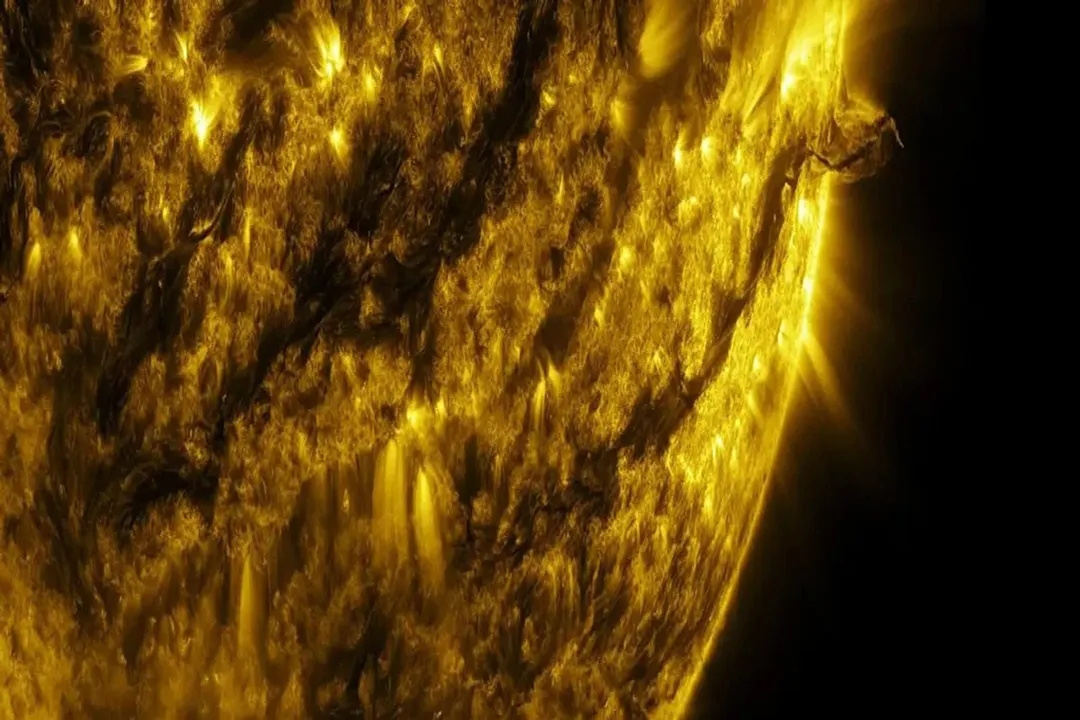
The destiny of any star in the cosmos is fundamentally dictated by a single property: its initial mass. Two terms often encountered when discussing the later lives of stars, Red Giant and Supernova, actually describe very different phases and endpoints in stellar evolution. One represents a bloated, aging stage for medium-sized stars, while the other signifies an almost unimaginably violent end for their much heavier brethren. Understanding the difference means charting two distinct paths after a star exhausts the hydrogen fuel at its heart.
# Stellar Giants Defined
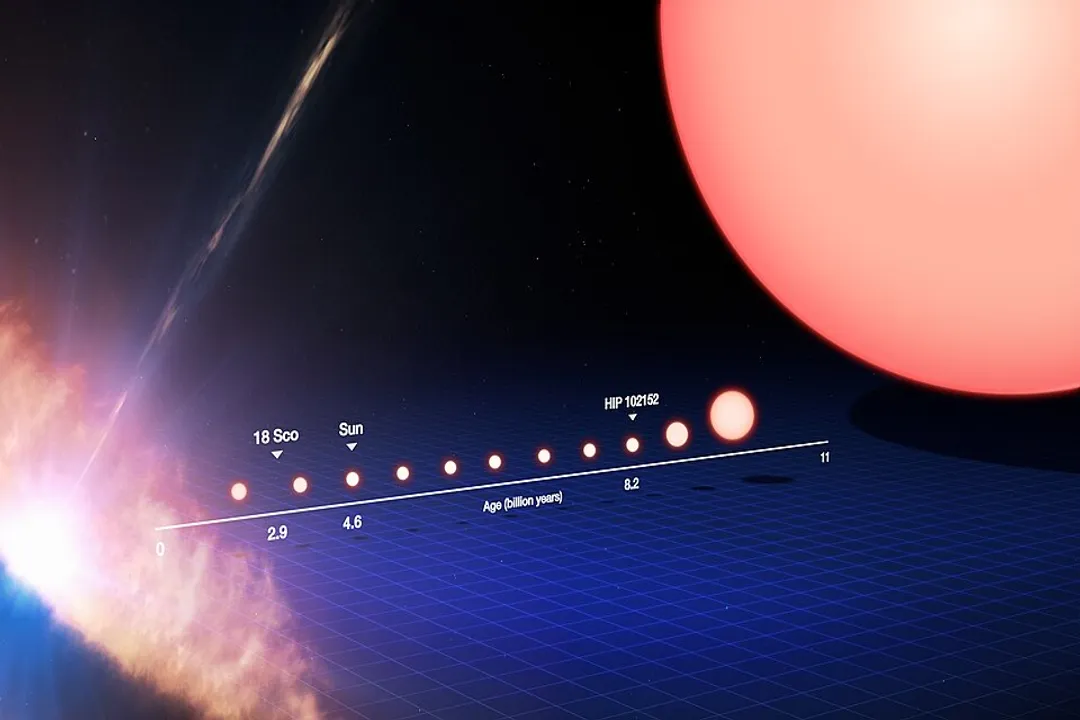
Stars spend the vast majority of their existence in a stable state known as the main sequence, diligently fusing hydrogen into helium deep within their cores. This fusion generates outward thermal pressure that perfectly counteracts the relentless inward crush of gravity—a state called hydrostatic equilibrium.
When a star on the main sequence depletes the hydrogen fuel in its core, this delicate balance is broken. The core contracts and heats up, eventually igniting hydrogen fusion in a shell surrounding the inert core. This shell fusion causes the star's outer layers to re-inflate and expand greatly, leading to a cooling surface temperature and a distinct reddish or yellowish-orange hue. The star has now evolved into a giant phase.
The crucial bifurcation in stellar evolution occurs here, determined by the initial mass. Stars born with low or intermediate masses, generally between about $0.3$ and $8$ times the mass of our Sun (), settle into the red giant phase. For comparison, stars significantly more massive than this threshold evolve into red supergiants. While both types are giants that have expanded and cooled, the magnitude of this change is vastly different.
# The Red Giant Stage
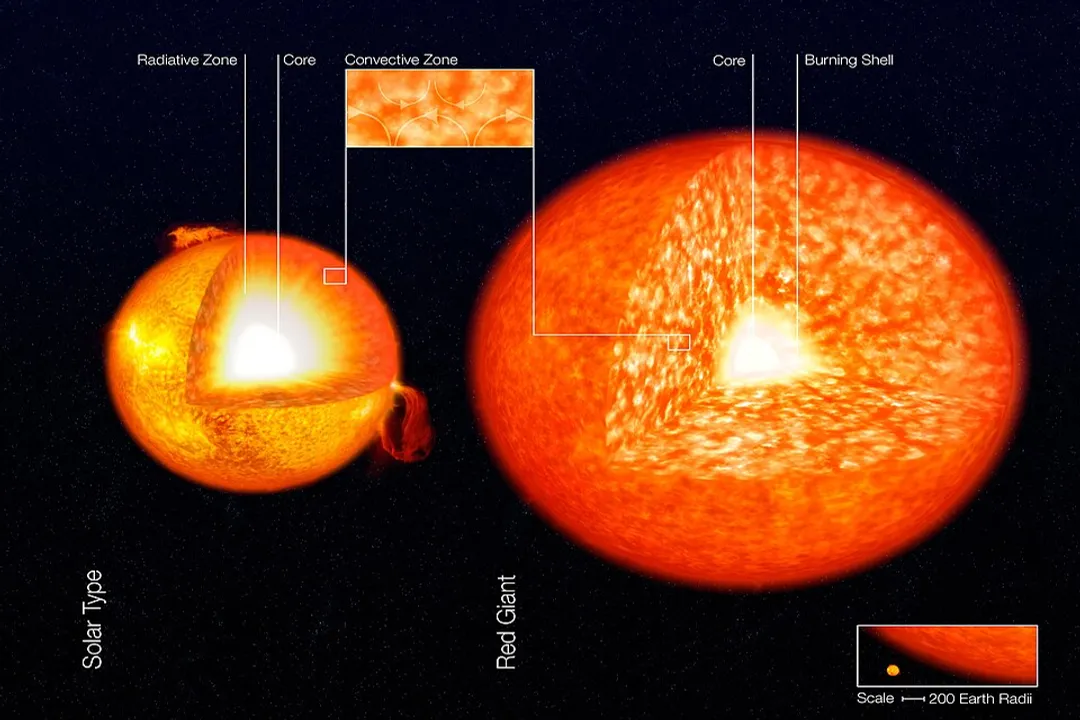
A star like our Sun is destined to become a red giant in approximately five billion years. When this transition occurs, the star will swell dramatically. Red giants typically achieve radii tens to hundreds of times that of the Sun. Some sources suggest they can reach sizes of about $10$ to $100$ times the Sun’s size, while others note that the Sun, as a red giant, might reach over $200$ times its current radius, large enough to engulf Mercury, Venus, and potentially Earth.
Despite their enormous physical size, the surface temperature of a red giant is relatively low, often around $5,000$ K or less, giving them their characteristic color—yellowish-orange, or spectral types K and M. Although the surface energy is spread thin, their sheer size makes them very luminous, up to nearly three thousand times the luminosity of the Sun for stars on the red-giant branch (RGB).
The internal workings of a red giant are complex, involving multiple stages of fusion:
- Red-Giant Branch (RGB): Hydrogen fuses into helium in a shell surrounding a helium core. This is where our Sun will spend the bulk of its red giant lifetime.
- Horizontal Branch/Red Clump: After the core-helium ignition via the triple-alpha process, the star fuses helium into carbon in its core.
- Asymptotic Giant Branch (AGB): Once core helium is exhausted, the star contracts again, resulting in two active shells: an inner shell fusing helium and an outer shell fusing hydrogen around an inert carbon-oxygen core.
This entire red giant phase, while representing the star’s twilight, is relatively gentle compared to what happens to bigger stars. The process culminates in the star becoming unstable, pulsating, and shedding its outer layers through a process that creates a glowing shell of gas known as a planetary nebula. The small, hot, dense core that remains is a white dwarf. This remnant shines solely from leftover heat and will eventually cool over billions of years into a theoretical black dwarf.
It is interesting to consider how this expansion affects any orbiting planets. While the final expansion is often thought to sterilize a world, research suggests that during the earlier RGB phase, a habitable zone might actually shift outward, potentially offering billions of years of temporary habitability for suitably distant worlds around a Sun-like star.
# The Supergiant Pathway to Explosion
The path diverges sharply for stars initially more massive than about . These stars become red supergiants. Because they are much more massive, they burn their fuel at a ferocious rate, leading to lifespans measured in mere millions of years, vastly shorter than the Sun's multi-billion-year main-sequence life.
Red supergiants are gargantuan—hundreds to thousands of times the size of the Sun—and can be as bright as a million suns. Their low surface temperatures (below $4,100$ K for red supergiants) place them in the red spectrum, similar to the low-mass red giants, but their scale is completely different.
The internal fusion process in a red supergiant is far more advanced than in a red giant. After hydrogen and helium are exhausted, the core continues to contract and heat, initiating fusion of progressively heavier elements: carbon, neon, oxygen, silicon. Each new stage of fusion buys the star less and less time. This layered fusion continues until the core is converted into iron. Iron is the stellar dead end because fusing it consumes energy rather than releasing it.
# Supernova Eruption
When the iron core forms, the outward thermal pressure instantly ceases. Gravity wins the long-fought battle catastrophically. The massive stellar core collapses incredibly rapidly. When the infalling material slams into the super-dense core, it rebounds in a process that drives shock waves outward through the star's layers.
This rebound results in a supernova explosion—one of the most energetic events in the universe, briefly shining brighter than an entire galaxy.
The outcome of this spectacular death depends on the mass of the remnant core:
- If the original star was massive (typically $8$ to ), the collapse halts when the core reaches nuclear density, forming a superdense neutron star. These can spin rapidly, appearing as pulsars.
- If the original star was exceptionally massive, the core collapse continues past the neutron star density, forming a black hole.
Supernovae scatter the newly forged elements—including those heavier than iron created during the collapse—across space, enriching the interstellar medium. This ejected material is essential for forming subsequent generations of stars and planetary systems, including our own.
A Type Ia supernova is a different beast entirely; it is a thermonuclear explosion involving a white dwarf in a binary system that accretes matter from a companion star until it exceeds the Chandrasekhar Limit of about , triggering runaway fusion and complete destruction. This process sometimes involves a companion red giant or a low-mass star.
# Contrasting Endpoints and Processes
The fundamental distinction is one of scale, mass, and outcome. A red giant is the late-life state of a small star, leading to a quiet shedding of mass. A supernova is the terminal event of a massive star's life, a sudden cataclysm.
Here is a direct comparison of the two primary stellar scenarios:
| Feature | Red Giant Phase (Low/Intermediate Mass) | Supernova Event (High Mass Star Death) |
|---|---|---|
| Precursor Star Mass | to (e.g., the Sun) | (Leads to Red Supergiant first) |
| Stage vs. Event | A protracted, late-stage phase of life | A brief, cataclysmic event marking death |
| Core Fuel at Transition | Exhausted core Hydrogen; shells fuse H and/or He | Exhausted core fuel, resulting in an iron core |
| Expansion/Cooling | Expands to Sun radius; surface $5000$ K | Preceded by Red Supergiant phase; immediate collapse/explosion |
| Final End Product | Planetary Nebula White Dwarf Black Dwarf | Core-collapse Neutron Star or Black Hole |
The difference in final contributions to the galaxy's elemental makeup is a fascinating point of contrast. Red giants undergo "dredge-up" events that cycle elements like carbon to the surface, eventually ejecting them gently into space via a planetary nebula. This material feeds into the galaxy slowly. By contrast, the supernova is the mechanism that drives nucleosynthesis past iron, scattering a much richer and heavier cocktail of elements across vast interstellar distances at immense velocities. Therefore, while both endpoints enrich the cosmos, the supernova acts as the principal, explosive mechanism for generating the heaviest elements required for rocky planets and life, beyond what the slow evolutionary processes of the red giant phase can produce.
Related Questions
#Citations
Star Types - NASA Science
Stellar Evolution - | The Schools' Observatory
Difference between red giant and super nova | Filo
Super Giant Stars and Supernovas / dottiedottiedoo - Observable
Red giant - Wikipedia