What is the peak luminosity of a supernova?
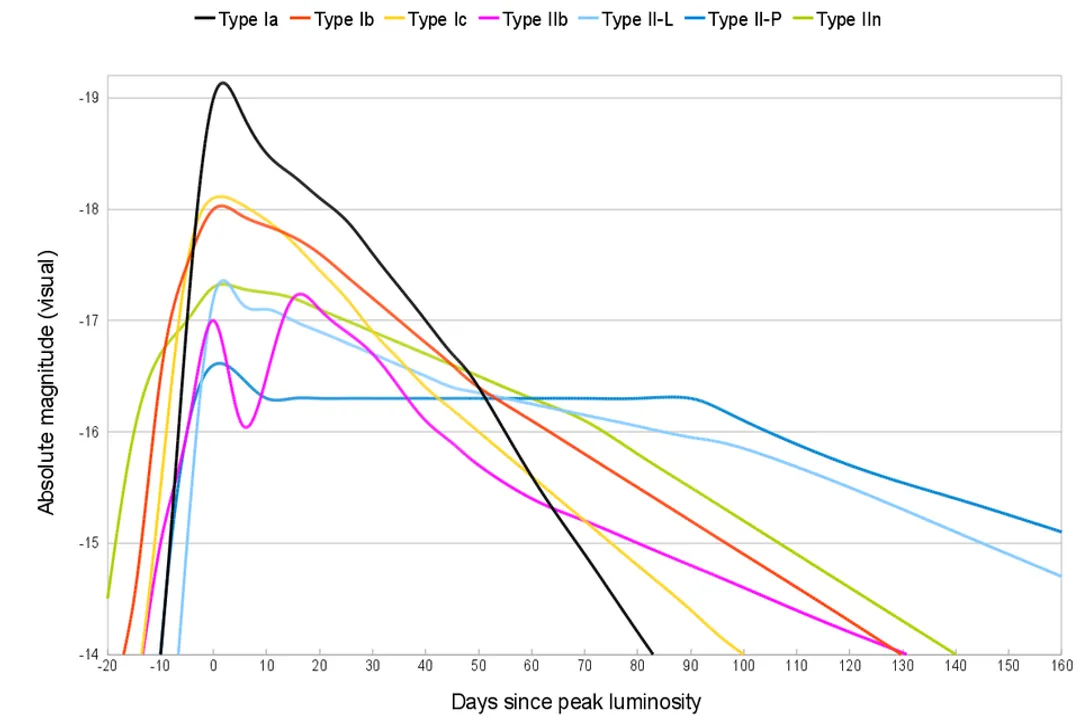
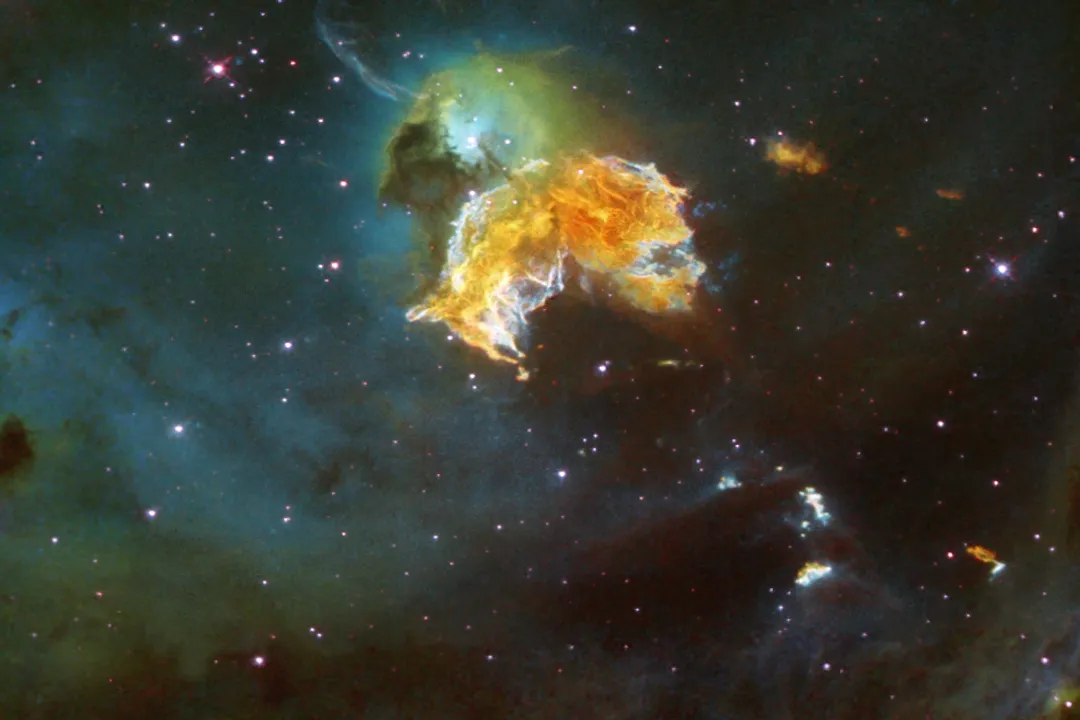
A stellar explosion marks one of the most dramatic events in the cosmos, a momentary blaze that can dwarf the collective light of the billions of stars in its host galaxy. Describing the peak luminosity of a supernova requires framing it not just in terms of visible light, but in the sheer, almost incomprehensible scale of energy release associated with the death of a massive star or a runaway thermonuclear reaction. For a brief period, these events outshine everything else, offering astronomers a unique window into the physics of extreme matter and the expansion of the universe.
# Brightness Scale
To grasp the peak output, we must look at the celestial magnitude scale. This system, which appears backward to the everyday mind, ranks brighter objects with lower (or more negative) numbers. Our own Sun, the nearest star, has an absolute visual magnitude of about $+4.8$. In stark contrast, a typical supernova explosion can easily reach an absolute magnitude near $-19$.
This difference of roughly 24 magnitudes translates into an enormous factor in actual brightness. Every one unit difference in magnitude represents a factor of $2.5$ in brightness; thus, a difference of 24 magnitudes means the supernova is about times intrinsically brighter than the Sun. Factoring this out, a peak supernova brightness can be billions of times greater than the Sun's total output. Some of the most luminous explosions, particularly certain superluminous supernovae, can even reach apparent magnitudes comparable to that of an entire galaxy. The sheer instantaneous radiation is so intense that for days or weeks, the explosion dominates the light coming from its entire host galaxy, sometimes even making a previously unseen galaxy temporarily visible to powerful telescopes.
# Type Ia Uniformity
Not all supernovae are created equal in their light curves, but one class stands out for its remarkable consistency in peak luminosity: the Type Ia supernova. These explosions occur when a white dwarf star in a binary system accretes enough mass, likely exceeding the Chandrasekhar limit, triggering a thermonuclear detonation that completely obliterates the star. Because the progenitor system is thought to always involve a star of nearly the same mass undergoing the same process, the resulting energy release is remarkably standardized.
The standard, or canonical, Type Ia supernova shines with an absolute magnitude consistently near . This uniformity is what makes them invaluable tools for cosmology, earning them the nickname "standard candles". They provide a reliable yardstick for measuring vast cosmic distances. If a Type Ia event is observed in a distant galaxy, astronomers can measure its apparent brightness, compare it to the known intrinsic peak brightness of $-19.3$, and accurately calculate how far away that galaxy must be.
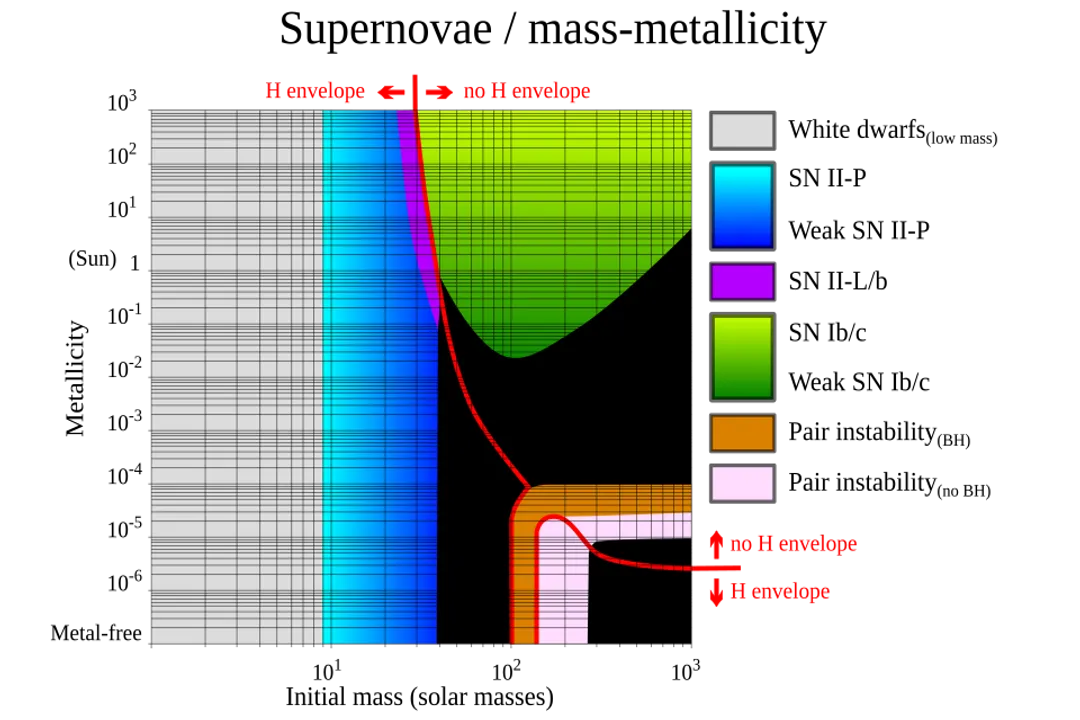
When comparing a standard Type Ia to the more varied core-collapse supernovae (like Type II), this standardization is the key differentiator. While a Type II explosion—the death of a star much more massive than the Sun—is also incredibly bright, its peak output depends heavily on the progenitor star's initial mass and the amount of hydrogen envelope it retained before collapse. This means Type II peak luminosities can vary more widely, making them less ideal as precise distance markers unless their light curves are meticulously modeled.
It is fascinating to consider the rate of energy production. If we take an approximate value for the total visible light energy released by a supernova as around Joules, and assume this peak output lasts for just a few weeks (say, 20 days), the instantaneous power output is staggering. Calculating this power, , reveals that the supernova briefly emits energy at a rate equivalent to nearly Watts. To put that power into a more relatable, albeit still immense, context: the Sun emits power on the order of Watts. Therefore, at its very peak, a single Type Ia supernova briefly outshines roughly ten Suns for every single second it maintains that peak intensity, and it does this across the entire electromagnetic spectrum, not just in the visual band.
# Energy Release Physics
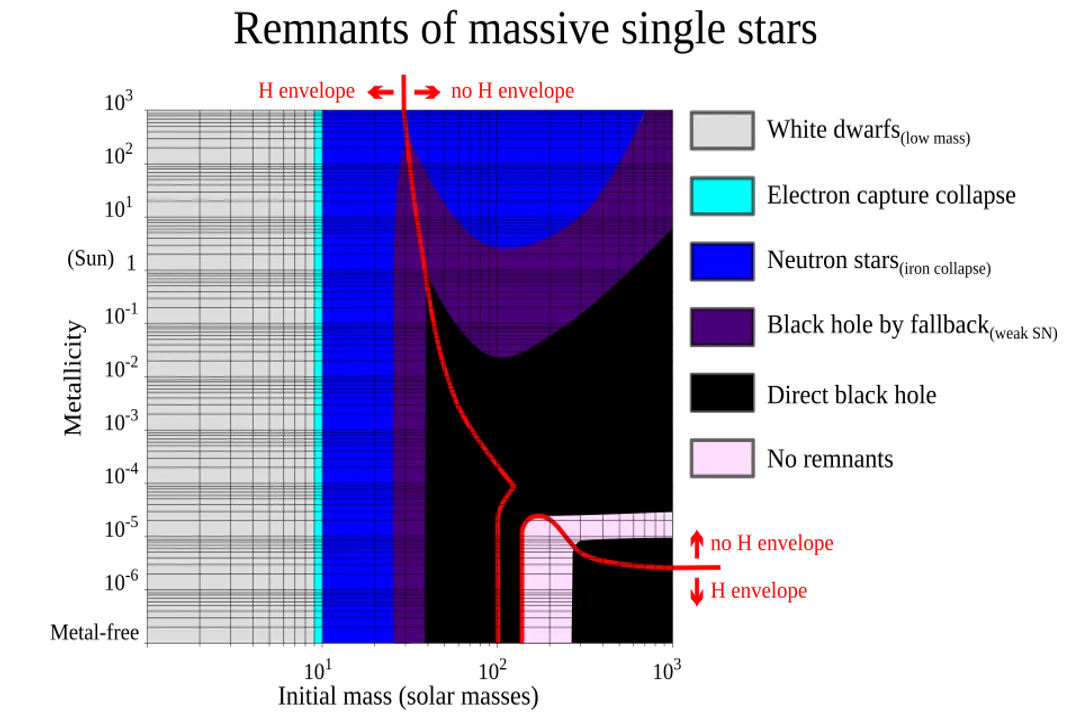
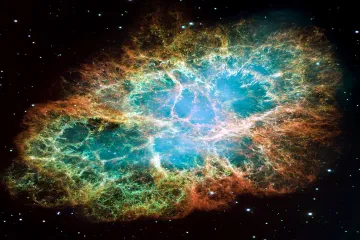
The intense luminosity is a direct consequence of the extreme physical processes involved in the explosion itself. Whether it is the detonation of a carbon-oxygen white dwarf or the core-collapse of a star exceeding about eight times the Sun's mass, the energy is liberated incredibly fast.
In Type Ia events, the burning of carbon and oxygen throughout the star generates the energy that rips the star apart. The light we see is primarily powered by the radioactive decay of Nickel-56, which is synthesized in vast quantities during the explosion and subsequently decays into Cobalt-56, and then into stable Iron-56. The gamma rays emitted during this radioactive decay are absorbed and re-emitted by the expanding gas cloud, causing the nebula to glow brightly at its peak. The light curve's decay phase is directly governed by the half-life of this radioactive material.
For core-collapse events, the enormous gravitational potential energy released when the core collapses into a neutron star or black hole powers the blast. A significant fraction of the total energy—upwards of $99%$—escapes in the form of neutrinos, which are nearly undetectable by the time the light peaks. The remaining $1%$ drives the visible explosion, heating the ejected stellar material to extreme temperatures, often reaching tens of thousands of Kelvin. This high temperature is what makes the visible light output so powerful.
# Luminosity Variations
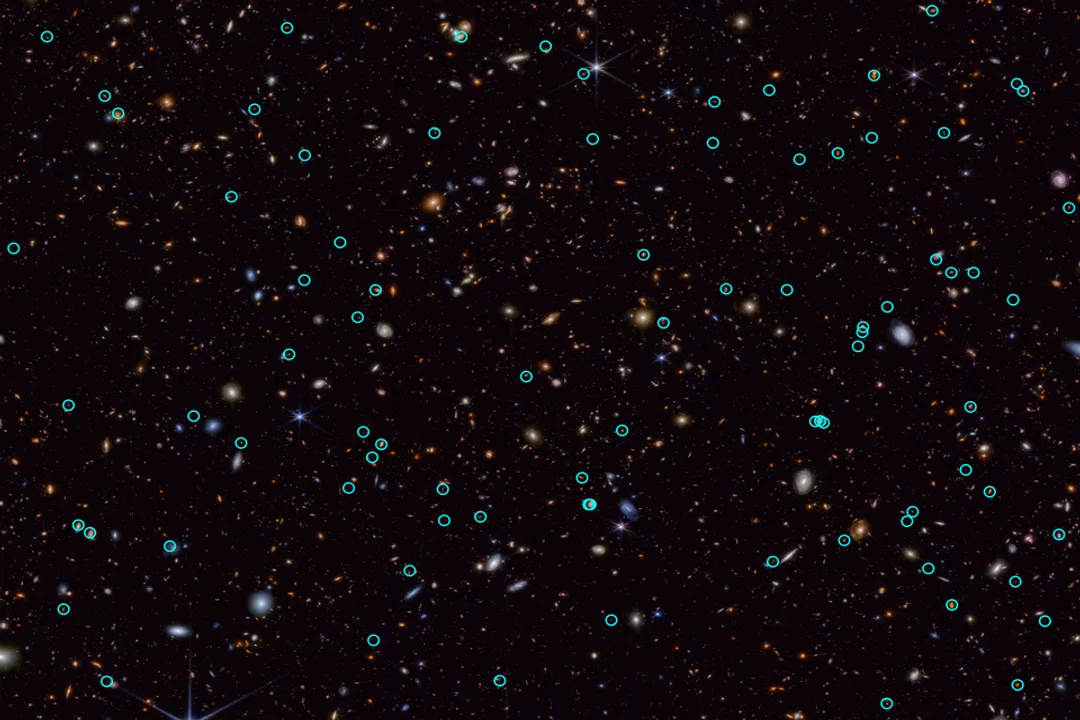
While Type Ia provides a good benchmark, supernovae exhibit a wide dynamic range in their maximum brightness.
For instance, the less energetic end of core-collapse events might peak closer to an absolute magnitude of $-17$ or $-18$, depending on the progenitor mass and interaction with surrounding gas. Conversely, there are outliers that defy the standard classification. Superluminous supernovae (SLSNe), for example, can significantly surpass the standard Type Ia peak luminosity, sometimes reaching absolute magnitudes of $-21$ or even fainter (brighter). These events are tied to the deaths of the most massive stars or involve complex mechanisms like magnetars or jets, leading to an energy release far greater than standard thermonuclear or core-collapse events.
It is crucial to remember that the term "supernova" also includes phenomena that are not as intrinsically bright as the canonical stellar explosions. A Nova, for example, involves a thermonuclear flash on the surface of a white dwarf that has not yet reached the critical mass threshold for full detonation. While a nova can cause a star to brighten by 7 to 16 magnitudes, a true supernova brightens by 20 magnitudes or more, representing a difference of hundreds of thousands to millions of times in light output between the two phenomena. A nova might reach an apparent magnitude of $+4$ or $+5$, whereas a distant supernova can be detected across billions of light-years at similar faintness levels.
# Observational Context
The perception of a supernova's peak luminosity is heavily influenced by the distance to the host galaxy, a concept astronomers call apparent magnitude. An intrinsically dimmer supernova in a nearby galaxy might appear brighter than a standard Type Ia in a galaxy billions of light-years away.
However, the physics is tied to the absolute magnitude, which corrects for this distance effect. When we see a supernova in the news, the event we are observing is the light that left the explosion a long time ago. For example, if a supernova is detected in a galaxy 100 million light-years away, the light reaching us today has been traveling for 100 million years. The peak luminosity we measure is the faint echo of an event that occurred in that galaxy's past.
An interesting analysis arises when considering the duration of peak luminosity across different types. While the Type Ia events are famous for their consistent peak magnitude, their light curves often show a relatively sharp rise and decay dominated by the Nickel-56 decay chain. In contrast, some very energetic core-collapse events or SLSNe might sustain a higher plateau brightness for a longer period, even if their initial peak magnitude isn't dramatically higher than a Type Ia. This means that while Type Ia offers a perfect snapshot of maximum brightness, other types might offer a longer period of "high luminosity," which can be important for detecting fainter events hidden within galactic dust clouds, as the extended light output increases the probability of observation during that window.
To manage the wealth of photometric data gathered from these events, astronomers use sophisticated modeling techniques, often involving detailed spectral analysis to classify the supernova first, before assigning a luminosity estimate. The spectral features—the presence or absence of hydrogen and silicon lines—are the primary way to differentiate between the physical mechanisms driving the luminosity.
# Measuring Output
While magnitude is standard, luminosity can also be expressed in terms of total radiated energy, as touched upon earlier. The kinetic energy driving the explosion is enormous, often around ergs, which translates to about Joules of mechanical energy. Only a tiny fraction of this, roughly $1%$, is converted into the light we observe. This small percentage, when released over a few weeks, is what results in the galaxy-dwarfing brightness we measure.
Another way to contextualize the peak output is by referencing the total integrated light of the entire host galaxy. A galaxy like the Milky Way radiates visible light equivalent to about solar luminosities over a long period. A supernova at its peak, radiating times the Sun's luminosity, is effectively radiating light equivalent to 5% of the entire Milky Way galaxy's total, sustained output, all from a volume smaller than our solar system, and doing so in a matter of days.
One practical consideration for observing these peaks, particularly for professional surveys, relates to the rise time to maximum light. For a Type Ia, the time from explosion onset to reaching peak is typically around 15 to 20 days. This means that observational efforts must be well-timed or constantly monitoring a large volume of sky to catch the event near its absolute maximum. If an observation misses the peak by even a week, the apparent magnitude can drop by half a magnitude or more, which significantly impacts the distance calculation precision, especially for the high-redshift objects where this measurement is most critical for cosmology. The rapid decline after the peak underscores the transient, fleeting nature of the true maximum luminosity event.
The peak luminosity of a supernova is not merely an impressive number; it is a direct, measurable signature of the catastrophic physics occurring at the final moments of a star's life, whether through runaway fusion or core implosion. The consistency found in Type Ia events provides a vital yardstick across the universe, allowing astronomers to probe the history and fate of the cosmos through these incredibly luminous, yet brief, cosmic beacons.
Related Questions
#Citations
Supernova - Wikipedia
Novas Vs. Supernovas: What's The Difference? - Adler Planetarium
Type Ia Supernova | COSMOS
Type Ia Supernovae - The Cosmological Constant - Sean M. Carroll
Supernova - ESA/Hubble
Supernovae - HyperPhysics Concepts
[PDF] Type II Supernovae
Texas Astronomers Find Super-luminous Supernova, Follow up with ...
Maximum luminosities of normal stripped-envelope supernovae are ...