What causes the standardization of peak luminosity observed in Type Ia supernovae?
Answer
The progenitor system involves a white dwarf reaching a nearly identical mass threshold.
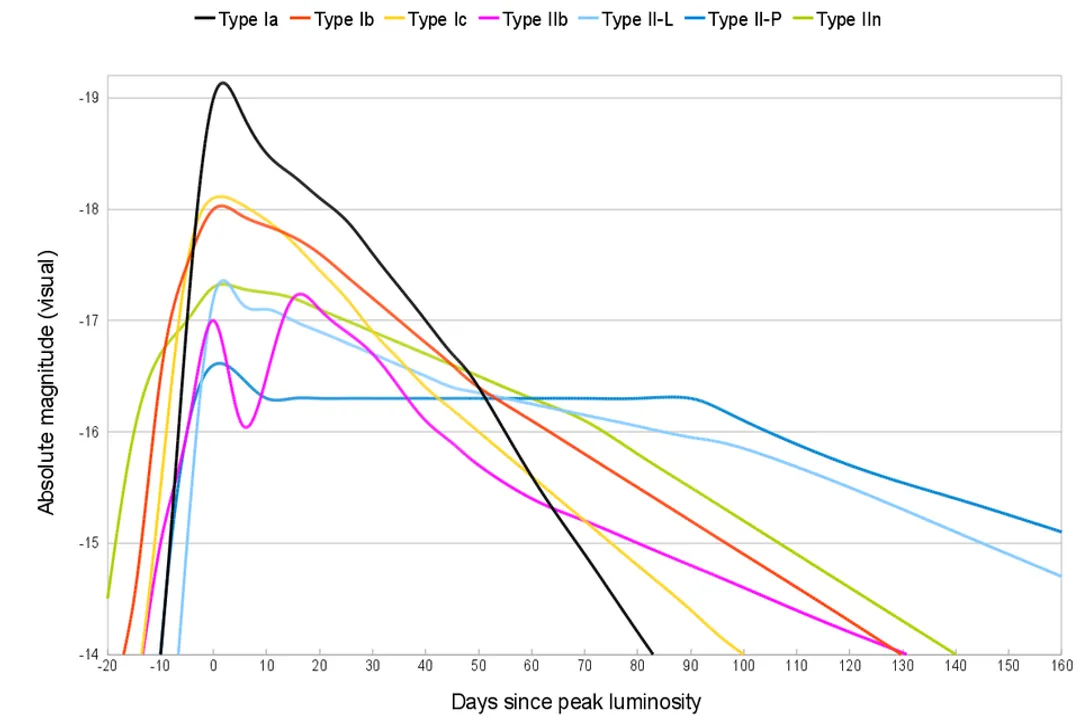
Type Ia events are triggered when a white dwarf in a binary system accretes mass, likely crossing the Chandrasekhar limit, leading to a standardized thermonuclear detonation based on nearly the same initial mass undergoing the same process.
Related Questions
What is the approximate absolute visual magnitude of our Sun?What is the consistent absolute magnitude for a standard Type Ia supernova, earning them the nickname 'standard candles'?How much intrinsically brighter is a typical supernova (magnitude -19) compared to the Sun (magnitude +4.8) based on the standard magnitude scale difference?What mechanism primarily powers the light observed from a Type Ia supernova after the initial detonation?What fraction of the total energy released during a core-collapse supernova escapes primarily in the form of neutrinos?What is the typical rise time, in days, for a Type Ia supernova to reach its maximum light from the moment of explosion?Which class of supernovae can significantly surpass the standard Type Ia peak luminosity, sometimes reaching absolute magnitudes of -21 or brighter?How does the peak output of a single Type Ia supernova compare to the Sun's power emission rate at its peak intensity?What causes the standardization of peak luminosity observed in Type Ia supernovae?By approximately how many magnitudes does a true supernova brighten compared to a Nova explosion?