What forms after a supernova explosion?
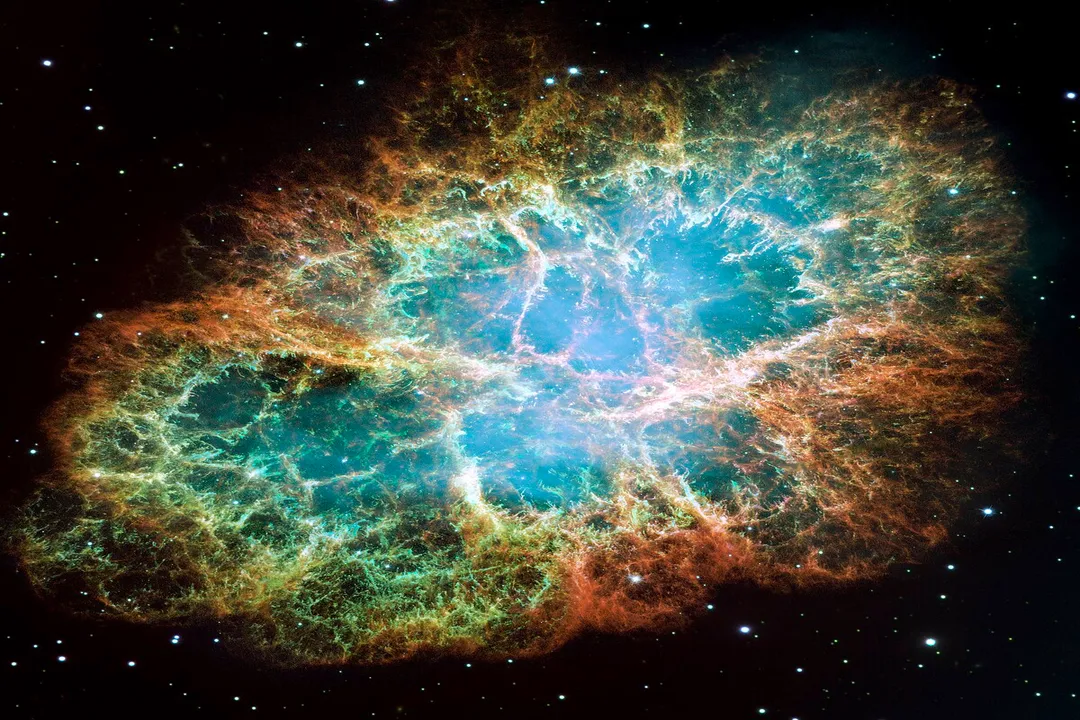
The spectacular demise of a massive star via supernova explosion is one of the most energetic events in the universe, but the end of the light show is just the beginning of a new cosmic chapter. Far from an event that simply vanishes, a supernova explosion results in two primary forms of stellar offspring: an incredibly dense core remnant, and a vast, expanding cloud of enriched gas and dust known as the supernova remnant. [3][5] Understanding what remains requires looking at what happens to the star's center versus what happens to its outer layers, as the fate of the star is determined by the physics acting on its mass during the final collapse. [1]
# Core Collapse
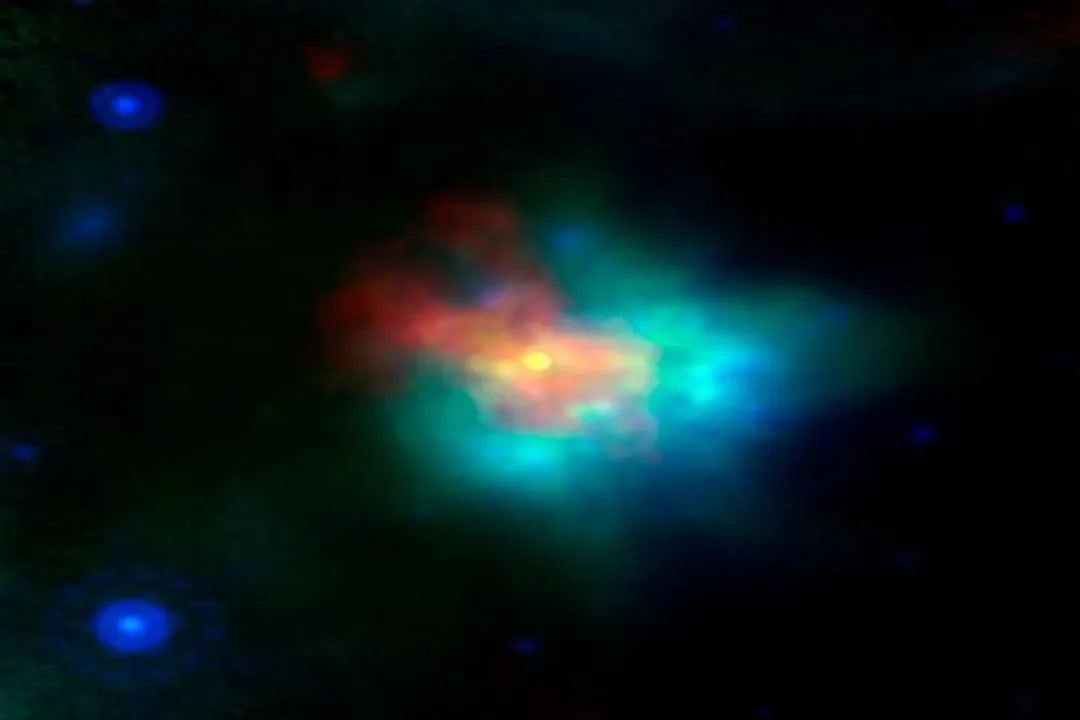
The dramatic mechanism that triggers the supernova explosion—the gravitational collapse of the star's iron core—also dictates what survives at the center. This collapse is so rapid and intense that gravity overwhelms all other forces, compressing matter to extreme densities. [1][8] What remains is an ultra-compact object that is far smaller than the original star but retains most of its initial core mass. [5]
This core remnant is not always the same. The final product depends entirely on the amount of mass left behind in that collapsed core after the outer layers have been violently ejected. [1] This process happens incredibly fast, with the core shrinking to immense densities within seconds of the collapse beginning. [1]
# Stellar Fate
The mass threshold dictates whether the aftermath is a neutron star or a black hole. [1] If the leftover core mass is greater than approximately $1.4$ solar masses (the Chandrasekhar limit, though the true limit for the remnant is higher) but below roughly $3$ solar masses, the degeneracy pressure of neutrons can briefly resist further collapse, forming a neutron star. [1] A neutron star is a mind-bogglingly dense object where a teaspoon of its material would weigh billions of tons. [1]
If the remaining core mass exceeds this upper limit, generally around $3$ solar masses, nothing known in physics can halt the crush of gravity. The core continues to collapse indefinitely, creating a black hole—a region of spacetime where gravity is so strong that nothing, not even light, can escape its boundary. [1] Thus, one star’s death results in either the densest matter in the known universe or a singularity cloaked by an event horizon. [1]
To provide a clearer picture of the two possible outcomes, the final state hinges on a critical mass assessment immediately following the shockwave:
| Remnant Type | Core Mass Range (Approximate) | Key Feature | Survival Factor |
|---|---|---|---|
| Neutron Star | to | Composed almost entirely of neutrons | Neutron degeneracy pressure |
| Black Hole | Spacetime singularity | No known opposing force |
This bifurcation based on initial stellar size means that one single type of explosive event yields two fundamentally different types of compact objects, influencing everything from local gravitational fields to the potential for future binary system interactions. [1]
# Ejected Material
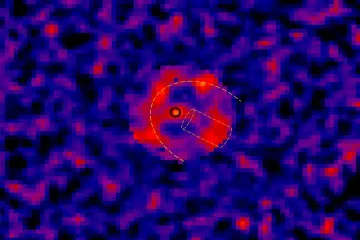
While the core shrinks down to a city-sized object or less, the star's outer layers are blasted away at enormous speeds, sometimes reaching 10 percent of the speed of light. [6] This outward rush of material forms the visible supernova remnant (SNR), which is essentially the expanding envelope of the star mixed with the interstellar medium (ISM) it encounters. [2][3] This remnant is not just the star’s debris; it is a complex cloud that glows across the electromagnetic spectrum, emitting radio waves, X-rays, and visible light. [4]
It is important to recognize that the star does not entirely disintegrate. [5] The explosion is a rearrangement: the heavy, central core is compressed, and the lighter, outer material is expelled. [6] The material ejected contains all the heavy elements—like the gold in your jewelry or the iron in your blood—that the star forged during its lifetime, enriching the surrounding galaxy. [5]
# Remnant Shape
The resulting supernova remnant evolves over tens of thousands of years, spreading its enriched material across the galaxy. [3] The structure of this expanding shell is often turbulent and far from uniform. [4] As the hot, fast-moving gas from the explosion slams into the comparatively cold, dense clouds of gas and dust already present in the interstellar medium, immense shock waves are generated. [2][4]
These shock waves heat the gas to millions of degrees, causing it to glow brightly in X-rays, while the interaction with magnetic fields can also generate radio emission. [4] The final appearance—whether it looks like a delicate filament, a perfect sphere, or a chaotic bubble—is a direct record of the density variations in the local galactic neighborhood where the star met its end. [2]
When considering the timescale of these events, we see a significant difference in how long each component persists. The formation of the compact core is almost instantaneous, a catastrophic event lasting mere moments. [1] Conversely, the visibility of the nebula is a slow burn; the material heats up, expands, and cools over epochs. While the star's gravity is powerful enough to hold the core in place permanently, the outward kinetic energy of the ejected gas dominates the environment for millennia until the remnant eventually merges back into the diffuse ISM. [3] It’s interesting to contrast the immediate, permanent nature of the core remnant with the long, drawn-out dispersal of the shell; one object defines the ultimate limit of stellar gravity, while the other defines the cycle of galactic chemistry. [5]
# Enrichment Cycle
The creation of these remnants is vital for galactic ecology. Before a star explodes, it synthesizes lighter elements into heavier ones during its main life phase and core fusion stages. [5] However, elements heavier than iron require the extreme energy of the supernova itself to be formed or scattered. [5] The material ejected forms the raw ingredients for the next generation of stars, planets, and life. [5]
The speed at which this material disperses can be analyzed by tracking the shape of the shock wave. Where the remnant hits a particularly dense patch of ISM, the shock front slows down rapidly, creating bright, relatively sharp edges that radiate intensely in X-rays as the gas cools quickly against the denser barrier. [4] In contrast, in regions of very low-density gas, the expansion is less impeded, resulting in a more diffuse, slower-cooling shell that may persist longer in the radio spectrum before fading from view. [2] This varying interaction means that the signature left behind is highly dependent on the specific environment of the stellar nursery the star inhabited. [4] The universe constantly recycles this debris, ensuring that future stellar systems are built from the ashes of the past. [5]
#Videos
After A Supernova Event, What Is Left Behind? - Physics Frontier
Related Questions
#Citations
When Does a Neutron Star or Black Hole Form After a Supernova?
How does a nebula form from a supernova? : r/askscience - Reddit
Supernova remnant - Wikipedia
Studying the complex aftermath of a supernova | Astronomy.com
What is the aftermath of a supernova? Is there any remnants left ...
How does a supernova completely destroy a star?
After A Supernova Event, What Is Left Behind? - Physics Frontier
Why does matter stay collapsed in the core, following a supernova ...
Supernova explosions - Las Cumbres Observatory