Why do supernova remnants glow?
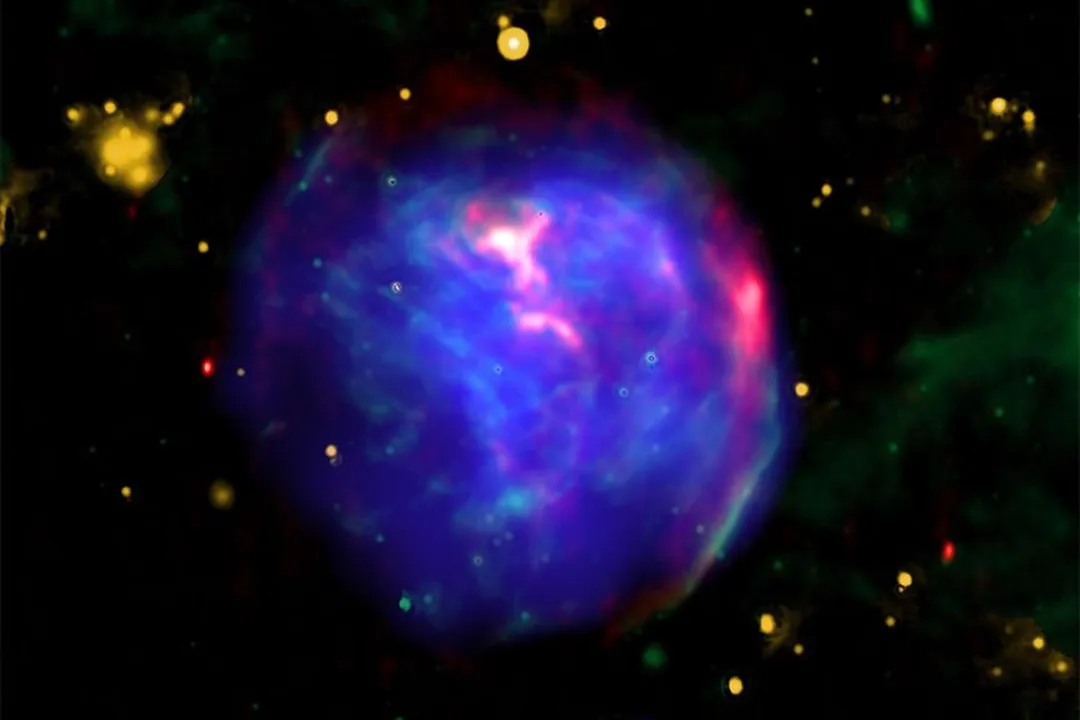
The glowing remnants left behind after a star violently ends its life—a supernova—are among the most spectacular sights in the cosmos, observable across the entire electromagnetic spectrum. These vast, expanding bubbles of gas and plasma, known as supernova remnants (SNRs), don't just light up briefly; they can shine for thousands of years, each phase of their illumination driven by different, powerful physical processes unleashed during the star's demise. [3] Understanding why these shells of stellar debris shine requires looking past simple reflection and delving into the extreme physics of shockwaves, high-energy particle acceleration, and even atomic decay.
# Ejected Power
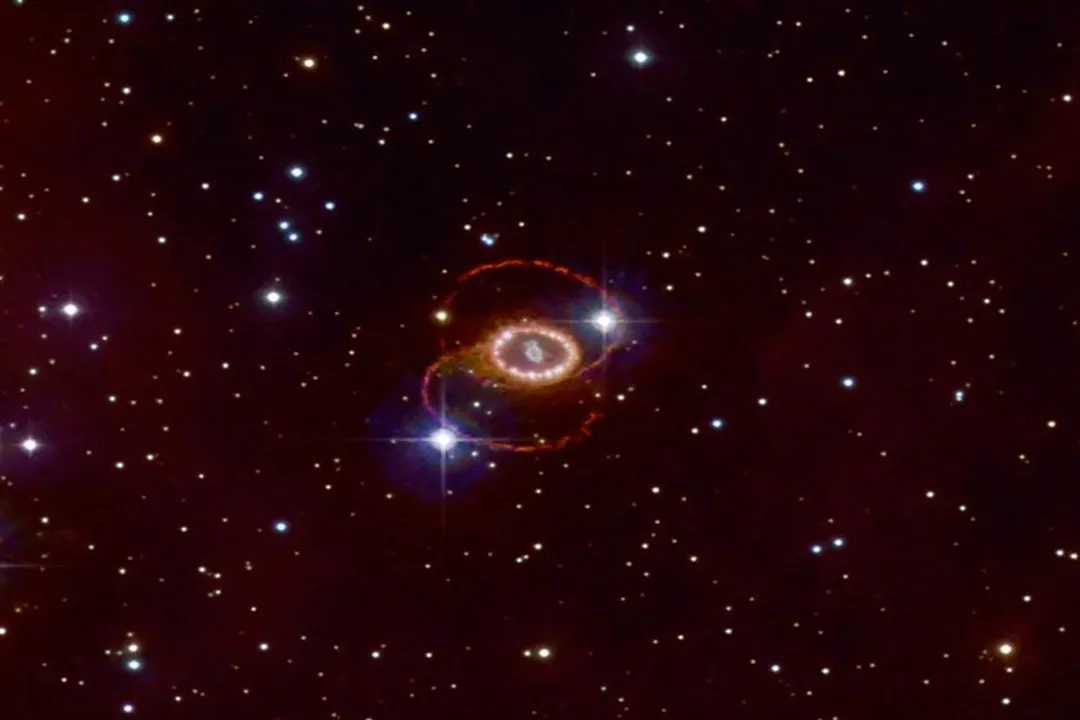
The initial, brilliant flash of the supernova explosion itself lasts only for a matter of days or weeks, but the material flung outward continues to interact with its surroundings, producing the long-lived glow of the remnant. [3] A supernova remnant is fundamentally the structure created by the ejecta from a stellar explosion colliding with the surrounding interstellar medium (ISM). [3] This collision generates colossal shock waves that heat the gas to millions of degrees and accelerate particles to near the speed of light, which is what makes the remnant visible across radio, optical, X-ray, and gamma-ray light.
# Radioactive Engine
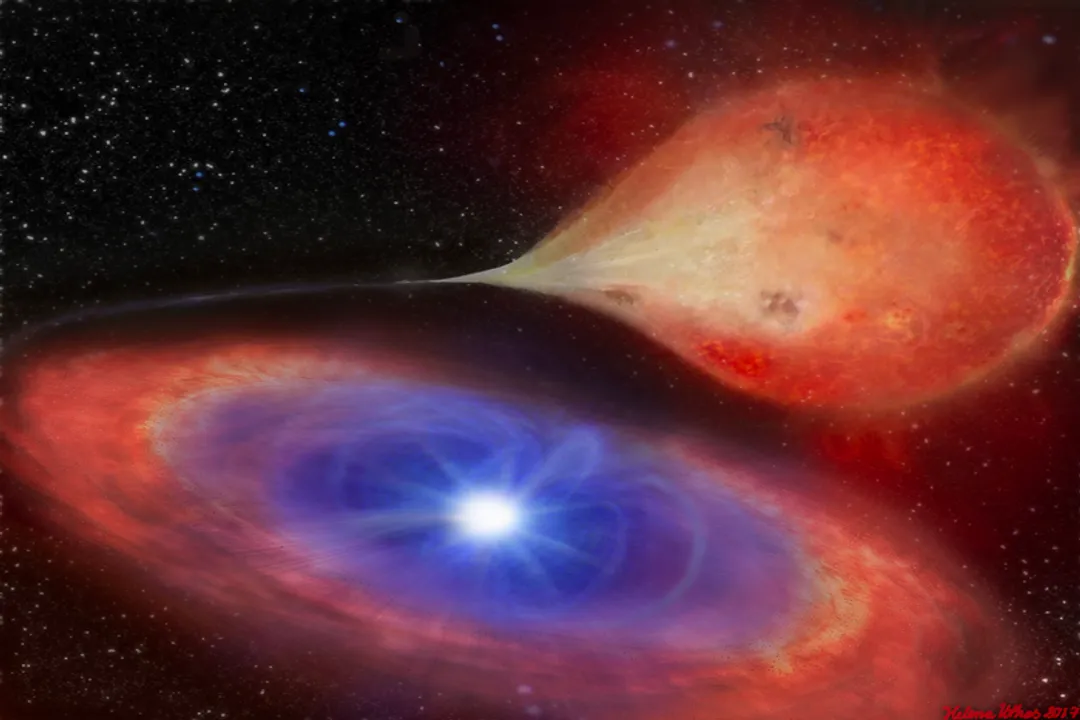
One of the primary reasons the immediate aftermath of a supernova shines brightly for decades is the radioactivity of the freshly synthesized elements created within the star just before it exploded. [1][9] During the final moments of a massive star's life, or during the merger of white dwarfs, nuclear reactions forge heavy elements, including large quantities of highly unstable isotopes like Nickel-56 (). [1][9]
This is the key ingredient for the initial, prolonged optical glow of the ejecta cloud. Nickel-56 has a relatively short half-life, decaying into Cobalt-56 (). [1][9] The Cobalt-56, which also has a half-life of about $77$ days, then decays into stable Iron-56 (). [1][9] The energy released during these decay chains—primarily in the form of gamma rays and kinetic energy transferred to the surrounding plasma—is sufficient to heat the expanding cloud, causing it to radiate visibly in optical light for several months to a few years. [1][9] This heat source ensures the debris glows long after the initial light curve from the stellar photosphere has faded. [1]
While the radioactive glow fades relatively quickly on astronomical timescales (decades), it provides crucial insight into the nucleosynthesis that occurred—telling astronomers what kind of star it was and what elements it produced. [1][9] For instance, the amount of synthesized is directly related to the peak brightness of the supernova observed. [1] If we could track the light from a remnant like the Crab Nebula purely through the radioactive decay of its initial yield, we would notice its optical brightness dimming predictably over a period of about $60$ days as the converts to . [1]
# Shockwave Heating
Once the initial radioactive energy begins to diminish, the dominant mechanism shifts to energy deposited by the continuous physical interaction between the expanding shell of stellar debris and the slower-moving gas of the ISM. [3] As the supernova shock wave plows outward, it slams into the surrounding material, compressing and heating it to extreme temperatures—often millions of Kelvin. [4]
# X-Ray Emission
This intense thermal energy manifests primarily as X-ray emission. [4] When the gas behind the shock front reaches these multimillion-degree temperatures, the electrons become highly energetic, and the atoms emit copious amounts of X-rays as they transition to lower energy states or undergo collisional excitation. [4] The Chandra X-ray Observatory, for example, specializes in capturing this high-energy light, revealing structures within the remnant that are invisible in optical light. [4] The X-ray glow highlights the boundary where the blast wave is currently interacting with the ISM, tracing the path of the expanding energy bubble. [4] These X-rays are generated by the hot, shocked gas, which is distinct from the radioactive material powering the earlier optical emission. [4][9]
For astronomers analyzing these remnants, the temperature derived from the X-ray spectrum directly relates to the speed of the shock wave hitting the ISM. [4] Faster shocks mean hotter gas and brighter X-rays. This thermal X-ray emission can persist as long as the shock wave continues to heat the ISM significantly, which can last for thousands of years, far longer than the initial radioactive phase. [3]
The structure observed in X-rays often shows intricate shells and filaments, which are the visible manifestations of density and temperature variations in the swept-up ISM. [4] Newer observations, such as those of a recent SNR, show these high-energy views peeling back layers, confirming the chaotic nature of the initial explosion and subsequent expansion. [5]
# Non-Thermal Acceleration
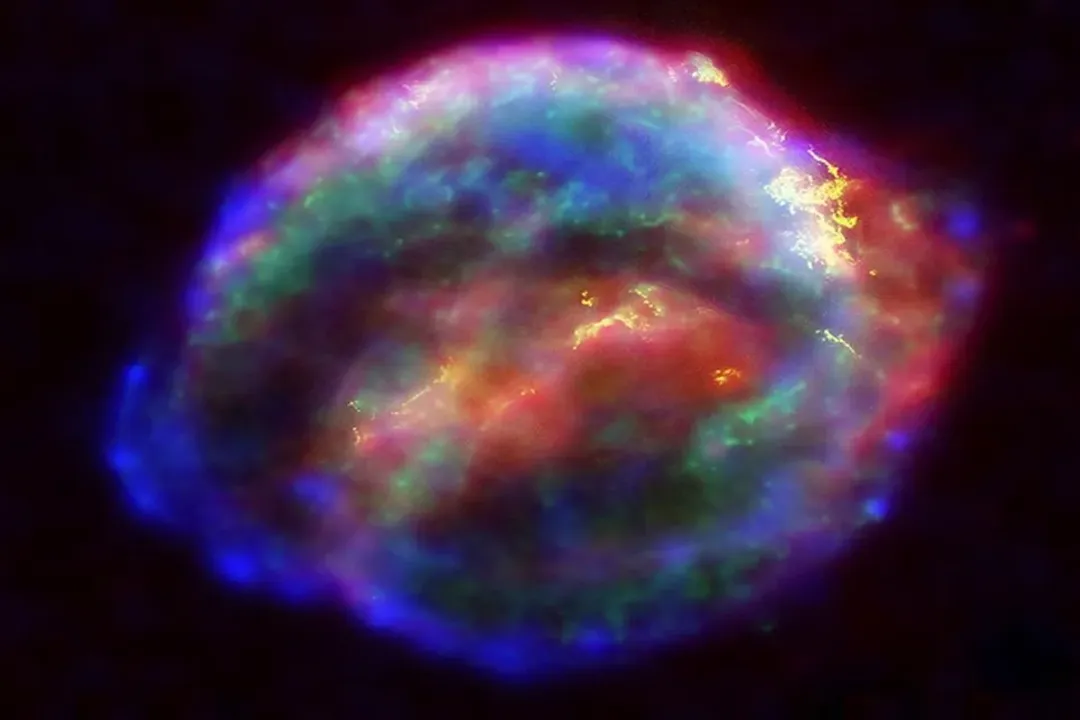
Beyond the thermal heating that produces X-rays, the shock waves are also responsible for accelerating charged particles—protons and atomic nuclei—to extremely high energies, turning them into cosmic rays. [2][7] This process provides a significant, non-thermal component to the remnant's glow, particularly in the radio and gamma-ray parts of the spectrum.
# Synchrotron Light
When these high-speed electrons spiral around the magnetic field lines generated or amplified at the shock front, they emit electromagnetic radiation known as synchrotron radiation. [4][8] This mechanism is responsible for the distinctive, broad-spectrum radio emission that many supernova remnants exhibit. [6]
The magnetic field within the remnant, which is amplified by the passage of the shock wave, acts like a confinement structure, forcing the energetic electrons into helical paths. [2] The faster the electron spirals, the higher the energy of the emitted photon, leading to strong emission across the radio spectrum and sometimes extending into higher frequencies. [2] This is a non-thermal process, meaning the intensity of this light is not simply related to the temperature of the gas, but to the energy distribution of the accelerated particles. [4]
It is through the study of synchrotron radiation that astrophysicists confirm SNRs are powerful particle accelerators in our galaxy. [7] The acceleration mechanism believed to be at work is Diffusive Shock Acceleration (DSA), where particles cross the shock wave multiple times, gaining energy with each traversal. [2] The efficiency of this process is why SNRs are considered a primary source of galactic cosmic rays. [2][7]
The interaction of these high-energy particles with the surrounding magnetic fields, and even with ambient interstellar gas, results in emissions observed by instruments like the Fermi Gamma-ray Space Telescope. [7] Therefore, the glow we observe is not just light from hot gas, but also high-energy radiation from accelerated matter.
# Wavelength Comparison
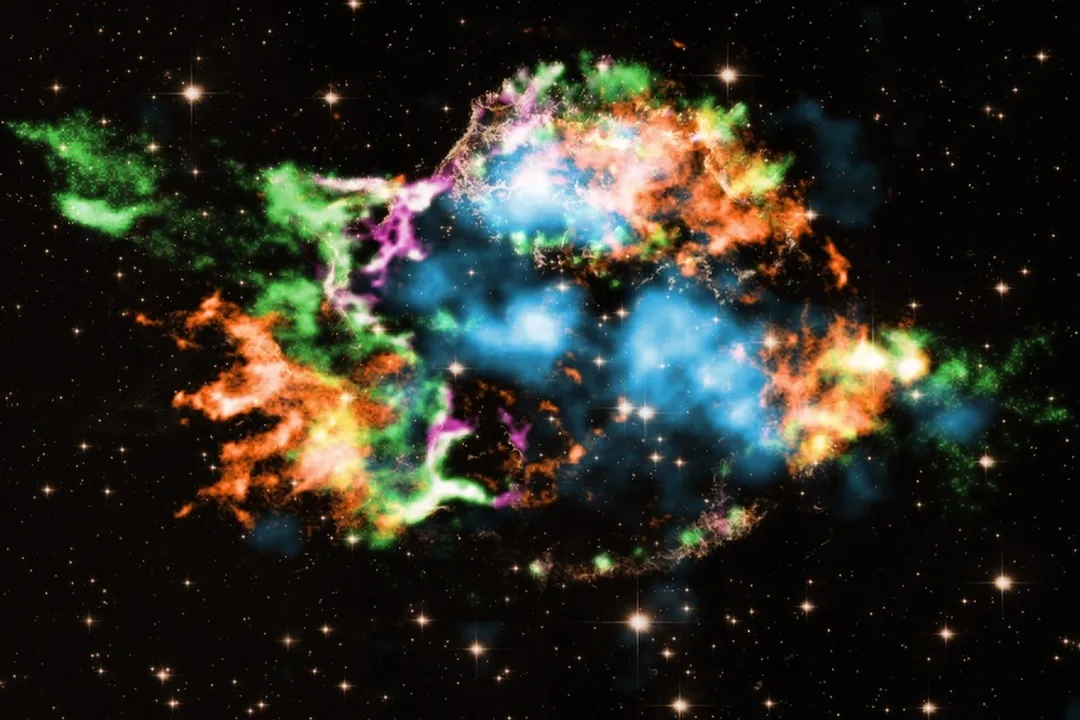
The fact that a supernova remnant glows across such a wide range of the electromagnetic spectrum is what makes them such rich scientific laboratories. [6] Different physical processes dominate at different wavelengths, meaning one telescope view tells only a fraction of the story. [4]
A simplified comparison of the dominant emission mechanisms across key wavelengths might look something like this:
| Wavelength Regime | Dominant Emission Process | Primary Source Material | Duration (Relative) |
|---|---|---|---|
| Optical/Infrared | Heating from Radioactive Decay | Supernova Ejecta (Ni-56, Co-56) | Months to Decades [1][9] |
| X-ray | Thermal Bremsstrahlung | Hot Gas heated by Forward Shock | Thousands of Years [4] |
| Radio | Synchrotron Radiation | High-Energy Electrons in Magnetic Fields | Tens of Thousands of Years [2] |
It’s important to note the distinction between the forward shock (moving into the undisturbed ISM) and the reverse shock (moving backward into the slower-moving ejecta). [8] Both contribute to heating and particle acceleration, though the nature of the material they are impacting differs, leading to complex, layered structures in the observed images. [8]
One interesting observation regarding the transition between these glow phases is how quickly the optical signal driven by radioactivity gives way to the shock-driven signals. If we imagine a very young remnant, say only a few months old, the sheer power of the initial radioactive decay means the optical light is dominant. [1] Yet, the forward shock is already moving at immense speeds, beginning to heat the ISM and initiate the X-ray and radio phases, even if they are temporarily fainter than the radioactive signal. As the shock wave continues to propagate, pushing outward at tens of thousands of kilometers per second, the input of thermal energy from the expanding debris will eventually dwarf the fading energy from the atomic breakdown, causing the X-ray and radio signatures to take over as the primary visible 'glow'. [3][4]

# Lifespan and Structure
The total lifespan of the visible glow is determined by how long the shock waves can maintain enough energy to heat gas or accelerate particles against the drag of the ISM. [3] For the thermal X-ray emission, this often lasts until the SNR has expanded so much that the energy density in the shock becomes too low to produce observable temperatures, potentially covering a span of $10,000$ to $100,000$ years. [3]
The energetic cosmic rays, whose presence we infer from radio emission, can, in principle, travel much further than the remnant shell itself, but the visible remnant glow tied to the localized shock acceleration fades sooner. [2][7] This distinction highlights that the "glow" is really a collection of overlapping phenomena originating from different layers of the explosion's aftermath. Observing an SNR at radio wavelengths allows us to see the energy signature of the entire history of particle acceleration within that shell, whereas an X-ray view is more sensitive to the current, hottest thermal boundary. [4][6]
The existence of these remnants provides direct physical evidence for our models of stellar evolution and death, confirming that the processes happening inside dying stars forge elements necessary for life and inject massive amounts of kinetic energy into the galactic environment. [3][9] The light they cast is a historical record written in X-rays, radio waves, and the slow fading of radioactive isotopes, all testifying to a singular, catastrophic event.
Related Questions
#Citations
Supernovae Glow For Decades Thanks To Radioactivity - Forbes
How do supernova remnants produce cosmic rays? : r/astrophysics
Supernova remnant - Wikipedia
Exploded Star Blooms Like a Cosmic Flower | Chandra Blog
New Supernova Remnant Lights Up | Smithsonian Institution
Light from supernova remnants - Stargazers Lounge
NASA's Fermi Proves Supernova Remnants Produce Cosmic Rays
the beauty of supernova remnants | Telescope Live
Supernovae glow for decades thanks to radioactivity | by Ethan Siegel