As a remnant ages, which emission phase eventually dwarfs the initial signal driven by radioactive decay?
Answer
The shock-driven signals (X-ray and radio)
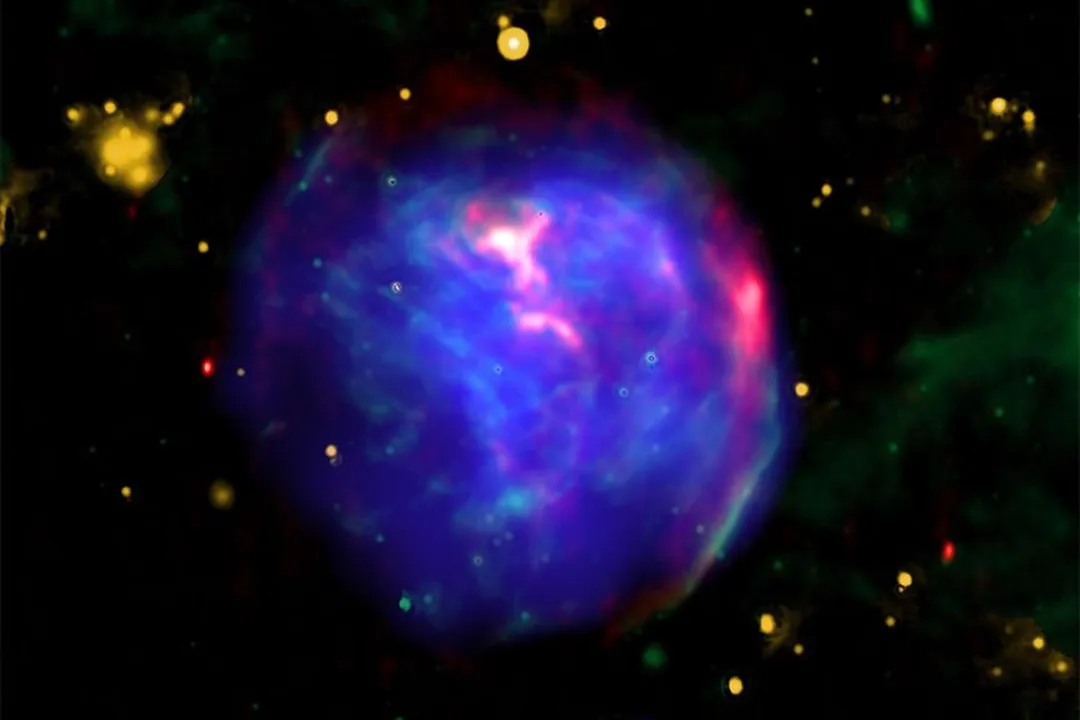
As the shock wave propagates, the input of thermal energy from the expanding debris eventually surpasses the fading energy from atomic breakdown, causing the X-ray and radio signatures to take over as the primary visible 'glow'.
Related Questions
What powers the initial, prolonged optical glow of a supernova remnant for months to years?What element does Nickel-56 ($^{56} ext{Ni}$) primarily decay into?What physical process primarily generates the X-ray emission observed in supernova remnants?What mechanism is responsible for the distinctive, broad-spectrum radio emission from SNRs?Charged particles accelerated to extremely high energies within SNRs are known as what?What is the believed mechanism for accelerating particles within SNRs to generate cosmic rays?How is the amount of synthesized Nickel-56 ($^{56} ext{Ni}$) related to the supernova observation?What material generates the hot gas responsible for the long-lasting thermal X-ray emission?As a remnant ages, which emission phase eventually dwarfs the initial signal driven by radioactive decay?What specific characteristic derived from the X-ray spectrum informs astronomers about the shock wave?