What are the remnants of a supernova called?

The celestial aftermath of a star's dramatic demise is given a specific name: a supernova remnant (SNR). These are not the quiet cinders left by a typical star, but rather the vast, violently expanding clouds of debris and shocked interstellar material left behind after a star explodes in a supernova event. During the brightest phase of this explosion, the expanding cloud can momentarily radiate as much energy as the Sun does over three million years.
Within a large galaxy like the Milky Way, such catastrophic events occur perhaps every 50 years, though many have gone unobserved because obscuring clouds of dust hide the optical light from our view. For instance, the remnant Cassiopeia A is believed to have resulted from a supernova around 1680 that observers missed due to this very obscuration, though it is now recognized as the strongest radio source in the entire sky. The physical remnants we observe today are crucial indicators of galactic evolution, providing the heat, heavier elements, and cosmic rays that shape the very environment where new stars and planets, including our own solar system, can eventually form.
# Violent Birth
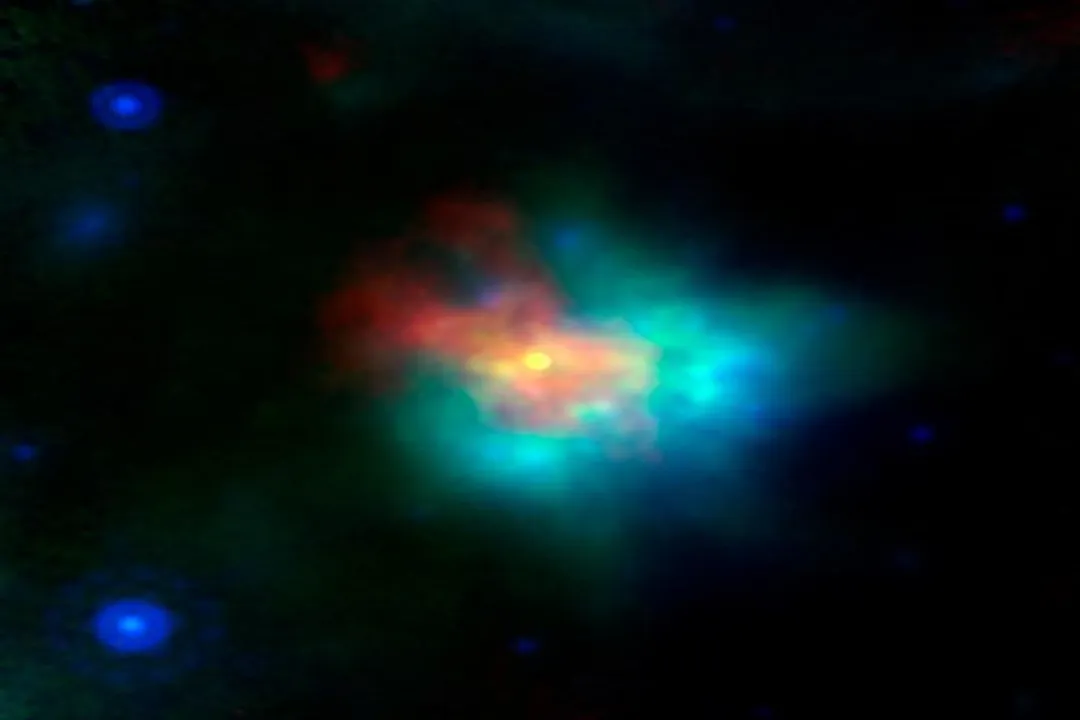
A supernova remnant begins its life following one of two primary stellar fates that result in a supernova explosion. In one scenario, a massive star exhausts its nuclear fuel, causing its core to collapse under its own immense gravity, leading to the formation of either a neutron star or a black hole. The alternative path involves a white dwarf star in a binary system that accretes material from its companion until it hits a critical mass, triggering a runaway carbon detonation.
Regardless of the trigger mechanism, the resulting explosion is prodigious, ejecting a substantial portion—perhaps most—of the star's original mass at speeds reaching up to 10% of the speed of light, which translates to roughly . This ejected material, known as ejecta, is immediately followed by a powerful shock wave that rushes outward into the surrounding interstellar medium (ISM). This shock front instantly heats the interstellar gas it encounters to temperatures exceeding several million Kelvin. The initial state of this expanding remnant is characterized by this high-temperature, rapidly expanding shell, often visible primarily in X-rays because the gas is too hot to radiate efficiently in lower-energy wavelengths.
# Stages of Expansion
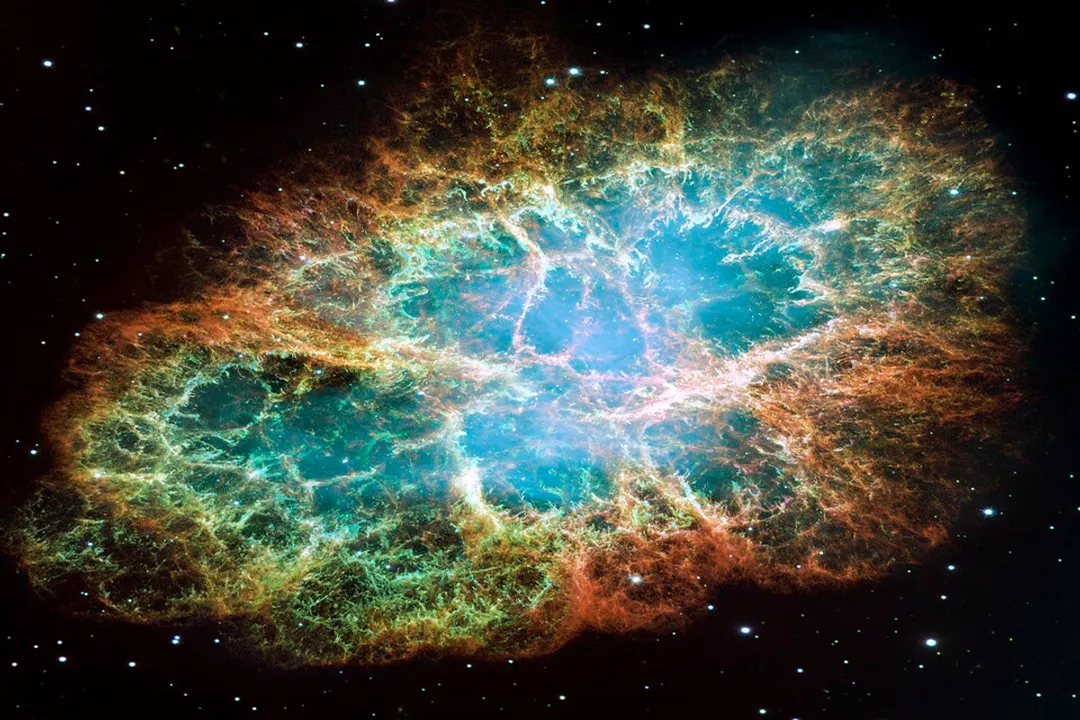
The evolution of a supernova remnant is a long process, unfolding over hundreds of thousands of years, with its appearance and dominant emission characteristics changing as it expands and interacts with its surroundings. Astronomers often categorize this evolution into distinct phases.
The very first phase is free expansion, where the ejecta moves outward so violently that it hasn't yet swept up a mass of surrounding material comparable to its own weight. This phase is characterized by a relatively constant expansion velocity for the shell and can last from a few decades up to a few hundred years, depending heavily on the density of the initial circumstellar or interstellar material.
As the remnant continues to plow through the ISM, it transitions into the Sedov-Taylor phase, often called the adiabatic phase. During this stage, the remnant begins to decelerate as it sweeps up more and more interstellar gas. The shock waves remain strong, continuing to generate high-energy X-ray emission, and the instability of the shell at this stage allows the original stellar ejecta to mix with the shocked ISM material. This mixing can also lead to an enhancement of the magnetic field within the shell. This phase is quite long, potentially lasting for 10,000 to 20,000 years.
The next transition marks the beginning of the pressure-driven snowplow or radiative phase. This occurs once the shell has swept up a mass of ISM comparable to its own mass, causing the expansion to slow significantly. Crucially, the shell has cooled enough—down to around —that atomic electrons can begin to recombine with the heavier ions, like oxygen. This recombination process allows the shell to radiate its energy away much more efficiently, causing it to cool rapidly, shrink, and become denser—a kind of snowball effect. Optical light emission, often from glowing hydrogen and oxygen filaments, becomes prominent in this phase.
Finally, after hundreds of thousands of years, the remnant reaches a point where the internal pressure balances the pressure of the surrounding ISM, and the remnant effectively loses its distinct identity, merging back into the general turbulent flow of the galaxy. Even after the bulk material dissipates, pockets of extremely hot gas emitting soft X-rays might persist locally for a time.
If the original star was massive enough and the explosion energetic enough, the remnant might be classified as a hypernova remnant, resulting from an even higher-energy explosion called a hypernova.
# Types of Remnants
The resulting appearance of a supernova remnant is highly dependent on the conditions of the explosion and the structure of the surrounding medium, leading to several recognized morphological types.
# Shell Structures
The most straightforward scenario results in a shell-type remnant. In these, the majority of the radiation originates from the expanding, shocked shell of material. When we view these three-dimensional shells, we see more material along our line of sight when looking toward the edge of the structure compared to looking through the center. This effect causes the edges to appear brighter than the middle, a phenomenon known as limb brightening. The Cygnus Loop, or Veil Nebula, is a classic example of this type.
# Pulsar Wind Nebulae
In contrast to the shell-dominated objects, some remnants are dominated by the central engine left behind—a rapidly spinning neutron star known as a pulsar. These are called Crab-type remnants, or sometimes plerions (from pulsar wind nebula). These objects look more like a filled "blob" of emission rather than a distinct ring. The interior is filled with high-energy electrons ejected from the pulsar, which interact with the magnetic field, generating intense synchrotron radiation that emits across the radio, visible, and X-ray spectrum. The Crab Nebula itself is the prototype for this category. About 50 known supernova remnants contain a visible pulsar.
# Hybrid Forms
Many remnants do not fit neatly into the two simple categories, resulting in composite remnants. These objects display features of both shell-types and Crab-like plerions, often depending on the wavelength of light used for observation.
There are subcategories here:
- Thermal composites: These often appear shell-like when observed at radio wavelengths (due to synchrotron radiation from the shell) but look Crab-like in X-rays. A key differentiator is that their X-ray spectra show spectral lines, which indicate the presence of hot, shocked gas, contrasting with the featureless spectra of true Crab-like remnants.
- Plerionic composites: These appear Crab-like in both radio and X-ray bands, indicating a central pulsar wind nebula, but they also possess an outer shell structure. In these cases, the X-ray spectrum in the center lacks spectral lines, but the X-ray emission near the shell does show spectral lines. The remnant W44, for instance, can be simultaneously classified as a "classic" composite (shell plus pulsar wind nebula) and a thermal composite.
When studying the expansion rate, one can estimate an age by measuring the expansion over time, though this works best for the youngest remnants, as the expansion naturally slows over time. For a remnant that expands by, say, $5%$ over 20 years, the rate is . If the total expansion since the explosion is $100%$, the age is estimated at . Since the expansion is decelerating, the true age is likely less than this calculated value.
# Observational Signatures
Observing a supernova remnant means detecting the various forms of energy released by the shocked gas and relativistic particles within it.
The collision of the shock wave with the ISM creates a very strong magnetic field and accelerates electrons to nearly the speed of light. As these high-speed electrons spiral around the magnetic field lines—a helical path—they emit radiation across a broad spectrum, which is called synchrotron radiation. This radiation is strongly concentrated forward and is highly polarized, dominating the radio emission from the remnant. Radio telescopes are exceptionally good at mapping SNRs because radio waves can penetrate the obscuring dust that hides many optical objects.
The intense shock front also heats the immediate post-shock gas to millions of Kelvin, causing it to emit intensely in X-rays. X-ray telescopes like Chandra are vital for observing this component, which maps the hottest gas just behind the shock. In older, cooler phases, optical light emission becomes significant, generated by hydrogen and oxygen atoms recombining in the relatively denser, outer shell. The detailed multi-wavelength image of Kepler's SNR shows this perfectly, with blue for high-energy X-rays, green for low-energy X-rays, yellow for optical light from dense knots, and red for emission from warm dust grains seen by Spitzer.
# Galactic Importance
The significance of supernova remnants to galactic ecology cannot be overstated; without them, the composition of our solar system, including Earth, would be drastically different.
One of the most critical roles of SNRs is chemical enrichment. Almost all elements heavier than iron are forged in the crucible of a supernova explosion, and the remnants are the mechanism by which this newly synthesized material is distributed into the interstellar medium (ISM). Since subsequent stars and their planetary systems form from the ISM, the elements necessary for rocky planets and life were delivered by these explosions.
Beyond chemistry, SNRs are major contributors of energy to the galaxy. The expanding shock wave injects enormous kinetic energy ( megatons per supernova) into the ISM, heating the gas and establishing temperature differences that help keep the galaxy dynamic. Furthermore, these shocks are believed to be the primary engine for accelerating cosmic rays. Particles crossing the shock front repeatedly gain energy through a process related to Fermi acceleration, becoming cosmic rays that stream throughout the galaxy. For many decades, this mechanism has been the leading explanation for compensating the energy lost by cosmic rays escaping the Milky Way.
A fascinating aspect that relates the remnant's appearance to its environment is how the surrounding medium dictates its shape. While the initial explosion energy is spherical, the resulting remnant often appears asymmetrical or clumpy. The appearance of the Cygnus Loop, with its distinct patches, strongly suggests the shock wave is encountering varying densities of interstellar clouds—denser clouds slow the shock more abruptly, causing brighter, more turbulent filaments. This tells astronomers that the gas clouds the star was born in were not perfectly uniform, providing a direct fossil record of the birth environment and the immediate aftermath of the explosion.
Another key role is related to star formation. If a massive star explodes while still embedded within its molecular cloud, the expanding remnant can compress the surrounding gas locally. If this compression is sufficient to push clumps of gas past the critical mass threshold (somewhere between the mass of Jupiter and the Sun), it can trigger the gravitational collapse necessary to ignite nuclear fusion and form a new generation of stars. This suggests that supernovae are not just endpoints but also catalysts for subsequent stellar creation. The age of a remnant, relative to the current star-forming region it occupies, can offer clues about whether it is currently compressing material for future stars or has already dissipated its influence. For instance, a remnant that has entered its radiative phase and is now a relatively cool, dense shell may be the perfect agent for triggering the next wave of stellar birth in its vicinity by pushing on pre-existing molecular clouds.
Related Questions
#Citations
Supernova remnant - Wikipedia
Supernova Remnants - Imagine the Universe!
Supernova remnants Info Page
Supernova remnant | Astronomy, Physics & Formation | Britannica
Supernova Remnant Type | COSMOS