What is the core after a supernova called?
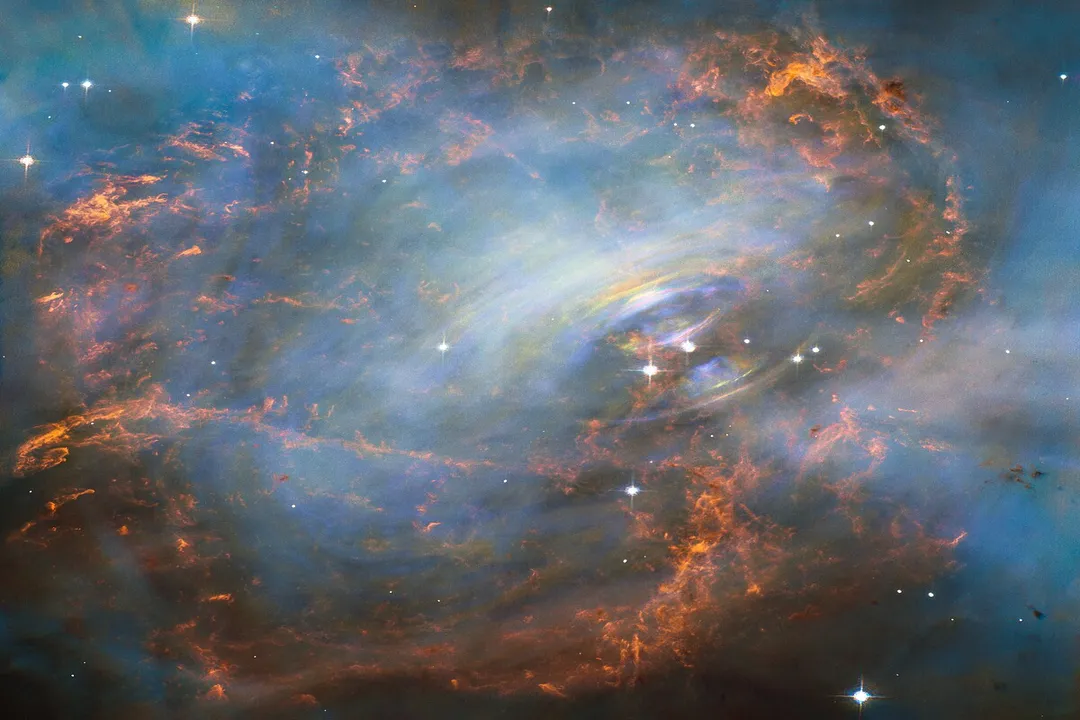
The final object left behind after a massive star exhausts its fuel and explodes in a supernova is one of the universe's most exotic states of matter. It’s not just a big lump of ash; it’s the compressed remnant of a stellar core that underwent a catastrophic gravitational collapse. Whether this remnant settles into a neutron star or collapses further into a black hole depends entirely on how massive the star was before it died.
# Stellar Mass Limits
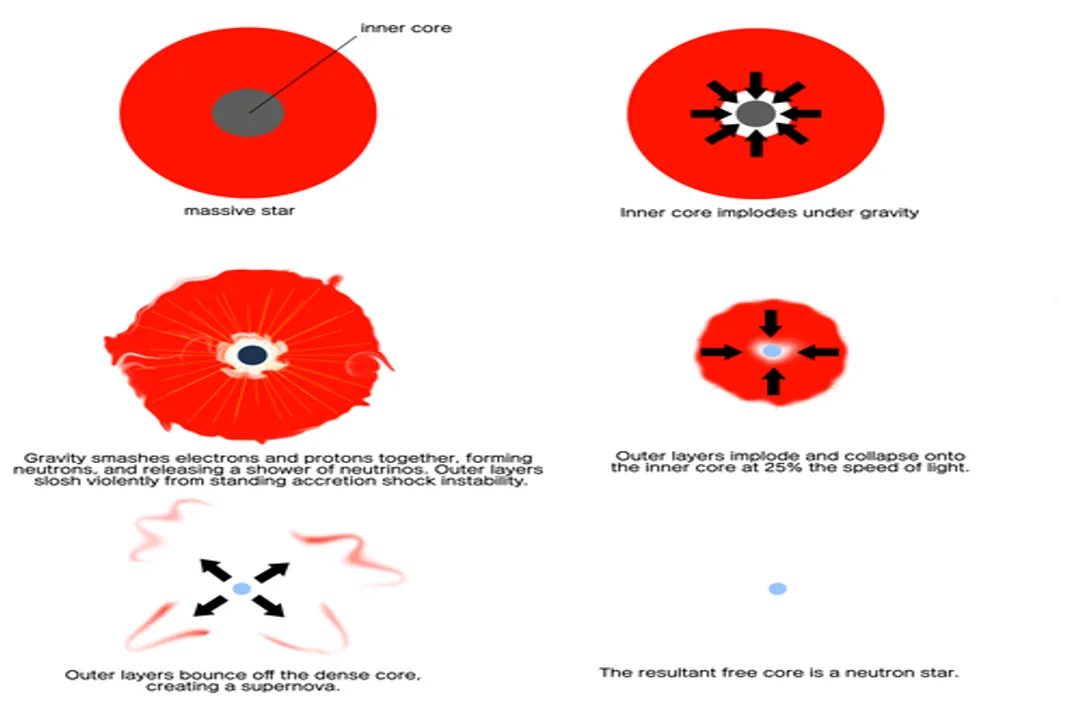
Understanding the core remnant begins by looking at the progenitor star—the object before the explosion. Not all stars go supernova. Our Sun, for instance, will end its life much more gently, puffing off its outer layers to leave behind a white dwarf. For the spectacular core collapse that triggers a supernova, the star must begin its life with a mass significantly larger than the Sun, typically around eight times the Sun’s mass () or more.
The crucial dividing line for what happens after the explosion hinges on the mass of the core that remains after the outer layers have blown away. Astronomers categorize the potential endpoints based on this surviving mass. If the original star was in a certain intermediate range, perhaps around to , the core remnant will stabilize as a neutron star. However, if the initial star was heavier, exceeding about , the gravitational forces are simply too immense for any known pressure to resist, leading to the formation of a black hole. This mass threshold defines the fate of the stellar corpse.
# Core Compression
The process leading to either remnant is violent and swift. Once the star fuses elements all the way up to iron in its core, fusion stops because iron fusion consumes energy rather than releasing it. Without the outward pressure generated by nuclear fusion to counteract the immense inward pull of gravity, the iron core begins to collapse. Gravity overcomes the electron degeneracy pressure, the quantum mechanical force that normally supports white dwarfs against further collapse.
As the core collapses inward, the density skyrockets to extraordinary levels. Protons and electrons are squeezed together with such force that they combine to form neutrons, releasing a flood of neutrinos in the process. This crushing process continues until the core reaches densities where the neutrons themselves resist further packing together. The rebound shockwave from this sudden halt in the implosion causes the outer layers of the star to be ejected in the dramatic supernova event we observe. The material that survives this blast constitutes the star's dense core remnant.
# Neutron Star Physics
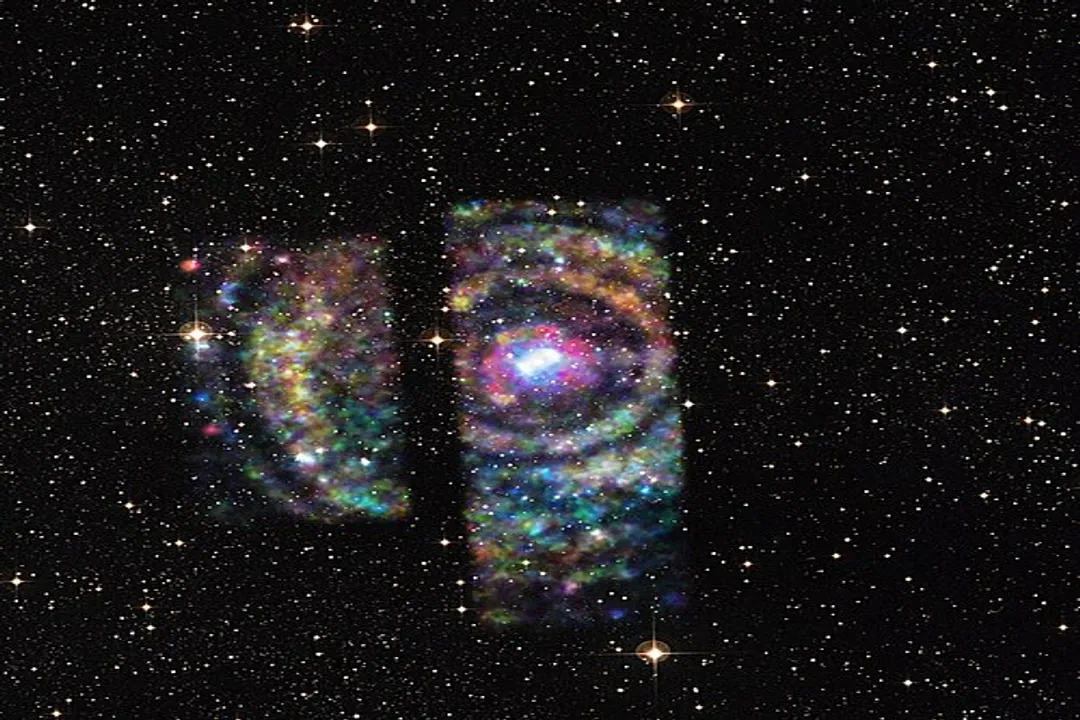
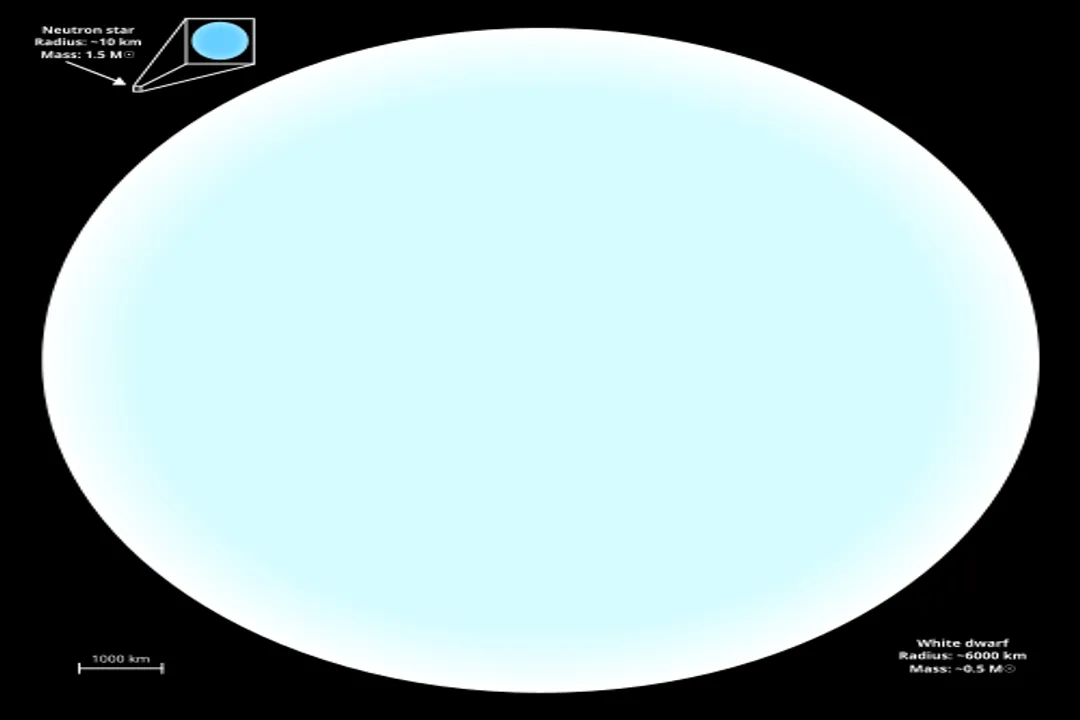
When the remnant core stabilizes, it manifests as a neutron star. These objects are astonishingly compact. A typical neutron star packs more mass than the Sun—perhaps $1.4$ to $2.1$ times the Sun's mass ()—into a sphere only about $20$ kilometers across. To put that density into perspective, a single teaspoon of neutron star material would weigh billions of tons, similar to the weight of Mount Everest concentrated into a sugar cube.
The stability of this object against total gravitational collapse relies on a purely quantum mechanical effect: neutron degeneracy pressure. This pressure arises because neutrons, like electrons, are fermions and obey the Pauli exclusion principle, meaning no two neutrons can occupy the exact same quantum state. When the core is crushed to this neutron-degenerate state, the resistance offered by these tightly packed, non-overlapping particles becomes powerful enough to balance the star's gravity, preventing further collapse—at least up to a certain mass limit.
It’s fascinating to consider that the pressure supporting a neutron star is entirely different in origin from the pressure supporting the progenitor star's main sequence or even the electron degeneracy pressure supporting a white dwarf. The core must transition through multiple forms of internal resistance before finally settling into the neutron degenerate state, provided the mass isn't too high.
# Black Hole Formation
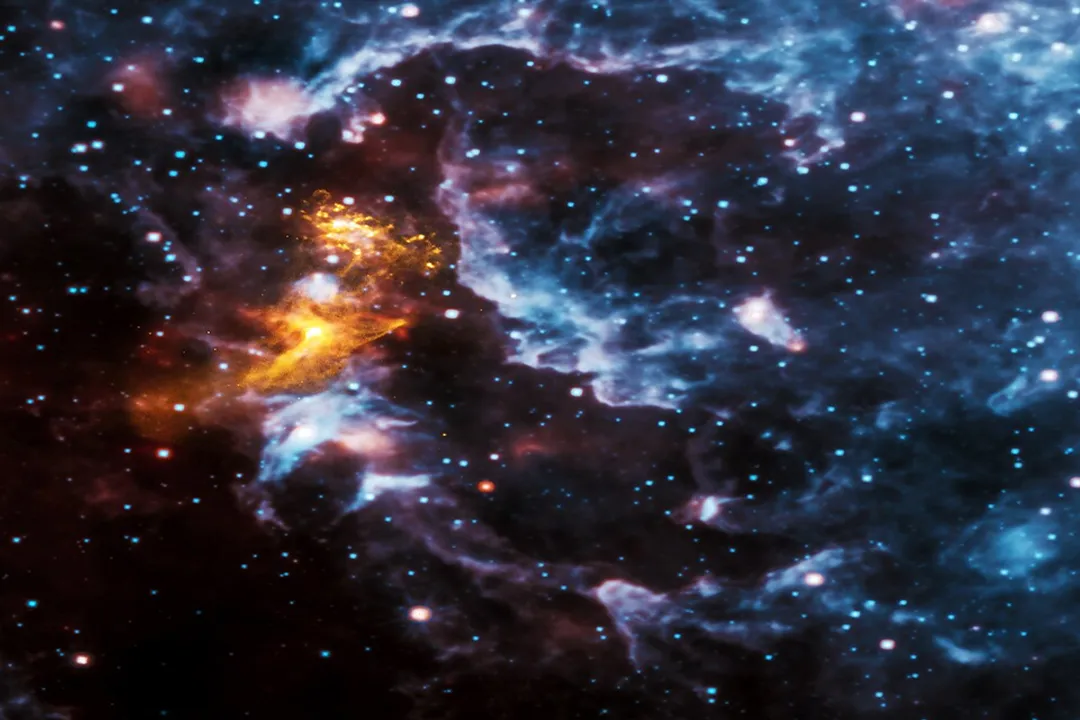
If the mass of the collapsing core exceeds the maximum limit that neutron degeneracy pressure can support—often cited around $2$ to —even the pressure of tightly packed neutrons is insufficient to halt gravity's relentless pull. In this scenario, the collapse continues unabated. There is no known force strong enough to stop the implosion once this threshold is crossed.
The core shrinks down to an infinitely dense point called a singularity, surrounded by an event horizon—the boundary from which nothing, not even light, can escape. The resulting object is a black hole. The difference between a neutron star and a black hole, therefore, is the ultimate success or failure of the neutron degeneracy pressure in its final stand against crushing gravity. The star either finds a temporary, hyper-dense equilibrium or succumbs entirely to spacetime curvature.
To visualize the extreme difference in outcomes, imagine two stars that undergo core collapse. Star A leaves behind a core, roughly the size of a city, radiating with intense magnetic fields and potentially visible as a pulsar. Star B, slightly more massive, leaves behind a singularity, an object whose size is defined only by its event horizon, which is proportionally much smaller than the neutron star's radius for its given mass. The mass discrepancy between the two remnant types, while perhaps looking small on a chart (e.g., vs ), represents a fundamental difference in the physics governing the final object.
| Progenitor Mass Range (Approx.) | Core Collapse Outcome | Supporting Pressure |
|---|---|---|
| (Low Mass) | White Dwarf | Electron Degeneracy Pressure |
| to (Medium Mass) | Neutron Star | Neutron Degeneracy Pressure |
| (High Mass) | Black Hole | None (Total Collapse) |
# Density and Scale Contrast
The defining characteristic of both remnants is density, but the degree is vastly different. A neutron star represents matter compressed to the density of an atomic nucleus across a stellar scale. We can think of this state as the densest stable configuration in the observable universe for bulk matter. The material exists as a superfluid of neutrons, an almost purely quantum object behaving on a macroscopic scale.
In contrast, the black hole represents matter that has passed the point of stability entirely. The critical takeaway here is that the collapse that forms the black hole is not just a continuation of the neutron star formation process; it is a qualitative jump into a region of physics where current models suggest density becomes undefined at the singularity. If you were observing a system where a neutron star was slowly accreting mass from a companion star, watching it approach the limit, the transition would not be gradual; it would be a swift, complete collapse once the critical density barrier is breached. This boundary condition is one of the most intensely studied problems in modern astrophysics because it tests general relativity to its limits.
# Observing the Aftermath
While the concept of a core remnant is clear—it’s either a neutron star or a black hole—detecting these objects after the visual spectacle of the supernova fades presents its own challenge. A neutron star, especially if it is not actively accreting material or if its magnetic poles are not pointed toward Earth, can be quite dim. However, many are detected as pulsars, rapidly spinning neutron stars emitting beams of radio waves. The regularity of these pulses is astonishingly precise, sometimes rivaling atomic clocks on Earth, which speaks volumes about the rigidity and consistency of the neutron star structure itself.
Black holes, by definition, emit no light, making them invisible to direct observation. We infer their presence through their gravitational influence on nearby stars or by observing the intense X-rays generated by material spiraling into them through an accretion disk, heating up to millions of degrees just before crossing the event horizon. Thus, the "what" of the core remnant is answered by two distinct observational pathways: the lighthouse beam of a pulsar versus the gravitational shadow of a dark companion. The investigation into these collapsed cores continues to push the boundaries of what we understand about matter under extreme pressure.
Related Questions
#Citations
Neutron star - Wikipedia
Neutron Stars - NMSU Astronomy
What happens to a massive star's iron core before it collapses?
What happens to the iron core of a star after a supernova explosion?
Core Collapse Definition - Intro to Astronomy Key Term | Fiveable
Why does matter stay collapsed in the core, following a supernova ...
Planetary Nebula - ASPIRE
What forms from a star's core after a supernova? - Facebook
Core-collapse | COSMOS