How bright can a supernova get?

The spectacle of a dying star culminates in an event of such colossal energy release that, for a brief period, its light can outshine every other star in its host galaxy combined. This cataclysm, the supernova, is not a single phenomenon but a diverse class of stellar deaths, each operating under different physics and releasing vastly different amounts of energy. To discuss how bright a supernova can get is to venture into the very limits of stellar physics, from the consistent flares of stellar remnants to the theoretically powered explosions of exotic stellar cores.
# Apparent Magnitude
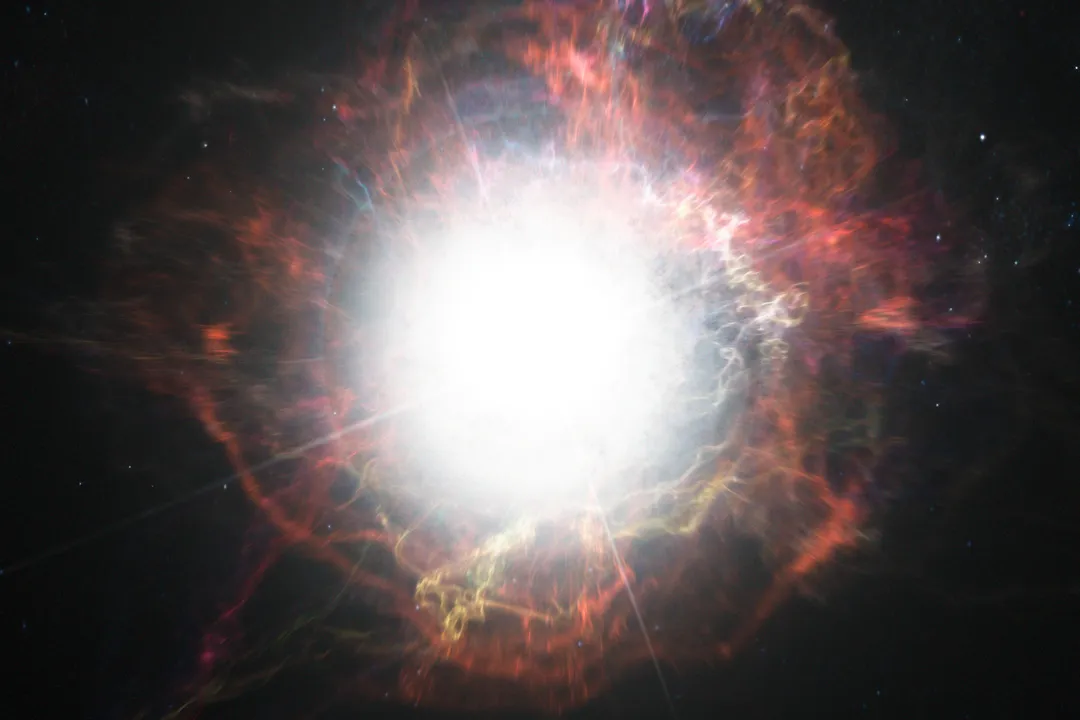
To appreciate the brilliance of these cosmic fireworks, it helps to understand the scale astronomers use to measure light: magnitude. This system is counterintuitive; the lower the number, the brighter the object, and negative numbers denote extreme brightness. The Sun is incredibly bright at an apparent magnitude of roughly $-26.7$, while the limit of naked-eye visibility on a clear night hovers around magnitude $+6$.
For a common, predictable stellar death—the Type Ia supernova—the peak absolute brightness is remarkably uniform, generally reaching an absolute magnitude of about $-19.3$. This consistency is why Type Ia events serve as crucial "standard candles" for measuring cosmic distances. At this standard peak, a Type Ia supernova observed from a distance of $10$ parsecs would be about times brighter than Sirius, the brightest star in our nighttime sky. In raw terms, a standard Type Ia explosion can shine with the luminosity of 5 billion Suns.
However, the vast majority of the total energy unleashed in a supernova, particularly a core-collapse event, is not in visible light. Over $99%$ of the energy from a core-collapse supernova is radiated away in a ten-second burst of neutrinos, an energy output of roughly joules, which is about $10%$ of the star’s entire rest mass energy. The visible, electromagnetic radiation is thus almost a side-effect of these energetic processes.
# Extreme Luminosity
In recent years, astronomers have documented events that force a re-evaluation of even the most energetic expected explosions: Super-Luminous Supernovae (SLSNs). These events burn far brighter than the typical Type Ia standard, stretching conventional models designed for less powerful stellar deaths.
The most luminous supernova ever recorded, as of its 2015 discovery, is ASASSN-15lh. This object blazed with a peak luminosity of approximately , which translates to about 570 billion times the luminosity of our Sun (). This made it roughly twice as luminous as the previous brightest known record holder. Such a bright transient challenges our understanding of what can power an explosion.
The mechanism proposed to explain events like ASASSN-15lh is the presence of a magnetar at the heart of the blast. A magnetar is a rapidly spinning neutron star possessing an extraordinarily powerful magnetic field, which can dump immense rotational energy into the surrounding expanding gas—the supernova ejecta—thereby brightening the visible explosion significantly. According to calculations by Tuguldur Sukhbold and Stan Woosley, a magnetar-powered supernova represents the upper limit of what standard core-collapse models can produce.
# Theoretical Ceiling
The investigation into how bright a supernova can possibly get suggests a theoretical ceiling hovering around 6 trillion () times the luminosity of the Sun. This hypothetical maximum is about ten times brighter than ASASSN-15lh. The mechanism relies on the conditions right after the core collapse: the formation of a magnetar with a magnetic field $20$ trillion times stronger than the Sun's, spinning at $1,500$ rotations per second.
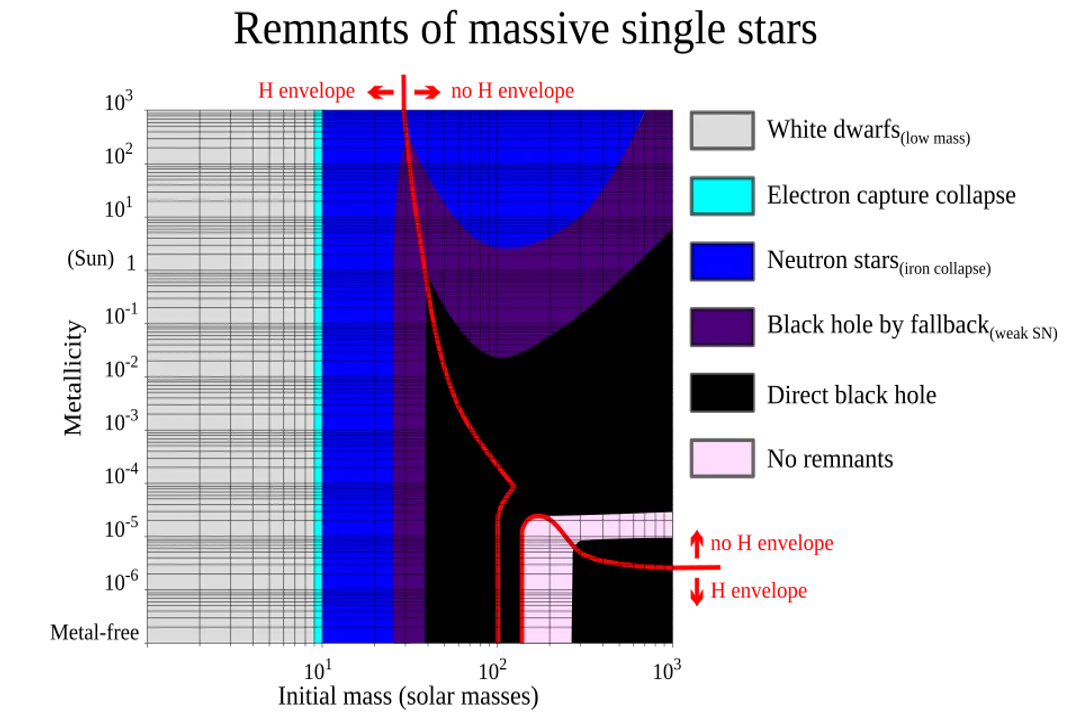
However, this ceiling is dictated by a fundamental physical constraint: the progenitor star's mass and the resulting neutron star's binding energy. If the collapsing core has a binding energy greater than one-sixth of the Sun's rest mass energy, the gravitational forces will overcome neutron degeneracy pressure, and the core will collapse directly into a black hole instead of leaving behind a neutron star that can power a magnetar-driven supernova. If a supernova is physically incapable of achieving the necessary magnetic field or rotational energy to reach this $6$-trillion-solar-luminosity mark, then that becomes the absolute limit based on known explosion mechanisms.
It is worth noting that even ASASSN-15lh’s extreme nature is still debated; some researchers suggested it might not be a supernova at all, but rather a Tidal Disruption Event (TDE), where a star is torn apart by the tidal forces of a supermassive black hole. Astronomers caution that the theoretical models explored only cover known methods, leaving open the possibility of an even more extreme, currently unmodeled event, though for now, $6$ trillion Suns is the calculated upper boundary for conventional supernovae.
# Galactic Neighbors
While the record-holders are observed billions of light-years away, appearing as faint smudges even in powerful telescopes, a supernova in our own cosmic neighborhood—the Milky Way—would be a comparatively more visible and historically significant event. Astronomers estimate that a supernova occurs in our galaxy about three times per century on average.
Historically, we have been fortunate enough to witness several bright ones without the aid of modern instruments:
| Historical Event | Year | Constellation | Apparent Magnitude (Approx.) | Daytime Visibility |
|---|---|---|---|---|
| SN 1006 | 1006 AD | Lupus | Yes | |
| SN 1054 | 1054 AD | Taurus | Yes | |
| SN 1572 (Tycho's) | 1572 AD | Cassiopeia | No (very bright night object) | |
| SN 1604 (Kepler's) | 1604 AD | Ophiuchus | No (very bright night object) |
The brightest of these, SN 1006, was so brilliant it reached an apparent magnitude of . This level of brightness made it visible during the daytime, even casting shadows at night for several days. The SN 1054 event, which created the famous Crab Nebula remnant, was also visible in daylight for $23$ days. These historical events were vital, as they helped dismantle the ancient Aristotelian view that the heavens were static and unchanging.
# Local Impact Forecast
The brightness that a nearby supernova achieves is entirely dependent on its distance. The light we see is governed by the inverse square law, meaning an object twice as far away appears four times dimmer.
Consider the case of Betelgeuse, the prominent red supergiant in Orion, which is considered a candidate for a future supernova. Current distance estimates place it around $170$ parsecs away ( light-years). If this star were to explode as a typical Type II supernova (peak absolute magnitude ), it would reach an apparent magnitude of approximately $-10.85$. This puts it slightly dimmer than the full Moon (around ), but importantly, it would be bright enough to be easily visible to the naked eye. Some suggest it would shine brighter than the full Moon.
Though the Sun has a magnitude of $-26.7$, making it roughly $100,000$ times brighter than a magnitude $-11$ supernova, an explosion this close could still be noticeable during the day. If the Sun were obscured by thick clouds, a very bright object like a magnitude $-11$ Betelgeuse supernova could potentially cast faint shadows, though even the full Moon cannot do so. Staring at it, even with a good telescope, would pose a risk to the eyes, similar to looking at the Sun for extended periods. Furthermore, other candidates like Eta Carinae are also on the list, though likely not due to explode for hundreds of thousands of years.
The perceived brightness, however, only tells part of the story of a nearby event. The potential for harm is also related to distance and the energy spectrum of the explosion. While the visible light is stunning, the flux of neutrinos poses a greater immediate threat to life near the source. For a supernova at the distance of SN 1987A (about $168,000$ light-years), the neutrino flux reaching Earth is harmless, detectable only by specialized underground observatories. If that same explosion occurred just $1$ Astronomical Unit (AU) away (the Earth-Sun distance), the neutrino bombardment would be sufficient to melt a human body into "goo in seconds," even underground, as each cell would be hit by billions of neutrinos. At $100$ light-years away, the chance of a neutrino interaction per cell is small enough that survival is probable, but closer than that, the lethality increases sharply.
This difference between visual impact and physical energy release is a key takeaway when considering supernova brightness. A Type Ia supernova releases about $1$ order of magnitude in electromagnetic energy (foe), while a core-collapse event releases about $1$ foe in kinetic energy and $100$ foe in neutrino energy, with the electromagnetic component being much smaller. The visual magnitude tells you how striking it is, but the energy budget reveals the true cosmic violence involved.
# Light Curve Consistency
Beyond peak brightness, the way a supernova shines and fades—its light curve—also varies dramatically depending on the underlying physics.
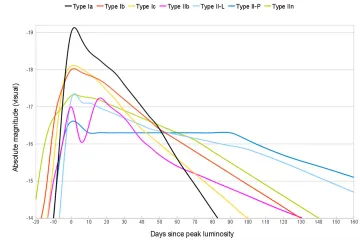
For the reliable Type Ia events, the light curve is highly consistent because they are triggered when a white dwarf reaches a specific mass threshold ( solar masses, the Chandrasekhar limit). The light output is fueled by the radioactive decay of Nickel-56 into Cobalt-56 (half-life of 6 days), and then into stable Iron-56 (Cobalt-56 half-life of $77$ days). This predictable energy source ensures a relatively steep and uniform decline in brightness over months.
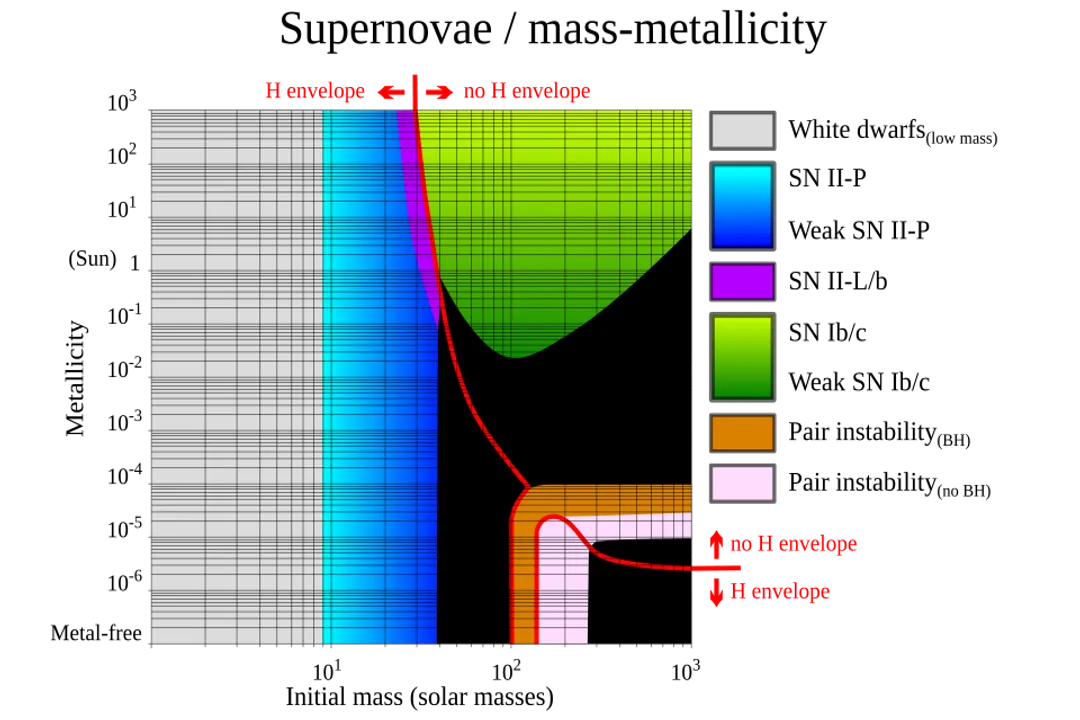
In contrast, Type II supernovae, resulting from massive stars running out of fuel, have a much slower decline, often characterized by a "plateau" phase lasting several months as hydrogen in the expanding envelope recombines and radiates light. Superluminous types, such as Type IIn, often derive their extended duration and high brightness from the kinetic energy of the blast interacting with dense circumstellar material ejected by the progenitor star shortly before collapse, rather than relying solely on radioactive decay. The extreme energy deposition from a magnetar in a magnetar-powered model results in a protracted and blinding display, as the magnetic field continuously pumps energy into the expanding shell.
It is this variety—from the standardized $-19$ magnitude of a Type Ia to the trillion-fold solar luminosities powered by exotic rotating neutron stars—that shows the sheer breadth of stellar death. Each explosion acts as a high-energy physics laboratory, visible across unimaginable gulfs of space, offering a glimpse into the universe's most violent mechanisms. Even though the maximum brightness is calculated based on current physical understanding, the discovery of an event like ASASSN-15lh reminds us that stellar death continues to hold surprises, pushing the boundaries of what we consider possible for the final moments of a star.
Related Questions
#Citations
How Bright Can Supernovae Get? - AAS Nova
What would a supernova look like in the sky ? : r/Astronomy - Reddit
Supernova - Wikipedia
Supernovae Background
How bright is a supernova? - Quora
How Bright Would a Supernova Be? #shorts - YouTube
How Bright Can A Supernova Be? | IFLScience
How bright would Betelgeuse's supernova appear?