How bright is the North America nebula?
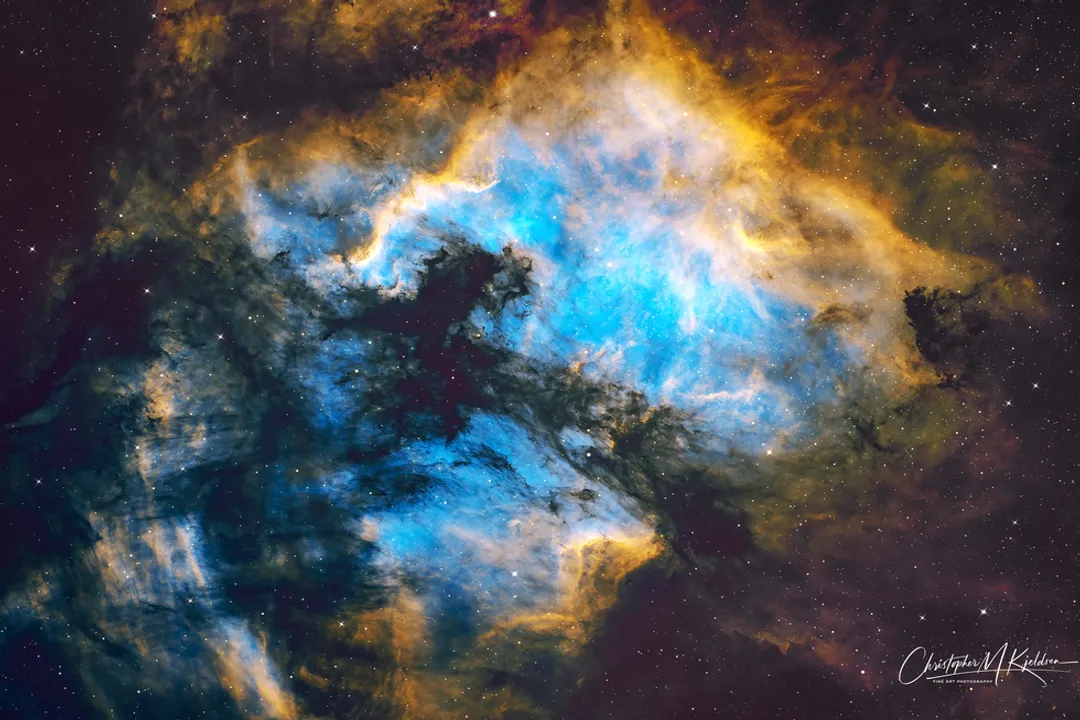
The North America Nebula, officially cataloged as NGC 7000, presents one of the great dichotomies in amateur astronomy. To the naked eye or through a small telescope, it can appear frustratingly faint, often leading observers to question if they are truly seeing the massive structure described in astronomical literature. [2][3] Yet, when captured by long-exposure cameras, this celestial cloud reveals stunning structures and vibrant color, justifying its inclusion in catalogs like the Caldwell 20. [1] Understanding how bright it is requires separating the concept of total light output from the crucial factor of surface brightness, which dictates its visibility to the human eye. [3]
# Celestial Geography
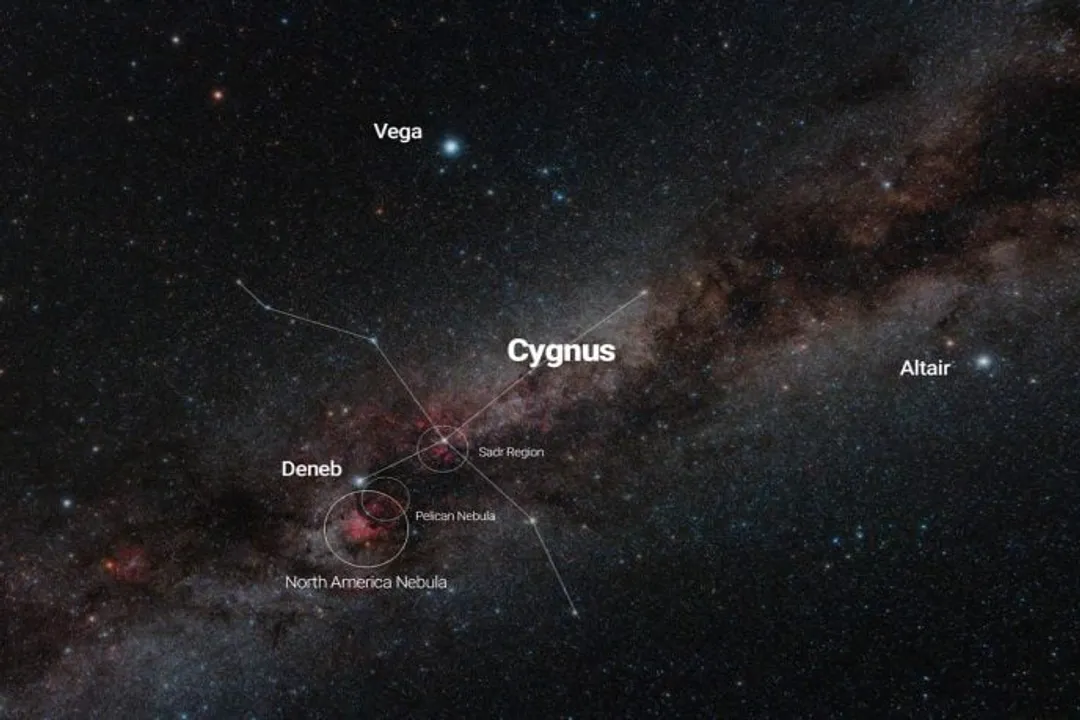
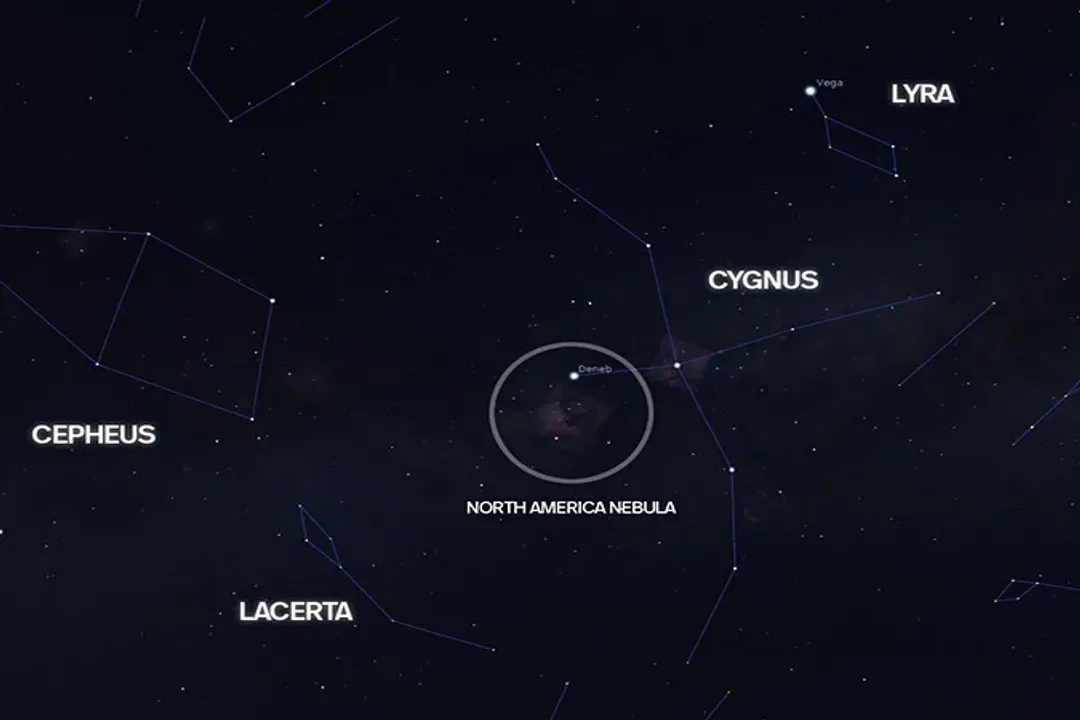
This sprawling emission nebula resides in the constellation Cygnus, the Swan. [1][7] It lies near the bright, blue-white star Deneb, which marks the tail of the swan. [1][7] While Deneb appears close, it is actually about 1,500 light-years away from us, and the nebula itself is generally thought to be around 2,000 light-years distant, meaning Deneb is not the primary source illuminating the nebula, though it plays a background role. [1]
One of the most striking facts about NGC 7000 is its sheer physical size. It spans approximately two degrees across the sky. [1] To put that into perspective, the apparent diameter of the full Moon is only about half a degree. [3] This means the North America Nebula is roughly four times the width of a full Moon, making it an exceptionally large object spanning a vast area of gas and dust in space. [1][3]
# Visual Perception
The integrated visual magnitude of the North America Nebula is listed around 4.0. [3] In astronomical terms, this suggests an object bright enough for easy viewing. However, this figure represents the total light collected from the entire area—a very large area—spread thin across the sky. [3] The critical factor here is surface brightness. Because its light is distributed over such a large angular extent, the light hitting your eye per square arcminute is incredibly low, rendering it faint and ghostly when viewed directly through an eyepiece. [2][3] Observers in dark, suburban, or city skies often report that it is underwhelming compared to objects with similar integrated magnitudes that are much more concentrated. [2]
When successfully located, the nebula might present as a faint, somewhat greenish-gray or slightly pinkish patch in a moderate telescope under dark conditions. [3] The famous dark lane, which gives the nebula its recognizable continental outline, appears as a distinct void in the brighter cloud background. [1]
# Optimal Seeing
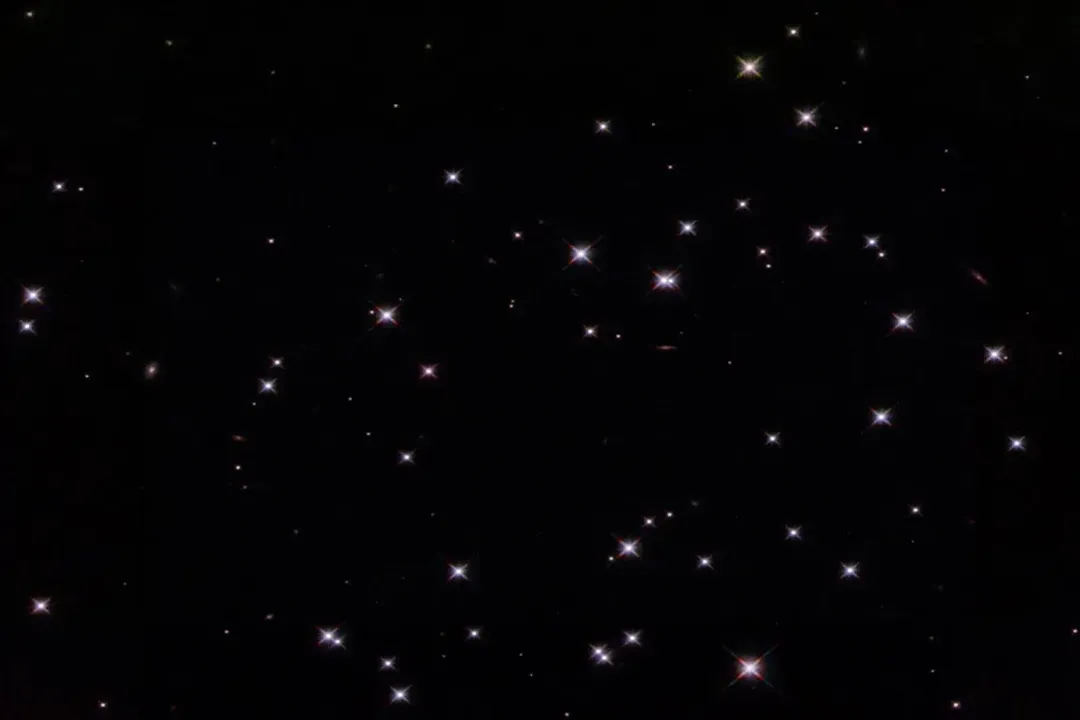
For the visual observer seeking to confirm the existence of NGC 7000, technique matters more than aperture, though darkness is paramount. [4] The location near Deneb helps in finding the general area in Cygnus. [7] In a small telescope, one might first need to locate the bright star Albireo or the area around the 6th-magnitude star 61 Cygni to orient oneself. [3]
Because the eye struggles to resolve faint light spread over a large area, using averted vision is highly recommended. [3] This technique involves looking slightly away from the object, allowing the light to strike the more light-sensitive rods on the periphery of the retina rather than the color-sensitive cones concentrated in the center of the field of view. This trick can often bring out the faint structure where direct gaze fails. [3]
The conditions of the sky itself dictate success. Light pollution severely washes out the low surface brightness of this object, making dark rural skies essential for a satisfying visual encounter. [3][4] Furthermore, the nebula is best observed during the late summer and early autumn months when it reaches its highest point in the sky for observers in the Northern Hemisphere. [3]
A practical approach for the novice aiming to spot this object is to start with the lowest magnification eyepiece available. A very wide field of view helps keep the entire sprawling structure in sight, preventing the observer from accidentally sweeping past the faint glow. Trying to observe it at high power is counterproductive when the main challenge is simply collecting enough photons across that large apparent area. [4]
# Photographic Revelation
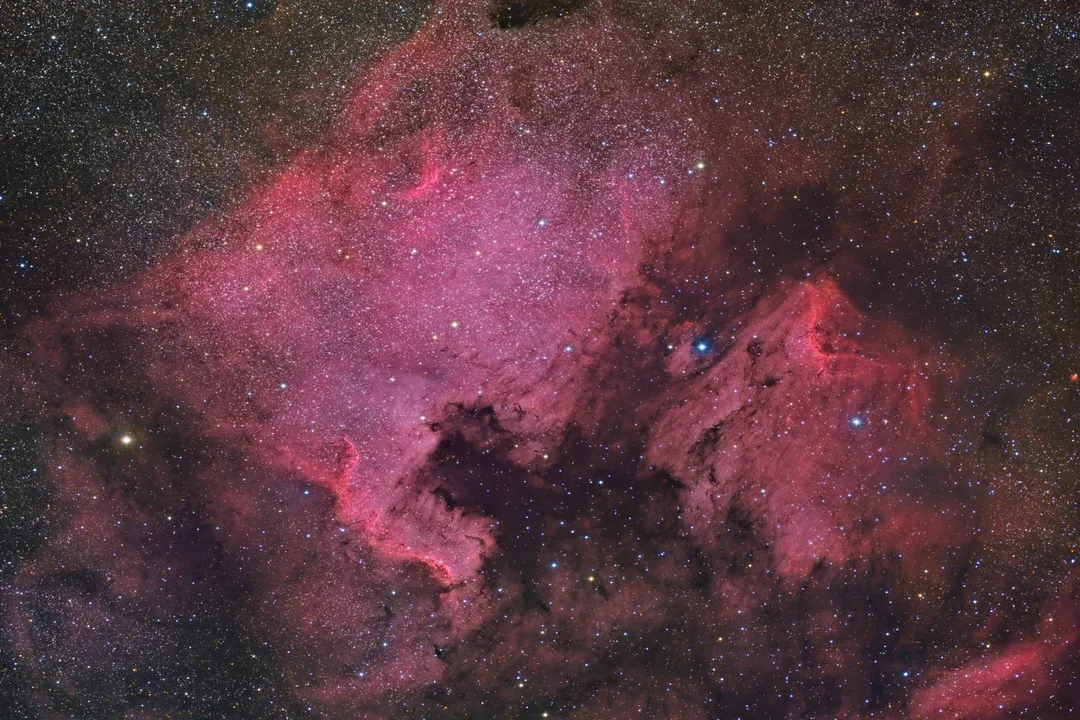
The true brilliance of the North America Nebula is unveiled through astrophotography, which allows for the accumulation of light over many minutes or hours. [5][8] When light pollution is managed and the camera shutter is left open, the nebula transforms from a faint smudge into a breathtaking celestial landmark. [1][8]
Hydrogen gas in the nebula glows intensely in the deep red part of the spectrum, specifically the Hydrogen-alpha () wavelength. [9] Standard cameras with appropriate filters, or specialized monochromatic cameras, capture this light exceptionally well. [9] Photographers often combine these images with data capturing the blue and green wavelengths to create the rich, colorful images seen online. [8][9] The dark dust lanes, which trace the coastlines and gulfs, stand in stark contrast to the glowing clouds. [1] The region known as the "Gulf of Mexico" is particularly well-defined by these dark molecular clouds that obscure the light behind them. [1]
# Ionization and Structure
Scientifically, NGC 7000 is classified as an region, meaning it is a cloud of ionized hydrogen gas where new stars are beginning to form. [1][6] The gas in this nebula is excited and made to glow by the intense ultraviolet radiation emanating from nearby hot, young stars. [1] These ionizing stars are likely located within the dense, dark dust cloud adjacent to the nebula, often referred to as the "Mexico" part of the shape. [1]
Technical studies have looked at the velocity structure and excitation properties of the gas. [6] Data collected on the and emissions indicate a complex structure, suggesting that the ionizing radiation penetrates unevenly through the cloud's material. [6] The presence of these emission lines confirms its status as an active stellar nursery, even if the ionizing source itself is obscured from direct visible light by the surrounding material. [1][6]
# Size Versus Light Density
When evaluating the brightness of NGC 7000, it is important to compare its characteristics with other well-known nebulae. Consider that the Orion Nebula (), a prime target for visual observers, has an integrated magnitude of about 4.0 as well. [3] If both nebulae share the same integrated magnitude, why is dazzlingly bright visually while NGC 7000 is nearly invisible?
The difference lies entirely in scale. is visually compact, roughly 1.3 degrees by 1.1 degrees, but it presents a concentrated source of light. [3] NGC 7000 covers an area four times larger across its longest dimension. [1] Mathematically, if we simplify the area difference dramatically: if one object has amount of light over area , and the second has amount of light over area , the surface brightness of the second object will be only one-quarter that of the first. [3] This explains why the North America Nebula demands a dark sky and averted vision, while is visible even from moderately light-polluted areas. [2] A visual observer must essentially "collect" the faint light of the entire North America Nebula across a field of view that is much wider than the typical Orion Nebula view, making the visual detection a triumph of technique over inherent luminosity. [3]
# Filters and Contrast
Since the primary visual obstacle is the low contrast against the background skyglow, specialized filters can sometimes aid in detection, even visually, though they are most famous for enhancing photography. [9] While the nebula glows primarily in (red), typical eyepiece views often rely on the fainter, scattered blue/green light perceived by the eye in low light. [3][9]
For visual use, a Hydrogen-Beta () filter is sometimes employed for certain planetary nebulae, but for large emission nebulae like NGC 7000, a narrowband filter is generally too restrictive for faint visual detection unless the observer has extremely dark skies and a very large aperture telescope. [9] The benefit of an filter in a visual context is that it sharply blocks out most light pollution frequencies (like mercury and sodium vapor lamps), allowing only the nebula's own emission to pass through, which can sometimes reveal the structure when everything else is blacked out. However, this technique demands an excellent dark site and a telescope capable of gathering significant light, otherwise, the narrow bandpass blocks too much light overall, making the object vanish entirely. [4]
When working with wide-field visual observation, remembering that the nebulosity is composed of ionized hydrogen atoms helps set the expectation for color if any subtle hue is perceived. If a slight pinkish tint does emerge using averted vision in pristine skies, it is the signature of that emission, distinct from the broader emission of oxygen or sulfur seen in other deep-sky objects. [9]
# Companionship in Cygnus
When observing NGC 7000, it is nearly impossible to ignore its famous neighbor, the Pelican Nebula (IC 5070/IC 5068). [8] The two objects are physically associated, lying only about 500 light-years from one another, making them part of the same massive star-forming complex within the Milky Way's Cygnus region. [8]
While the North America Nebula has the distinct shape recognized by its dark dust lanes, the Pelican Nebula is characterized by its own bright region and a dark, beak-like dust formation pointing toward the brighter gas. [8] Often, astrophotographers capture both nebulae in a single, sweeping wide-field image. [8] For the visual observer, locating one often aids in finding the other, as they occupy a relatively rich field in Cygnus. The Pelican often appears slightly brighter visually than NGC 7000 due to its more concentrated light structure, offering a slightly easier target for confirming the presence of this complex, but even the Pelican rewards the patient observer with enhanced views only under the darkest skies. [3]
# Synthesis of Surface Brightness Data
To better illustrate the viewing challenge, we can conceptualize the brightness data provided:
| Object | Integrated Visual Magnitude | Approximate Angular Size | Implication for Viewing |
|---|---|---|---|
| North America Nebula (NGC 7000) | Very low surface brightness, faint visually [1][3] | ||
| Orion Nebula () | High surface brightness, prominent visually [3] |
This comparison clarifies the central issue: an object's total light output (magnitude) only tells part of the story. The "brightness" you perceive is dictated by how densely packed that light is on your retina, a property that makes large, diffuse objects like NGC 7000 challenging to see visually despite their high total integrated magnitude. [3] Success here is a measure of one's ability to maximize contrast in very dark environments, rather than simply pointing a large telescope at a bright target. [4]
Related Questions
#Citations
Caldwell 20 - NASA Science
The North American Nebula is so underwhelming. : r/telescopes
101 Must-See Cosmic Objects: The North America Nebula
Photograph the North America Nebula - AstroBackyard
NGC 7000 The North America Nebula | Telescope Live
NGC 7000: the North America Nebula - NASA ADS
North America Nebula
Astrophotography: The North America & Pelican Nebulae
NGC7000, North America Nebula - Astrodoc - Ron Brecher