Despite sharing a similar integrated visual magnitude ($ ext{ extasciitilde}4.0$) with the Orion Nebula ($ ext{M}42$), why is NGC 7000 visually much fainter?
Answer
NGC 7000 is spread over a much larger angular extent
NGC 7000 covers an area roughly four times larger than $ ext{M}42$, meaning the same total amount of light is distributed over a much greater area, drastically reducing surface brightness.
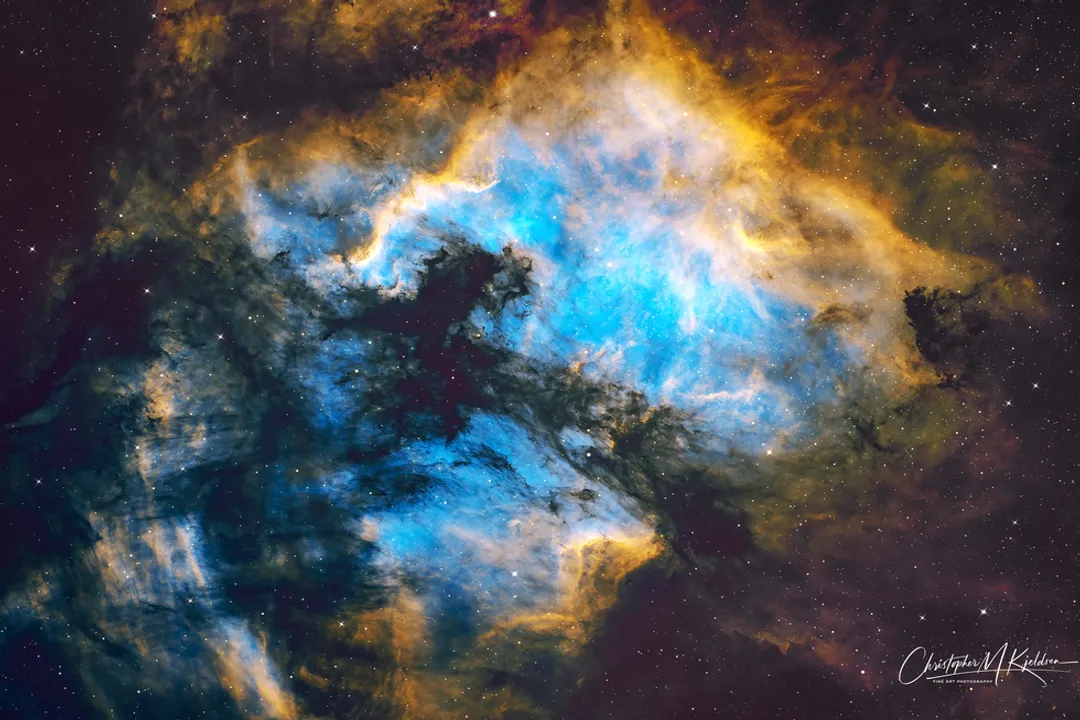
Related Questions
In which constellation is the North America Nebula (NGC 7000) primarily located?How many times wider is the apparent diameter of NGC 7000 compared to the full Moon?What critical factor makes the North America Nebula appear faint to the naked eye despite having a total visual magnitude of 4.0?What visual observation technique is highly recommended to help see the faint structure of NGC 7000?Scientifically, what type of celestial object is NGC 7000 classified as?Which specific wavelength does the hydrogen gas in the nebula glow intensely in, often targeted by astrophotographers?Despite sharing a similar integrated visual magnitude ($ ext{ extasciitilde}4.0$) with the Orion Nebula ($ ext{M}42$), why is NGC 7000 visually much fainter?What famous nebula shares the same massive star-forming complex as NGC 7000?Where are the hot, young stars believed to be ionizing the gas in NGC 7000 located?What condition is paramount for a successful visual encounter with the low surface brightness of NGC 7000?When first attempting to locate NGC 7000 with a small telescope, which magnification approach is suggested?