Is the North Star stationary?

The star we call the North Star, Polaris, appears utterly fixed in the night sky for observers in the Northern Hemisphere. While gazing up, it seems like a singular, unmoving beacon, providing a reliable reference point in a universe of celestial motion. This steadfast appearance is one of the most fundamental concepts in naked-eye astronomy, yet it relies on a unique alignment with our planet’s rotation, rather than the star actually being motionless in space. [1][2] To truly understand why Polaris seems stationary, we must first acknowledge that every star in the sky is moving; the magic lies in our perspective from Earth. [1][4]
# Celestial Center
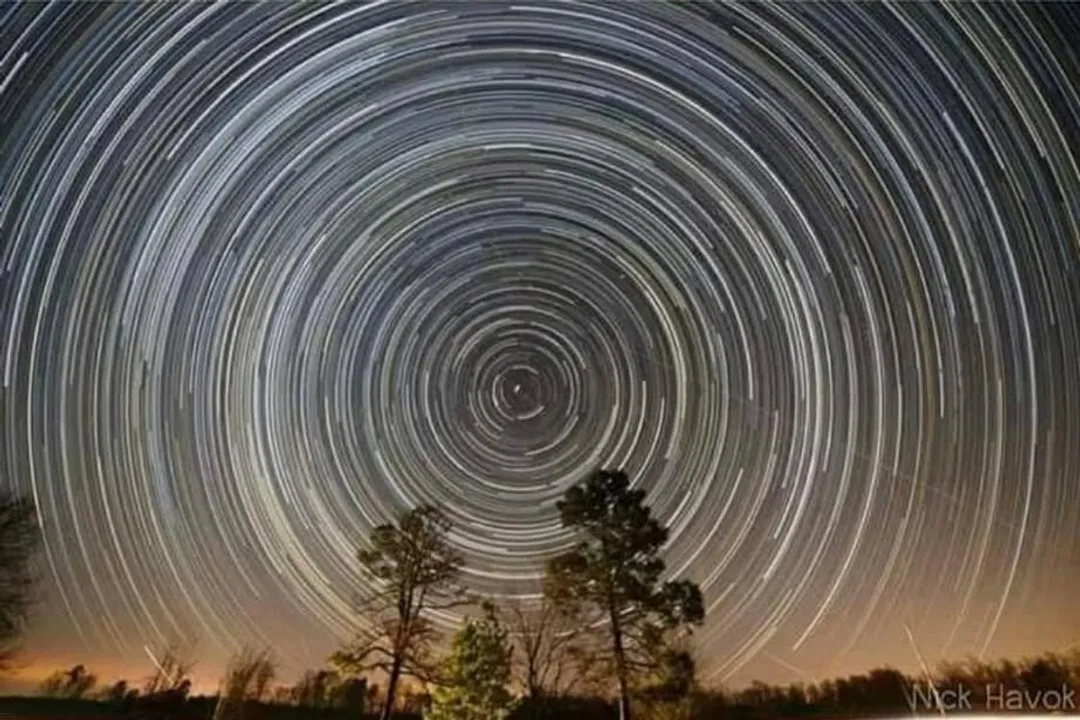
The concept that Polaris remains in the same spot, while other stars appear to wheel overhead, stems directly from the mechanics of our solar system and how we observe it. [1][7] The apparent movement of the night sky is not due to the stars moving around us, but rather due to the Earth itself spinning on its axis, much like a top. [1][2] This rotation happens constantly, completing one full turn roughly every twenty-four hours. [2]
When you stand still and watch the sky over several hours, you are witnessing the result of your own planet turning beneath you. [1] Because of this rotation, the entire celestial sphere—the imaginary dome covering the Earth upon which all the stars seem to be affixed—appears to rotate around an imaginary line passing through the Earth’s geographical poles. [2][10] This imaginary line defines the North Celestial Pole (NCP) in the north and the South Celestial Pole in the south. [2]
Imagine throwing a ball into the air while spinning around slowly; the ball would trace a circle relative to your body, but the center of that circle remains fixed relative to your spin axis. [1] In this analogy, the Earth’s axis of rotation is the axis of the spin, and the distant stars are the ball. [1]
# Perfect Position
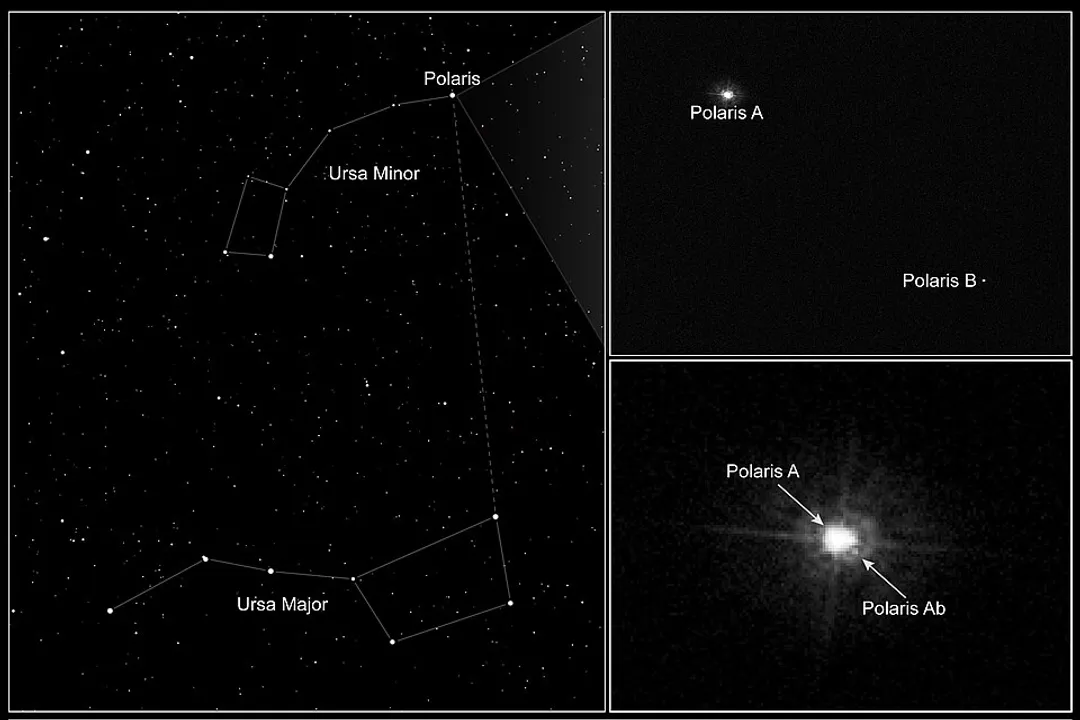
The reason Polaris earns the title of North Star is simple geometry: it happens to be situated almost precisely along the line of the Earth’s rotational axis projected outward into space. [5][7][10] It is exceptionally close to the North Celestial Pole. [5] Because its position aligns so closely with the point around which the entire northern sky appears to pivot, Polaris appears to remain virtually in place while everything else seems to sweep in arcs around it. [1][4]
Contrast this with most other stars. A star situated far away from the celestial pole, such as those in the constellation Orion, traces a wide circle across the sky during the night as the Earth turns. [2] Stars near the celestial equator, if visible, would appear to rise almost due east and set almost due west. The closer a star is to the NCP, the smaller the circle it traces. [2] Polaris is simply the closest visible star to that central point. [5][7]
It is interesting to note that the Southern Celestial Pole does not have a bright star marking its location. Navigators in the Southern Hemisphere must use other asterisms, like the Southern Cross, to approximate the South Celestial Pole, which lacks a convenient, bright marker like Polaris. [2]

# Slight Wiggle

While we say Polaris appears stationary, that is a generalization based on naked-eye observation over a few hours. [2] In reality, Polaris is not perfectly aligned with the North Celestial Pole. [9] It drifts a small amount as the Earth rotates, tracing a very small circle in the sky, taking approximately 24 hours to complete that circuit. [2][9]
The star is actually about 0.7 degrees away from the true NCP. [9][5] For context, the apparent width of the full Moon in the sky is about half a degree. [9] This means that over the course of an evening, Polaris will shift slightly, tracing a tiny circle barely larger than the diameter of the Moon, before returning to its starting point the next night. [2][9] Furthermore, Polaris is not a truly single star; it is part of a multiple-star system, which adds another layer of minute movement known as proper motion, though this is negligible compared to its rotational drift. [7] When observing Polaris through a telescope or high-powered binoculars, this small circle of movement becomes apparent over a few hours, unlike other stars which appear to move along much larger arcs. [4]
To put this near-stillness into perspective, consider a bright star like Sirius in Canis Major. If you observe Sirius for four hours during a winter night, it will have traveled a significant arc across the sky, visibly changing its altitude and azimuth significantly from your fixed viewpoint. Polaris, on the other hand, will have only moved a fraction of that distance, remaining stubbornly close to its initial location. [1] This relative stability is what makes it such a profound navigational tool—its motion is the baseline against which all other celestial movement is measured. [5]
# Ancient Guidance
The consistent position of Polaris relative to the North Pole has given it enormous historical significance as a navigational constant. [5] For sailors and travelers navigating the Northern Hemisphere for centuries, knowing where Polaris was meant knowing the direction of true north. [7] Before the advent of GPS and modern electronic navigation, this celestial marker was indispensable for maintaining a consistent course when land was not visible. [5]
If a person standing at the North Pole were to look straight up, Polaris would be directly overhead, at the zenith. [7] As one travels south toward the equator, Polaris sinks lower and lower toward the northern horizon. [7] Once a traveler crosses the equator into the Southern Hemisphere, Polaris drops below the horizon entirely, becoming invisible. [7] This relationship—the star’s altitude above the horizon equaling the observer’s latitude—forms the basis of celestial navigation in the north. [7]
# Epoch Shift
The Earth’s axis, while appearing fixed in the short term, does not point to the same star forever. [10] This is due to a slow, majestic wobble in the Earth's orientation called the precession of the equinoxes. [10] This wobble is caused by the gravitational pull of the Sun and Moon tugging on the Earth’s equatorial bulge, similar to how a slightly off-balance spinning top wobbles. [10]
This wobble takes a vast amount of time to complete one full cycle, roughly 26,000 years. [10] Because the celestial pole is defined by the Earth’s axis, the celestial pole itself slowly traces a gigantic circle in the sky over that period. [10] Consequently, the star closest to the pole changes over the ages. [10] Around 3000 years ago, the star Thuban in the constellation Draco was the North Star. [10] Looking far into the future, in about 12,000 years, the star Vega will be the closest bright star to the North Celestial Pole. [10] Polaris is merely the current occupant of this privileged celestial address. [5]
# Fixing Location
Finding Polaris is straightforward once you understand how to use the "pointer stars" in the Big Dipper, which is part of Ursa Major. [5][7] The Big Dipper is one of the most recognizable asterisms in the sky, making it an excellent starting point. [7]
To find it, you simply need to locate the Big Dipper: [5][7]
- Identify the seven bright stars that form the familiar "scoop" shape. [7]
- Focus on the two stars that form the outer edge of the bowl, opposite the handle—Merak and Dubhe. [5] These are often called the "Pointers". [7]
- Draw an imaginary line connecting these two stars and extend that line outward, away from the bowl. [5][7]
- Follow that line roughly five times the distance between the two pointer stars. [5]
- The first relatively bright star you encounter along that line is Polaris. [5][7]
Polaris is the brightest star in the constellation Ursa Minor, the Little Bear, whose tail end it marks. [5][7] The entire Little Dipper asterism, of which Polaris is the end of the handle, appears to rotate around the North Celestial Pole, but Polaris itself barely moves during the rotation. [5]
When utilizing this ancient guidance system in a modern context, think about the stability it offers as a fixed reference point for calibrating sensitive modern instruments, such as long-range terrestrial radio antennas or even some types of scientific survey equipment, where maintaining a precise alignment to the Earth’s rotational axis is key, even when digital references are available. The star provides a physical, observable confirmation of "true north" that is independent of magnetic fields or localized electronic interference. [7] It is a constant against which we can check our modern, high-tech readings. If your GPS heading deviates significantly, you can step outside and confirm the direction of Polaris to see if your local magnetic compass or inertial navigation system has a local error source, acting as an invaluable, time-tested cross-check. [5]
#Videos
Why is the North Star Always in the Same Place? - YouTube
Related Questions
#Citations
ELI5: Why does the north star appear stationary? - Reddit
Does the North Star ever move in the sky? - EarthSky
Why is the North Star Always in the Same Place? - YouTube
Why does Polaris, the North Star, seem to not move at all ... - Quora
What is the North Star and How Do You Find It? - NASA Science
How is it that the North star is stationary? - Facebook
What keeps the North Star stuck at exactly North?
The North Star | Polaris Facts, Location, and How to Find It
Polaris - Wikipedia
Why does the north star always point north? - PhysLink.com