Is the North Star stationery?
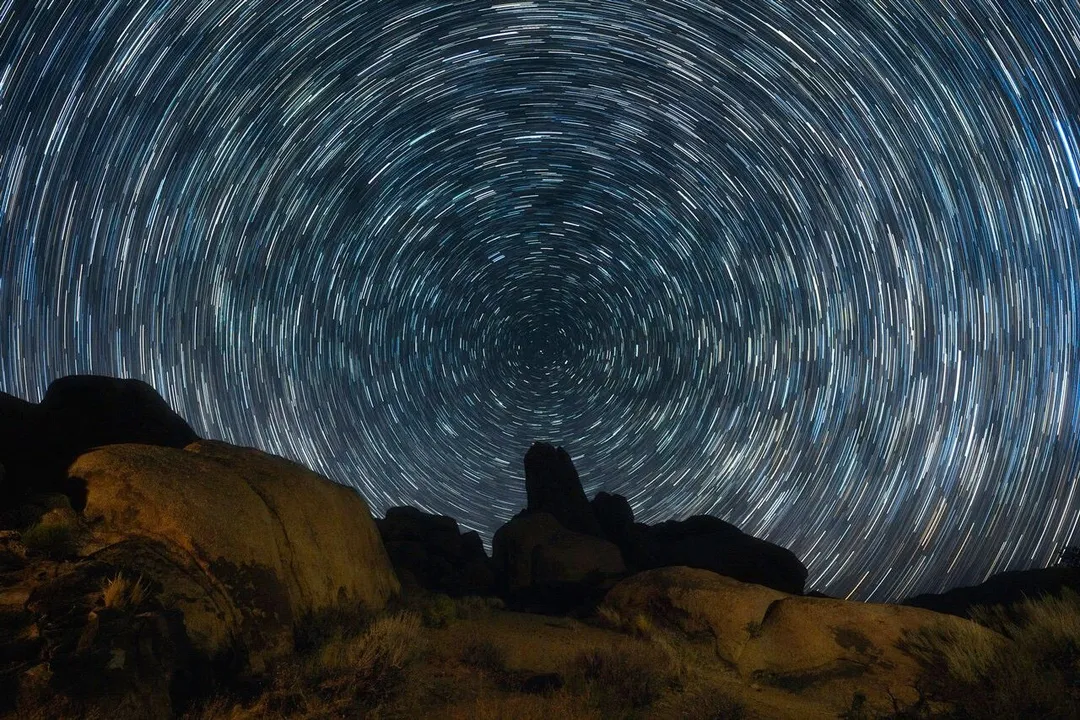
The star we call the North Star, formally known as Polaris, is often assumed to be fixed in the night sky, an unmoving beacon against which all other celestial bodies seem to wheel. While this perception is central to its fame and historical importance for navigation, the idea that Polaris is absolutely "stationary" is an approximation that requires careful definition. In reality, its position is relative to the Earth’s rotation, the tiny wobble of our planet’s axis, and its own motion through space. [6][1]
# Apparent Fixity
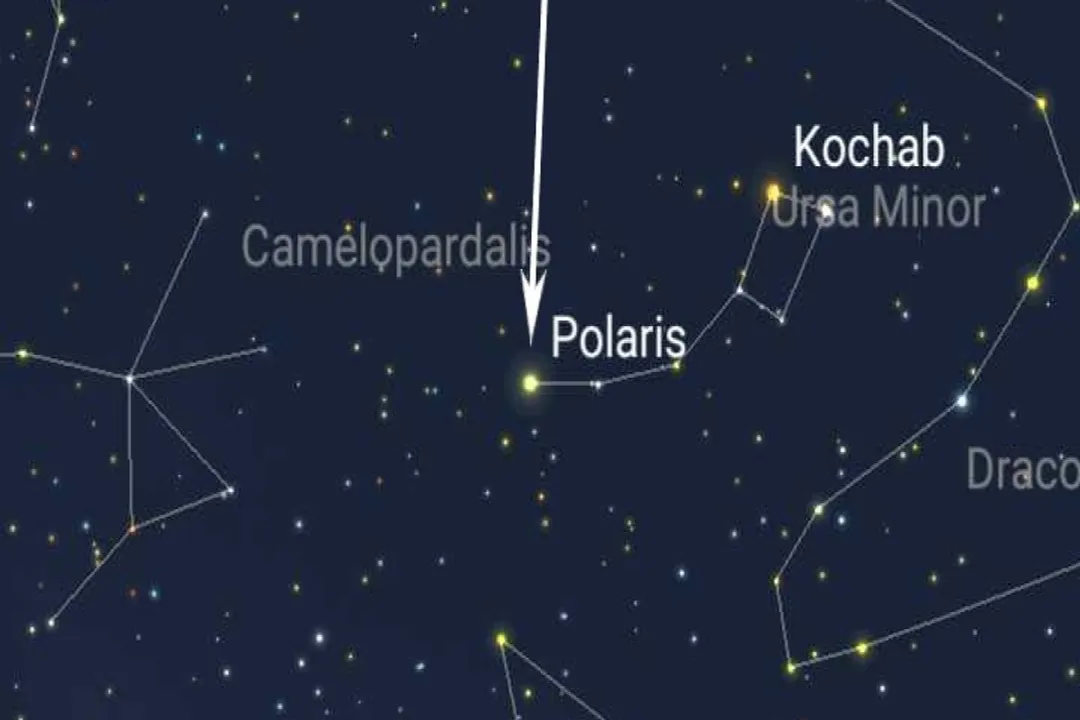
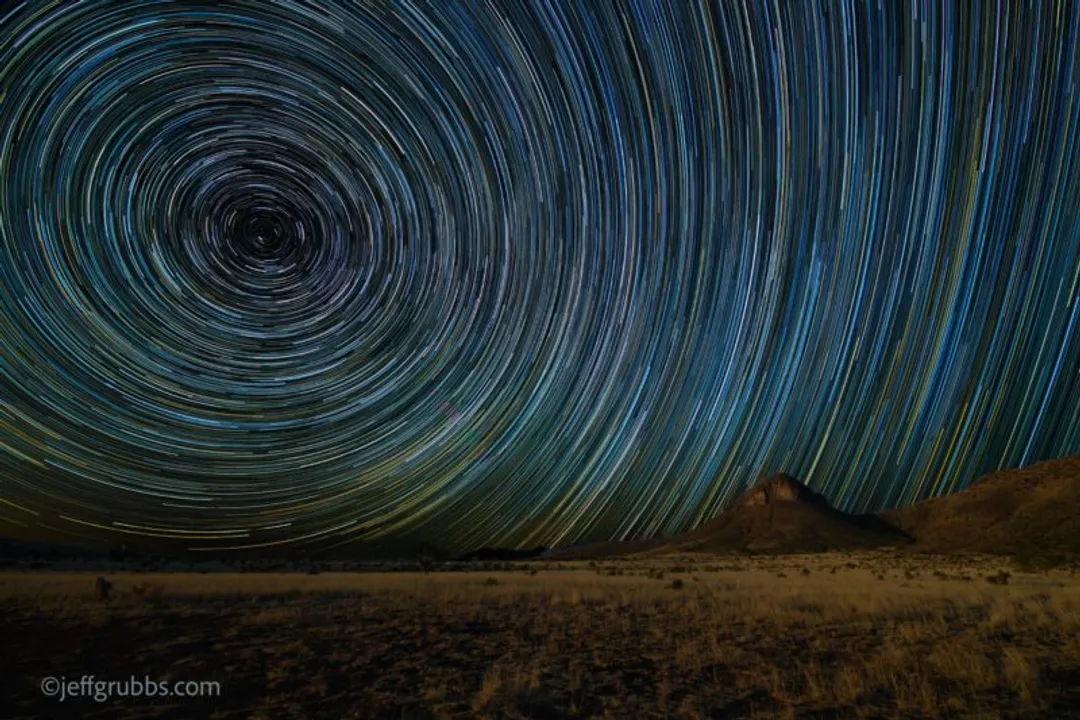
Polaris holds its honored place because it is currently situated less than one degree away from the north celestial pole. [1] This celestial pole is the imaginary point in the sky directly above the Earth’s geographic North Pole. As our planet spins on its axis over the course of a night, nearly every other star appears to trace out a circular path around this central, almost fixed, point. [3][6]
The reason Polaris seems stationary is directly tied to this rotational dynamic. Stars farther away from the pole traverse large arcs, but because Polaris sits so very close to the axis of rotation—the hub of this cosmic wheel—it traces only a very small circle in the sky over 24 hours. [3][5] This makes it an invaluable signpost for determining true north, a role it has held for navigators and observers for several centuries. [1][3]
# Earth's Spin
To be truly stationary, a star would need to be exactly aligned with the Earth's rotational axis. Polaris is not perfectly there. It is offset by approximately (or 39.6 arcminutes) from the rotational pole as of recent observations. [1][6] This slight offset means that, rather than being a single fixed point, Polaris executes its own tiny, daily orbit around the celestial north pole. [6]
This daily revolution results in a daily circle approximately in diameter. [6] While this circle is minute compared to the vastness of the sky, an attentive observer or a camera using a long exposure will capture this movement. In the northern hemisphere, if you observe Polaris over several hours, you will see the star drift in a very small, tight circle rather than remaining precisely at one coordinate. [6] This small circle of apparent motion is expected to shrink further; in about a century, around the year 2100, Polaris will be at its closest proximity to the pole, tracing an even tighter arc of about in diameter. [1][6]
# Precession Cycle
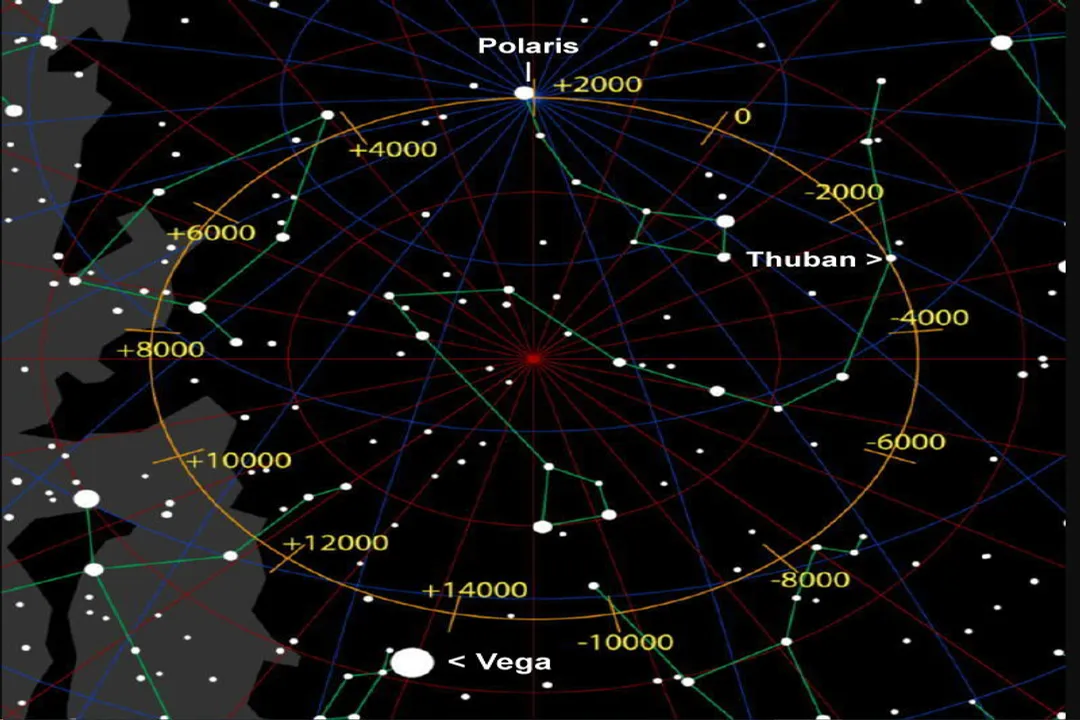
The concept of a North Star is fluid over vast stretches of time, dictated by a phenomenon known as precession. This is the slow, stately wobble of the Earth’s axis, much like a spinning top slowing down. [3][5] This wobble causes the apparent location of the celestial pole to wander in a massive circle across the sky over approximately 26,000 years. [1][3]
Thousands of years ago, during the time of the Egyptian pyramids, the pole star was a dimmer star called Thuban (Alpha Draconis). [1][5] Polaris only approached the celestial pole in the medieval period, becoming the primary navigational star around the High Middle Ages. [1] Looking into the deep future, this title will pass to other stars. In about 12,000 years, the bright, blue-white star Vega in the constellation Lyra will take over the role as the North Star. [3][5] Thus, Polaris is only the North Star for now; its claim is temporary on a cosmic timeline. [1]
It is worth noting that ancient Greek navigators, like Pytheas around 320 BCE, described the celestial pole as essentially starless, indicating that Polaris was not as prominently placed then as it is now. [1] The fact that we have a bright star so near the pole right now is largely a cosmic coincidence of timing within the precession cycle. [5]
# Polaris System
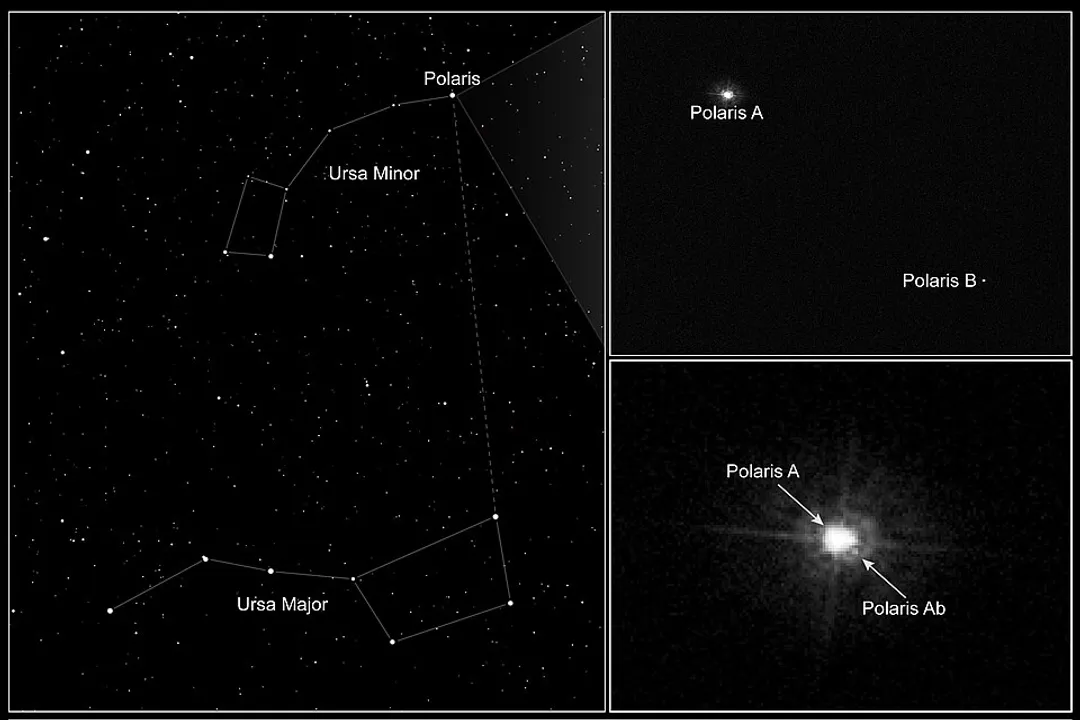
When we refer to the North Star, we are looking at a single point of light, but Polaris is actually a complex triple star system. [4][1] The system consists of the primary star, Polaris A (specifically Polaris Aa), which is a yellow supergiant. [1][4] Orbiting this giant closely is a companion, Polaris Ab, which is a smaller main-sequence star. [1][4] Further out, in a much wider orbit, is the third component, Polaris B, another main-sequence star discovered by William Herschel in 1779. [1]
The primary star, Polaris Aa, is scientifically fascinating because it is the nearest classical Cepheid variable star to Earth. [1][4] Cepheids are crucial for measuring cosmic distances, serving as "standard candles" in the cosmic distance ladder. [1] Polaris’s variability—its subtle fluctuation in brightness over a period of about four days—is studied intensely because its known characteristics help calibrate those distance measurements. [1][4] Astronomers have observed that the amplitude of its brightness variation has been decreasing, then unexpectedly increasing again, a behavior considered peculiar compared to other Cepheids. [1][4] Determining the accurate mass of Polaris Aa by observing the orbital motion of its close companion, Polaris Ab (which has an orbital period around 30 years), is a major goal for modern astrophysics. [1][4]
# Navigational Aid
The primary reason for the North Star's lasting fame is its unwavering utility for finding direction in the Northern Hemisphere. [3][5] For anyone without a compass, or even for those calibrating magnetic compasses, Polaris offers a true geographic reference. [3][4]
A simple technique involves locating the Big Dipper asterism within the constellation Ursa Major. [3][4] You find the two stars that form the outer edge of the Dipper’s "cup"—Merak and Dubhe—and draw an imaginary line through them, extending it about five times the distance between those two stars. [3][4] The bright star you encounter at the end of that line is Polaris, marking the end of the handle of the Little Dipper (Ursa Minor). [3][4]
Beyond direction, the star’s height in the sky corresponds directly to the observer’s latitude. [6] If you are standing at North latitude, Polaris will appear above the northern horizon. Travel $690$ miles north, and its elevation will increase by roughly . [6] This relationship was indispensable for maritime navigation for centuries. [1][6]
# Not Brightest
A common misconception about Polaris is that it ranks as the brightest star in the night sky. This is simply not the case. [4] While it is the brightest star in the constellation Ursa Minor, it is only the 49th brightest star visible overall, with an apparent magnitude fluctuating around $1.98$. [1][4] Stars like Sirius or Canopus outshine it dramatically. [1]
Its fame has nothing to do with brilliance and everything to do with its unique celestial address. Furthermore, the title of "North Star" itself is not permanently attached to Polaris; it is a role that shifts over the millennia due to axial precession. [5][1]
To put the fleeting nature of its current fixed appearance into perspective, consider that if you were observing the sky from the Southern Hemisphere, you would not have a comparable, bright guide star marking the South Celestial Pole. [3] Observers there rely on the Southern Cross constellation to orient themselves toward South. [3] This highlights that the "stationarity" of the North Star is a strictly Northern Hemisphere phenomenon, dependent on that specific alignment with the Earth's wobble, not an inherent quality of Polaris itself in isolation. [4] Even the star's minor proper motion—its actual drift through space due to its movement within the Milky Way—is too small to be noticeable in a human lifetime, reinforcing its practical constancy over decades. [6] However, understanding that the sky is a dynamic place, where even the most reliable anchor is merely passing through a celestial office, adds a humbling layer to stargazing. For those setting up precision equipment, knowing that the star is moving in a small circle daily means that for exact polar alignment, modern tools are required to find the true pole rather than relying solely on Polaris's visible position. [4]
#Videos
Why is the North Star Always in the Same Place? - YouTube
Related Questions
#Citations
Polaris - Wikipedia
Why is the North Star Always in the Same Place? - YouTube
What is the North Star and How Do You Find It? - NASA Science
The North Star | Polaris Facts, Location, and How to Find It
Polaris: AKA The North Star | Utah Public Radio
Does the North Star ever move in the sky? - EarthSky