What is the order of classification of stars from hottest to coldest?
The way astronomers sort the billions of stars visible in the night sky relies fundamentally on one key physical property: surface temperature. [1][4] This ordering, known as stellar classification, is not arbitrary but follows a well-established sequence determined by the star's spectral characteristics, which are a direct readout of how hot its outer layers are. [4][8] If you are looking to arrange stars from the searingly hot down to the comparatively cool, you are looking for the spectral type sequence: O, B, A, F, G, K, M. [1][3][8]
This sequence represents the descending order of temperature, making the O-type stars the hottest, and the M-type stars the coolest among the main stellar classes. [1][4] Astronomers commonly use a simple mnemonic device to recall this order: Oh Be A Fine Girl/Guy, Kiss Me. [1][4] While the sequence seems straightforward, understanding what drives this classification reveals much about stellar physics and evolution. [2][8]
# Hottest Stars

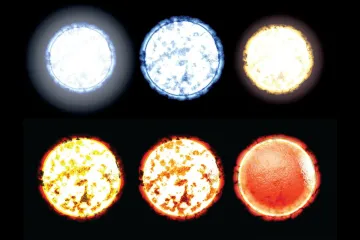
The spectral class O defines the extreme upper end of the temperature scale. [1][4] These stars boast surface temperatures exceeding $30,000$ Kelvin () and are incredibly rare because of their short lifespans. [1][4] Because they are so hot, they emit prodigious amounts of energy, primarily in the ultraviolet portion of the spectrum, which causes them to glow a brilliant blue or blue-white. [3] They are massive and luminous, burning through their fuel supply rapidly. [4]
Following O stars are the B type stars, which are still very hot, with surface temperatures generally ranging between and . [1][4] These stars often appear blue-white to white. [3] The spectral lines in O and B stars show significant ionization of helium, a signature of their extreme heat. [8]
# White Stars
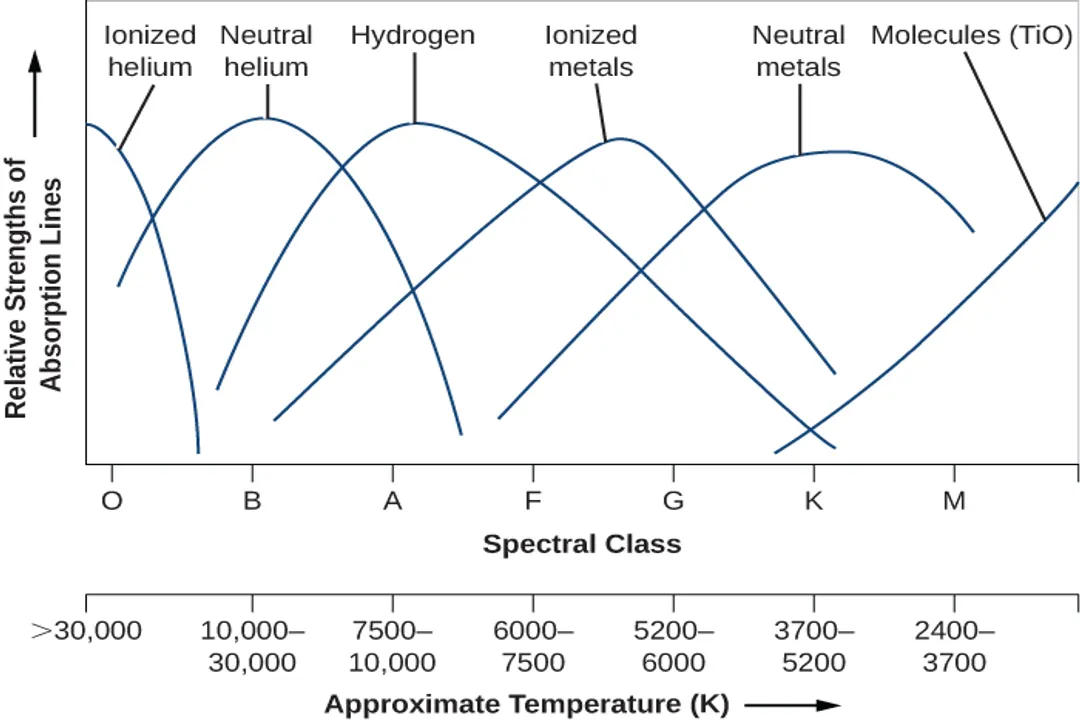
The middle ground of the sequence is occupied by A type stars. [1][4] These stars typically have temperatures between and and appear distinctly white. [1][3] A key characteristic of A-type stars is the prominence of their hydrogen spectral lines, which reach peak strength in this temperature range. [8] Our own Sun, for context, is significantly cooler than an A-type star.
Next come the F type stars, which bridge the gap between the hot, white stars and the warmer, yellow stars. [1][4] Their temperatures fall between and , and they typically exhibit a yellowish-white hue. [3] In the spectra of F stars, the hydrogen lines are beginning to weaken, but the lines of ionized metals, such as calcium and iron, are becoming more prominent. [8]
# Yellow and Orange
The G spectral class is perhaps the most familiar, as it includes our Sun, which is classified as a G2 star. [1][4] G-type stars have surface temperatures in the range of to and appear yellow. [1][3] The G-class spectra are characterized by strong lines of ionized calcium, alongside many neutral metal lines. [8]
Moving down the temperature scale, we reach the K stars, which are noticeably orange. [3] These are cooler, ranging from about to . [1][4] In K-type stars, molecular lines begin to appear, but metal lines remain dominant over hydrogen lines. [8]
# Coolest Stars
The coolest stars in the standard sequence belong to the M spectral class. [1][4] These are the most common type of star in the Milky Way galaxy. [3] They have surface temperatures below and glow deep red. [1][3] The spectra of M stars are dominated by molecular absorption bands, particularly titanium oxide (), which signifies the lower temperatures allow complex molecules to form in the atmosphere. [4][8]
It is interesting to consider that while the hottest O stars might shine millions of times brighter than the Sun, the cool, abundant M-dwarfs are typically faint red dwarfs that emit far less energy. [4][5] This disparity highlights that classification by temperature doesn't automatically imply classification by luminosity, though the two are often related, especially for Main Sequence stars. [2]
To better visualize this temperature-based ordering, here is a summary table aligning the spectral class with its approximate temperature range and associated color:
| Spectral Class | Approximate Temp. () | Dominant Color | Example Feature |
|---|---|---|---|
| O | $>30,000$ | Blue | Ionized Helium |
| B | $10,000 - 30,000$ | Blue-White | Neutral Helium |
| A | $7,500 - 10,000$ | White | Strongest Hydrogen Lines |
| F | $6,000 - 7,500$ | Yellow-White | Weakening Hydrogen, Ionized Metals |
| G | $5,200 - 6,000$ | Yellow | Strong Ionized Calcium () |
| K | $3,700 - 5,200$ | Orange | Neutral Metal Lines |
| M | $<3,700$ | Red | Molecular Bands () |
| [1][4] |

# Fine Tuning Classes
The sequence O, B, A, F, G, K, M is just the backbone. [1] To achieve finer distinctions within the temperature ordering, each letter designation is further subdivided using a numerical scale from $0$ to $9$. [1][4] A lower number indicates a hotter star within that letter group, meaning a G0 star is hotter than a G5 star, which is in turn hotter than a G9 star. [4] Therefore, the absolute hottest stars are O0, and the coolest in the main sequence are M9. [1] This decade-long subdivision provides $70$ distinct bins for classification based purely on temperature and spectral line strength. [1]
If we consider the extended system that includes the very coolest objects, we also see classes L, T, and Y added below M. These classes represent objects cooler than traditional M-type stars—brown dwarfs—whose atmospheres are cool enough to show evidence of alkali metals and even methane ice. [1] While these are often grouped with stars, their physics starts to overlap with that of giant planets, yet they still technically follow the temperature order established by the visible stars. [1]
# Context Beyond Temperature
While the OBAFGKM sequence dictates the order from hottest to coldest, it is crucial to remember that astronomers use a multi-dimensional classification scheme. [1][4] The Yerkes luminosity classification system adds a second crucial piece of information: the star's size or luminosity class, designated by Roman numerals ( through for main sequence). [1][4]
A star’s position on the Hertzsprung-Russell () diagram places it on a diagonal main sequence based on its mass, luminosity, and temperature. [2] If we were simply classifying by mass, the order would be nearly the same as temperature, as more massive stars burn hotter and faster. [5] However, a Red Giant star ( spectral type, Luminosity Class ) can be far larger and more luminous than a Main Sequence star ( spectral type, Luminosity Class ), even though the Giant has a much lower surface temperature. [2] The key point remains that the spectral sequence OBAFGKM always dictates the relationship between surface temperature and spectral line strength. [4]
One insightful realization when looking at this sequence is how much of the observable universe's stellar census is concentrated at the cooler end. O and B stars are rare and short-lived, sometimes lasting only a few million years before exploding or collapsing. [4] In contrast, the abundance of K and M stars means that if we were surveying a random volume of space, we would overwhelmingly find objects whose surface temperatures sit below . [3] This implies that the most common environments capable of supporting liquid water on orbiting planets—those around K and M dwarfs—are fundamentally different from the environment around our G-type Sun, offering a constant reminder that "average" in stellar terms means "cool and dim". [5]
The very foundation of this classification system lies in spectroscopy—analyzing the specific pattern of light absorbed or emitted by the star's atmosphere. [4][8] When Annie Jump Cannon formalized this system at Harvard in the early 1900s, she was essentially organizing the stars based on the visibility and strength of hydrogen lines, which turned out to be a perfect proxy for surface temperature. [8] Early attempts at classification sometimes used alphabetical order based on the strength of the 'A' line, which led to the initial, jumbled sequence (A, B, C, D...). [4] It was only later, when the physical connection to heat was understood, that the sequence was reorganized into the temperature-ordered OBAFGKM system we use today. [4][8] This transition from an empirical visual ordering to a physics-based spectral ordering represents a major step in astronomical expertise, moving classification from mere appearance to measurable physical properties. [4]
Related Questions
#Citations
Stellar classification - Wikipedia
HR Diagram
Star Types - NASA Science
Star - Spectral Types, Classification, Astronomy | Britannica
Stellar Astronomy: Part 3 – Classes and the Main Sequence
Types of Stars - Las Cumbres Observatory
Star classification - Astrophysical.org - Istituto Scientia
11.2 Classification by Spectra – Fanshawe College Astronomy
Classifying Stars By Colour: Hertzsprung-Russell Diagram