What stars have the hottest temperature?

The visual appearance of a star offers the quickest clue to its relative heat. If you look up on a clear night, the reddest stars are invariably the coolest in the stellar population, while the intensely bright, dazzlingly blue-white objects are the ones burning at the highest possible surface temperatures. [4] This relationship between color and temperature is fundamental to astrophysics, governed by the principles of blackbody radiation; the hotter an object gets, the shorter the wavelength of light it emits most strongly. [4] Consequently, the stars topping the cosmic temperature charts radiate overwhelmingly in the blue and ultraviolet portions of the spectrum. [4]
# Color Heat Link
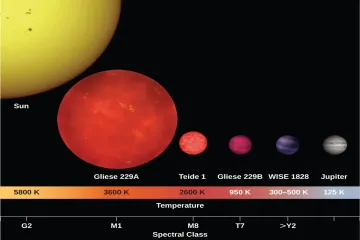
When astronomers discuss stellar temperature, they usually refer to the effective surface temperature, the temperature of the visible photosphere from which most light escapes. [1] This measurement dictates the star's spectral classification. Cooler stars, often less than 3,500 Kelvin (K), appear red, classifying them as M-type stars. [4] Moving up the scale, our Sun, a G-type star, sits at about 5,800 K and appears yellow-white. [4] Once you pass the 10,000 K mark, stars become distinctly blue-white, belonging to the B-class or hotter. [4] The hottest known stars, however, push well past 40,000 K, radiating such intense energy that their color is a blinding, pure blue. [1][8]
# Temperature Limits

Determining the absolute hottest star is tricky because it depends on whether we are looking for the hottest stable star or the hottest star detected in any phase of its life, which might be extremely short-lived or already evolved. [5] In general, stellar fusion processes place a practical ceiling on sustained surface temperatures in the range of about 100,000 K. [5] While some theoretical models might suggest slightly higher temperatures are possible for very brief moments, the observed distribution of stars shows a significant drop-off around this figure. [5] Conversely, the lower limit for true stars powered by hydrogen fusion is much lower, hovering around 2,500 K to 3,000 K. [5]
A useful mental check for readers is to realize that the typical temperature difference between a G-type star like our Sun (around 5,800 K) and the hottest known stars (often exceeding 50,000 K) is an order of magnitude difference in energy output, not just a slight adjustment. [4] The sheer amount of energy being generated per square meter on the surface of the hottest contenders is staggering.
# Hottest Classes

The overwhelming majority of the most incandescent stars fall into two primary spectral categories: the O-type stars and the Wolf-Rayet (WR) stars. [1][9]
# O-Type Stars
O-type stars are the largest, most massive, and hottest stars found on the main sequence, where they spend the hydrogen-burning phase of their lives. [9] These stellar behemoths can have masses up to 100 times that of the Sun and surface temperatures easily exceeding 30,000 K, often reaching 40,000 K or 50,000 K. [1][9] Because they burn through their nuclear fuel so quickly, they have incredibly short lifespans, sometimes lasting only a few million years. [9] Their brilliance is extreme, with some being a million times more luminous than the Sun. [9]
# Wolf-Rayet Stars
If O-type stars are the reigning champions of the main sequence, Wolf-Rayet stars are the undisputed heavyweights of stellar death throes, and thus, often the hottest measured objects in the galaxy. [2] WR stars are evolved, massive stars that have already exhausted the hydrogen fuel in their cores and have shed their cooler outer layers through powerful stellar winds. [1][2] By stripping away the outer hydrogen envelope, they expose the ultra-hot helium-fusing or even heavier element-fusing core material. [2] This exposed core radiates immense energy, pushing surface temperatures significantly higher than those of stable O-stars, frequently recording values above 50,000 K and sometimes even reaching or slightly exceeding the 100,000 K limit. [1][2]
# Specific Extremes
When compiling specific star lists, certain names frequently appear at the very top, usually belonging to the WR class. For instance, Wolf-Rayet 136 (WR 136) is frequently cited as one of the hottest, with surface temperatures reported in the range of 50,000 K, though measurements can vary depending on the specific layer of the ejected atmosphere being analyzed. [1][8] Other Wolf-Rayet stars, particularly those identified as WN or WC subtypes, dominate the upper end of temperature scales compiled by astronomers. [1]
A comparison of compiled data across various astronomical resources reveals that the definitive list is fluid, as measurements of extreme stellar atmospheres are subject to revision, but the contenders consistently remain within the O- or WR- classes. [1][8] For example, some of the hottest stars cataloged can reach effective temperatures of over 60,000 K. [2]
While we list surface temperatures, it is important to remember that these extreme heat levels drive incredible stellar winds—streams of expelled material moving at thousands of kilometers per second. The effective temperature we measure is tied directly to this atmospheric expulsion; a star that is 60,000 K is not just brighter; it's actively tearing itself apart via sheer thermal pressure, something a 10,000 K star isn't doing on the same scale. This high-energy outflow is a key differentiator between the "hot" stars and the "hottest" stars.

# Observational Challenges
Pinpointing the exact temperature of the most remote or obscured hot stars presents significant difficulties for observers. [9] Much of the light from these extremely hot objects is shifted into the ultraviolet spectrum, which our atmosphere largely blocks, requiring specialized instruments placed in space for accurate measurement. [9] Furthermore, the intense radiation field of these stars often causes the surrounding gas and dust to glow brightly, creating complex emission nebulae that can complicate remote temperature sensing. [2] This need for space-based observation underscores why precise figures for the absolute hottest stars can shift as new data from orbiting telescopes becomes available. [1][9] The quest for the truly hottest star often involves sifting through these highly energetic but often obscured objects near the theoretical upper limit of stellar existence. [5]
Related Questions
#Citations
List of hottest stars - Wikipedia
What Are The Hottest Stars In The Universe? - Forbes
What is the Hottest Star? - Universe Today
Some stars are red and some are blue, so which star has a ... - Quora
What is the upper and lower limit of temperatures found on stars?
How hot are the hottest stars in the Universe? - Big Think
What are the hottest stars in the universe? - Facebook
The Five Hottest Stars In The Universe - World Atlas
How Hot Is the Hottest Star? [Excerpt] - Scientific American