What are the colors of stars by temperature?
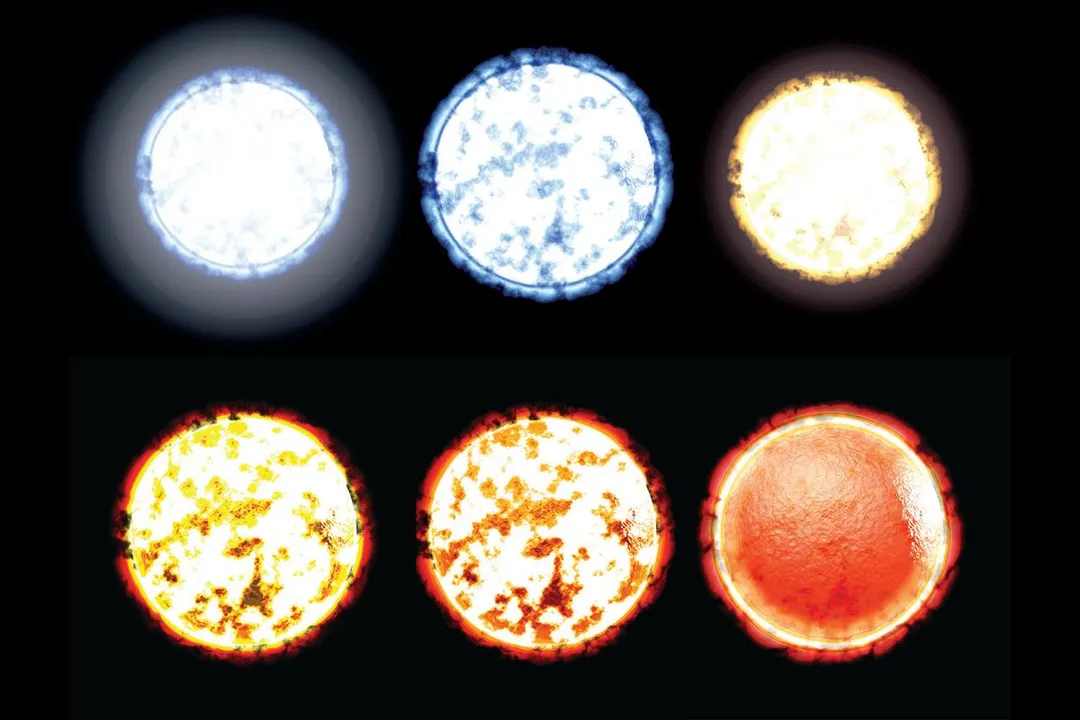
The color of a star provides immediate and vital clues about its fundamental physical properties, primarily its surface temperature. This relationship is not arbitrary; it is rooted in the physics of how hot objects radiate energy across the electromagnetic spectrum. Simply by observing a star's hue—whether it burns a fierce blue or a deep, smoldering red—astronomers can gauge its thermal state, ranging from the scorching infernos of the hottest stars down to the relatively cool embers of the oldest ones.
# Light Physics

A star behaves, to a good approximation, like an idealized concept known as a blackbody radiator. This means that an object, when heated, emits light across a continuous spectrum of wavelengths, but the peak wavelength—the color where it emits the most energy—shifts predictably as the temperature changes. When an object gets hotter, the peak wavelength of its emitted radiation shifts toward the shorter, higher-energy end of the visible spectrum. Conversely, cooler objects emit most of their radiation at longer, lower-energy wavelengths.
For visible light, this translates directly to color. The shortest wavelengths we perceive are associated with blue and violet light, while the longest wavelengths correspond to red light. Therefore, a star whose peak emission falls into the blue region must be significantly hotter than one whose peak emission is in the red region. Astronomers classify stars based on these colors, which neatly organizes them according to their surface temperatures, often using a sequence like O, B, A, F, G, K, M, though the primary observable is the color itself. The hottest stars approach temperatures around $25,000$ Kelvin or even higher, while the coolest visible stars hover around $3,000$ Kelvin.
It is interesting to note that while the Sun appears distinctly yellow or white to the naked eye, its actual peak emission falls squarely in the green part of the visible spectrum. However, because stars emit light across all visible colors simultaneously, our eyes blend these emissions together. For a star like our Sun, the combination of blue, green, yellow, and red light results in the appearance of white or yellow-white light, rather than pure green. Stars that are significantly hotter shift their peak toward blue/violet, and stars that are cooler shift their peak toward red/orange. This continuous spectrum means that a star will never appear purely green, as the intensity of the adjacent colors (blue and red) is too strong to allow the central green peak to dominate our perception.
# Color Sequence
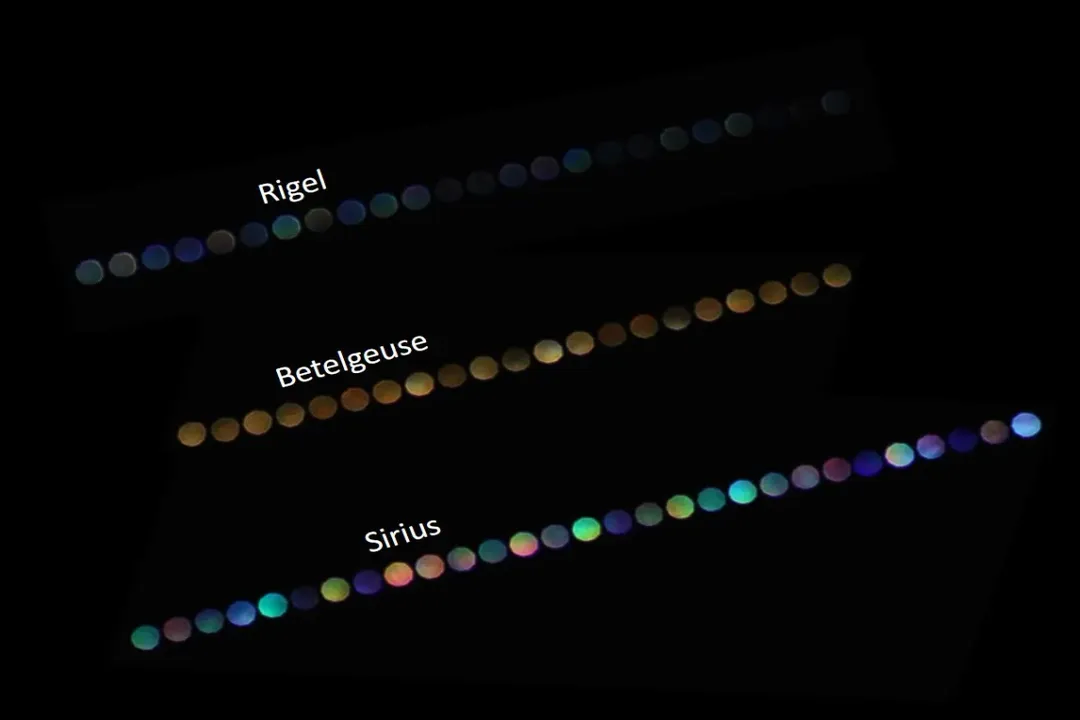
The observable colors of stars are used to place them on a simple thermal scale, running from the hottest stellar objects down to the coolest. This sequence is crucial for understanding stellar evolution and comparison across the galaxy.
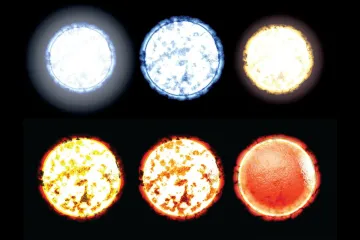
The general sequence, moving from hottest to coldest, is as follows: Blue, Blue-White, White, Yellow-White, Orange, and finally, Red.
To provide a clearer picture of the thermal magnitude involved, we can correlate these colors with approximate surface temperatures, recognizing that these are general ranges and actual stars fall along a continuum.
| Star Color | Approximate Temperature Range (Kelvin) |
|---|---|
| Blue | $> 25,000$ K |
| Blue-White | $10,000$ K to $25,000$ K |
| White | $7,500$ K to $10,000$ K |
| Yellow-White | $6,000$ K to $7,500$ K |
| Orange | $3,500$ K to $5,000$ K |
| Red | $2,000$ K to $3,500$ K |
This table, constructed by synthesizing data points across multiple sources, illustrates the dramatic temperature span involved, covering thousands of degrees Kelvin. For example, a blue star is roughly eight times hotter at its surface than a red star, demonstrating the significant energy output difference implied by the color.
# Hottest Stars

At the very top of the temperature scale are the Blue stars. These are the hottest stars known, possessing surface temperatures exceeding $25,000$ Kelvin. Stars that are slightly less scorching but still intensely hot fall into the Blue-White category, often registering between $10,000$ K and $25,000$ K. Rigel in the constellation Orion serves as a famous example of a star in this blue-white class.
These extremely hot stars emit the majority of their radiation in the shorter, higher-energy end of the spectrum, which is why they appear blue. They are typically massive and burn through their nuclear fuel very rapidly, meaning they have relatively short lifespans compared to stars like the Sun. Their high luminosity is a direct consequence of their extreme surface temperature.
# Mid Spectrum
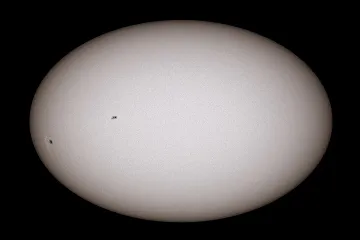
Moving down the temperature scale brings us to the White stars, typically found between $7,500$ K and $10,000$ K. Just below this group are the Yellow-White stars, which often bracket the temperature of our own star, the Sun. The Sun’s surface temperature is approximately $5,800$ K or $6,000$ K, placing it firmly in this yellow-white range.
Stars in this central band, like the Sun, radiate energy relatively evenly across the visible spectrum, leading to a perception of white or slightly yellowish light. These stars represent the "main sequence" phase for an average star, where they spend the longest portion of their existence fusing hydrogen into helium in their cores. The color provides a quick visual reference for where a star sits relative to the extreme ends of the stellar classification system.
# Coolest Stars
The lowest temperatures correlate with the longest visible wavelengths, producing Orange and Red stars. Orange stars generally maintain surface temperatures between about $3,500$ K and $5,000$ K. The coolest stars, which appear red, have surface temperatures dipping down to $3,500$ K or even below, sometimes as low as $2,000$ K.
Betelgeuse, the shoulder of Orion, is a well-known example of a massive, cool Red star. While their surfaces are cool, it is important to remember that a star’s color only reflects its surface temperature, not its total energy output or mass. Many very large stars, known as Red Giants or Supergiants, are cool on the outside (hence red) but are so enormous that they still shine brilliantly because they possess a vast surface area from which to radiate heat. An observer looking at a dim, small red dwarf versus a bright, huge red giant must factor in size alongside color to estimate actual energy output.
# Classification Context
Astronomers utilize this color-temperature relationship as the basis for a formal system to categorize stars. While the visual color is the starting point, the complete classification system, often referenced by letters like OBAFGKM, places stars in sequence based on decreasing surface temperature. This system allows for a more nuanced understanding than just "hot" or "cool". For instance, a star classified as G (like the Sun) has a more specific temperature range than just "Yellow-White".
One helpful way to contextualize this system for amateur observation is to consider it a measure of spectral quality. The hottest O-type stars emit vast amounts of UV radiation, while the coolest M-type (red) stars emit most of their energy in the infrared spectrum, meaning only a fraction of their total energy is in the visible band our eyes detect. The overall appearance is a composite of this energy distribution.
# Surface vs. Core
It is a common point of mild confusion that while we observe the visible color of a star’s surface, the vast majority of a star’s energy production happens deep within its core, where temperatures reach millions of degrees. The surface temperature—the one that dictates the color we see—is merely the final temperature the energy reaches before escaping into space. The star’s initial mass determines the core temperature, which in turn dictates how quickly the star burns and thus what its ultimate stable surface temperature (and color) will be. A massive star compresses its core more intensely, leading to hotter fusion rates, a hotter surface, and a blue color. A smaller star has lower core pressure, resulting in lower surface temperatures and a redder hue.
For instance, imagine two stars, one blue and one red. Both are fusing hydrogen. The blue star is consuming its fuel at a rate perhaps thousands of times faster than the red star, meaning that even though the red star might live for trillions of years, the blue star could exhaust its core fuel in just a few million years. This inherent link between surface color, temperature, and lifespan makes color one of the most fundamental observables in stellar astronomy. When you look up and see a star that appears slightly more yellow than our Sun, you can confidently deduce that its surface is slightly cooler, and thus it will likely enjoy a slightly longer main-sequence life than our own G-type star.
Related Questions
#Citations
Colors of Stars | Astronomy
Star colours explained for beginners
Classifying Stars By Colour: Hertzsprung-Russell Diagram
The Colors of the Stars From Hottest to Coldest
The Many Colors of Stars
Star Colors and Temperatures
At a Glance: Star Color and Temperature
Stellar Classification