spectral class articles
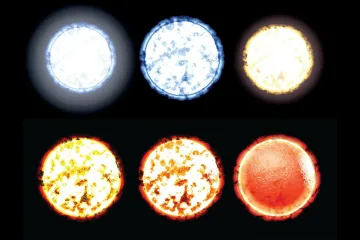
How does the peak wavelength of emitted radiation change when an object behaving like a blackbody radiator increases its temperature?
Where does the Sun's actual peak emission fall within the visible spectrum, contrasting with its perceived color?
What is the approximate minimum surface temperature threshold for stars classified as Blue?
Which Kelvin temperature range generally characterizes the surface of the coolest visible stars identified as Red?
To which spectral classification range does the star Rigel in Orion belong based on its associated temperature?
What is the correct progression of star colors listed from the hottest stellar objects down to the coldest?
What letter classification corresponds to the Sun, and what is its approximate surface temperature?
How does a star's initial mass dictate its core temperature and subsequent main-sequence lifespan relative to its color?
Why does the Sun, whose peak emission is green, appear white or yellow-white to human perception?
Despite having a cool surface temperature, why can Betelgeuse, a Red star, still shine brilliantly?
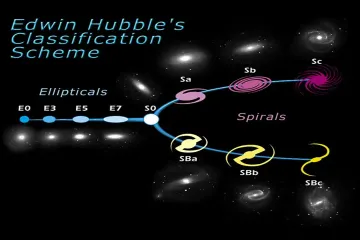
What diagram illustrates the Hubble Sequence for classifying galaxies?
Why do elliptical galaxies typically exhibit a soft yellow-red hue?
What structural component sits at the center of a spiral galaxy?
What feature distinguishes a barred spiral galaxy from a standard spiral?
Which galaxy type represents the transition between elliptical and spiral galaxies?
What usually causes galaxies to have an irregular, asymmetric shape?
Why do the spiral arms of a galaxy appear bright blue?
How can an observer identify an elliptical galaxy through a telescope?
What is the classification of the Milky Way galaxy?
What process might cause a spiral galaxy to eventually become an elliptical galaxy?

How is introductory astronomy frequently perceived compared to introductory physics or chemistry by college students?
What key factor often determines the perceived difficulty level when students discuss astronomy being 'easy'?
What type of mathematics is typically required in the Astronomy Survey course designed for non-majors?
Despite lighter math, what presents a unique cognitive hurdle in astronomy courses?
What characterizes the 'Astronomy for Majors (Physical Science Track)'?
According to student observations, what factor inherently increases the time commitment and potential difficulty of an introductory science course?
What is a crucial factor influencing the actual experience of taking an astronomy class, regardless of its title?
When compared to Introductory Biology, what study habit difference is often noted regarding astronomy?
Why might introductory Geology labs be considered more tedious or difficult than astronomy labs in some cases?