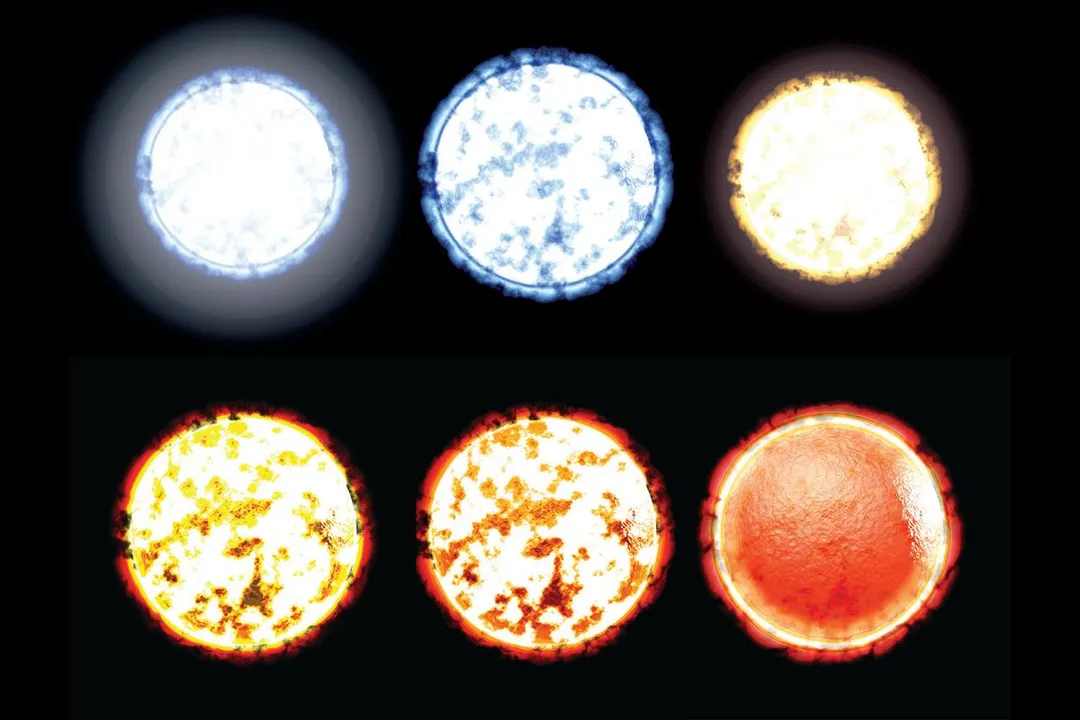
How does a star's initial mass dictate its core temperature and subsequent main-sequence lifespan relative to its color?
A more massive star compresses its core more intensely, leading to hotter fusion rates, a hotter surface, a blue color, and a much shorter lifespan.
The initial mass of a star is the primary determinant of its stellar characteristics throughout its life, influencing everything from core conditions to observable surface features. Greater mass means greater gravitational compression within the core. This intense pressure drives nuclear fusion reactions (fusing hydrogen into helium) at a significantly faster and hotter rate. Consequently, the star achieves a much higher stable surface temperature, resulting in a blue color. Because these massive stars burn through their substantial fuel supply at an extremely accelerated rate, their main-sequence lifespans are comparatively brief, often lasting only a few million years, which is vastly shorter than lower-mass stars like the Sun or red dwarfs.