What is the hottest star core in the universe?
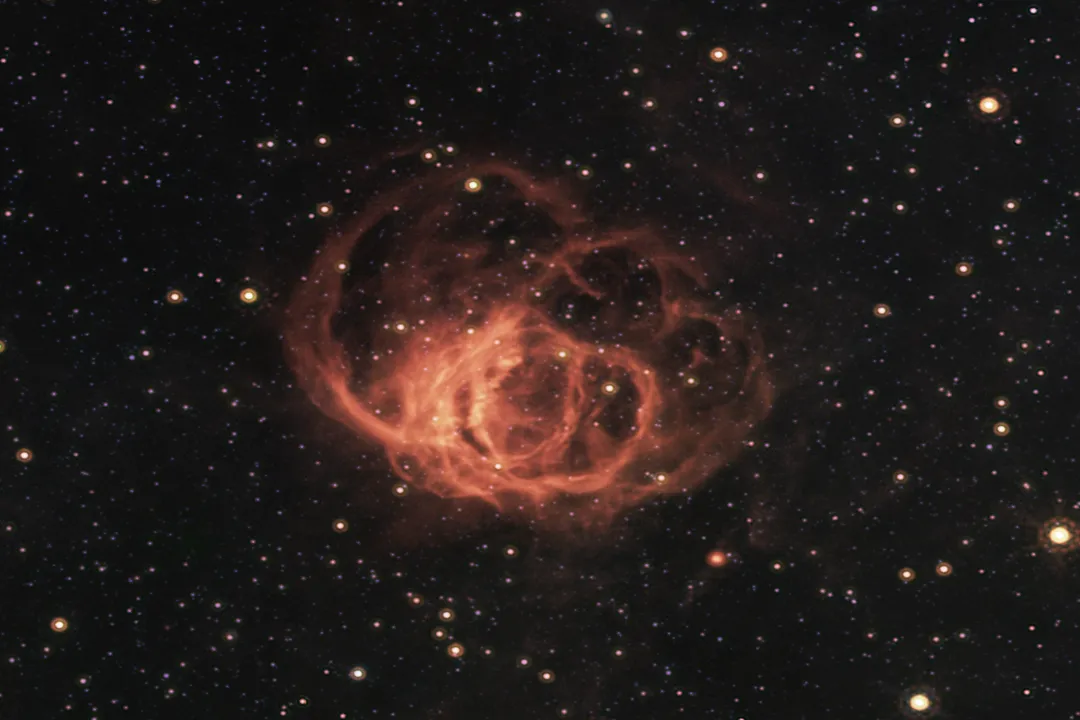
The search for the universe’s most scorching locale inevitably leads to debates about what we are actually measuring: the blazing visible surface or the incomprehensibly dense, energetic interior. These two measurements—surface temperature and core temperature—paint vastly different pictures of stellar extremes, and understanding the distinction is the first step to answering where the real heat resides.
# Surface Temperature
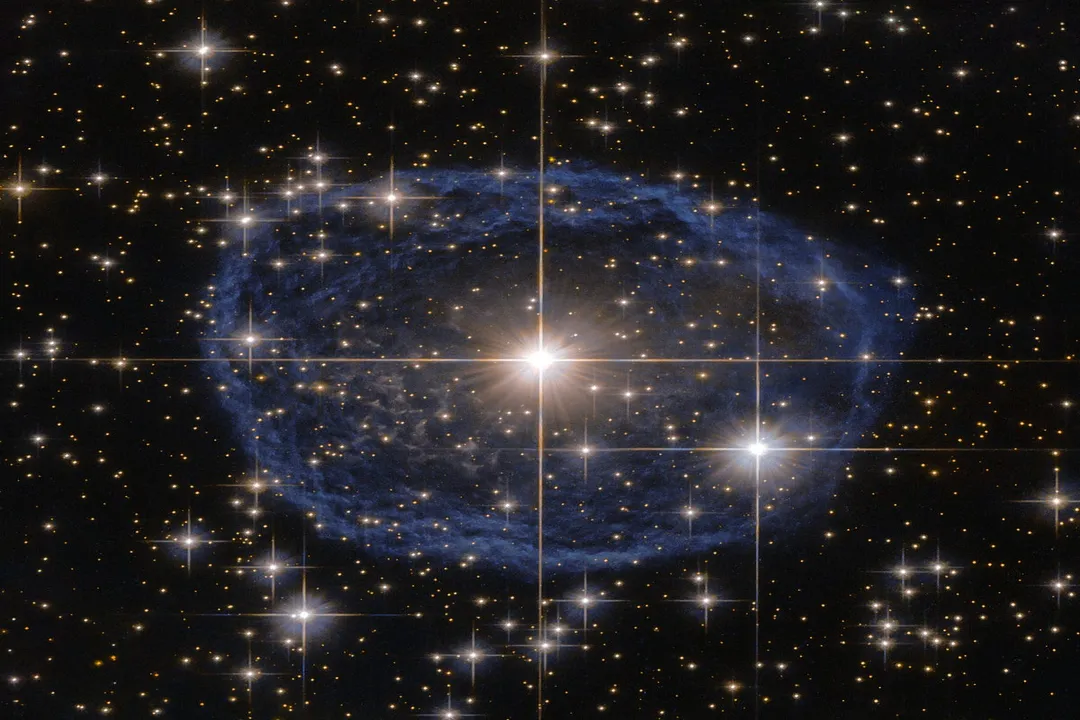
When astronomers discuss the hottest stars we can directly observe, they are referring to the effective temperature of the star's photosphere, the visible layer from which light escapes into space. These stellar titans are rare, massive, and short-lived, belonging primarily to the spectral class O-type stars. They burn through their fuel at an astonishing rate, resulting in incredibly high surface heat.
# Observing Extreme Heat
The surface temperatures for the most massive, hottest main-sequence stars generally begin around $30,000$ Kelvin and climb significantly from there. Some sources indicate that the hottest stars can push their surface heat past $50,000$ K. Even more extreme examples exist, such as certain Wolf-Rayet stars, which are massive stars nearing the end of their lives that have shed their outer hydrogen envelopes, revealing super-hot helium and heavier element cores. These rare objects are cited as possibly exceeding $200,000$ K on their surfaces.
One object frequently cited as a benchmark for stellar temperature is R136a1. Located within the Large Magellanic Cloud, this incredibly massive star is one of the most luminous and hot known objects in the cosmos, sporting a surface temperature around $50,000$ K in some estimates. While this heat is staggering—hot enough to utterly ionize nearly all surrounding elements—it is merely the skin of the star.
| Star Type | Typical Surface Temp Range (K) | Relative Mass () | Primary Location |
|---|---|---|---|
| O-Type Stars | $30,000 - 50,000+$ | High | Various Galaxies |
| Wolf-Rayet Stars | Up to $200,000+$ | Very High | End-of-Life Evolution |
| Our Sun | $1$ | Milky Way |
# Stellar Interior Heat
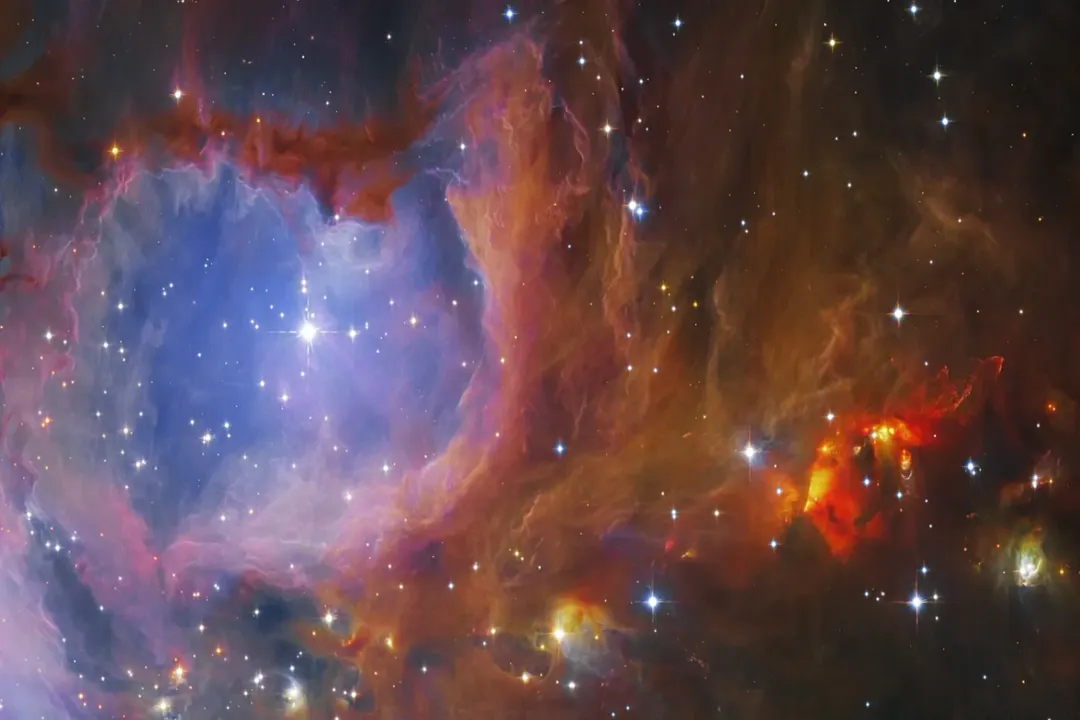
To locate the hottest core in the universe, we must look past the visible light and consider the thermonuclear furnaces where fusion occurs. The core temperature is fundamentally linked to the star's mass: the more massive the star, the greater the gravitational pressure squeezing the center, which in turn demands a higher core temperature to maintain the necessary outward pressure from fusion.
# Baseline Comparison
A familiar reference point is our own Sun. Its core temperature is estimated to hover around $15$ million Kelvin ( K). This is the engine that powers our solar system, yet it pales in comparison to the centers of the universe's most massive stars.
For the most enormous stars—those with masses perhaps approaching $100$ times that of the Sun ()—the central conditions are far more extreme. Models suggest that the cores of these giants can achieve temperatures in the range of $30$ to $40$ million Kelvin ( K).
The critical point here is that we do not directly measure these core temperatures with a stellar thermometer; they are derived from complex astrophysical models based on stellar structure and evolution theories. These models predict that the hotter the surface, the higher the internal temperature must be to support that energy output against crushing gravity.
It’s an interesting thought experiment: If a star like our Sun, with a $15$ million K core, has a surface of nearly $6,000$ K, what kind of temperature differential does that imply for the star? If its surface is $50,000$ K, the internal temperature gradient needed to move that energy from a $40$ million K center outward must be steeper and more energetic than anything we can replicate in most terrestrial labs, highlighting the sheer thermodynamic challenge gravity imposes.
# Understanding the Gradient
The immense disparity between the surface and core temperatures across the most massive stars demonstrates a profound physical principle: heat transport efficiency is not constant throughout a stellar body. While a star's surface temperature is a direct product of its luminosity and radius (), the core temperature is a product of hydrostatic equilibrium dictated by mass.
For the stars with the hottest cores, the primary fusion process shifts from the proton-proton chain (dominant in the Sun) to the far more temperature-sensitive CNO cycle. This cycle, which uses carbon, nitrogen, and oxygen as catalysts, requires those much higher central temperatures ($>18$ million K) to efficiently fuse hydrogen into helium, explaining why only the most massive stars generate heat this intensely at their centers.
# Non-Stellar Extremes
While we have identified the hottest stellar cores based on theoretical predictions—peaking around $40$ million Kelvin for the largest known star candidates—it is vital to remember that the universe contains temporary, non-stellar heat sources that far surpass this thermal limit.
# Artificial Heat
The title for the absolute hottest place that humans have ever created goes to particle accelerators, such as the Large Hadron Collider (LHC) at CERN. When heavy ions are smashed together at nearly the speed of light, they create a quark-gluon plasma, a state of matter that briefly achieves temperatures in the trillions of Kelvin—far exceeding even the calculated cores of any known star. These temperatures are fleeting, existing only for fractions of a second, but they represent the most extreme thermal environment we have successfully engineered.
# Cosmic Aftermath
Another context for extreme heat lies in stellar death and remnants. While not a stable star core, the immediate aftermath of a supernova explosion or the environment within certain supernova remnants can briefly generate heat that outstrips stable stellar cores. Furthermore, the universe itself was infinitely hotter at the moment of the Big Bang.
However, if the question is strictly about the hottest, sustained, self-regulating energy-generating center of a naturally occurring, stable celestial object still fusing hydrogen, the current scientific understanding points to the cores of the most massive O-type or Wolf-Rayet precursors, estimated to be in the range of 30 to 40 million Kelvin. These stellar centers, though hidden from direct view, represent the highest sustained thermonuclear temperatures achievable within a single stellar object in the current cosmic epoch.
#Videos
WR102. A star that is 200,000 degrees hotter than the Sun. - YouTube
Related Questions
#Citations
Is the temperature of the hottest star's core known?
List of hottest stars - Wikipedia
WR102. A star that is 200,000 degrees hotter than the Sun. - YouTube
Where is the warmest place in the known universe? : r/askscience
How hot are the hottest stars in the Universe? - Medium
What Are The Hottest Stars In The Universe? - Forbes
What is the hottest object in the universe?
A Star Can Be Hotter Than 200,000°C Some of the hottest stars in ...
How Hot Is the Hottest Star? [Excerpt] - Scientific American