What temperature range defines the hottest sustained thermonuclear centers of stable, hydrogen-fusing celestial objects?
Answer
30 to 40 million Kelvin
When restricting the definition to the hottest, sustained, self-regulating energy-generating centers found within naturally occurring, stable stars that are currently fusing hydrogen, the scientific consensus points towards the cores of the most massive candidates, specifically O-type or Wolf-Rayet precursors. Models predict that the central temperatures within these giants can reach or exceed $30$ million Kelvin, potentially peaking around $40$ million Kelvin. This range represents the highest sustained thermonuclear heat achievable within a single stellar object during the current epoch of the universe.
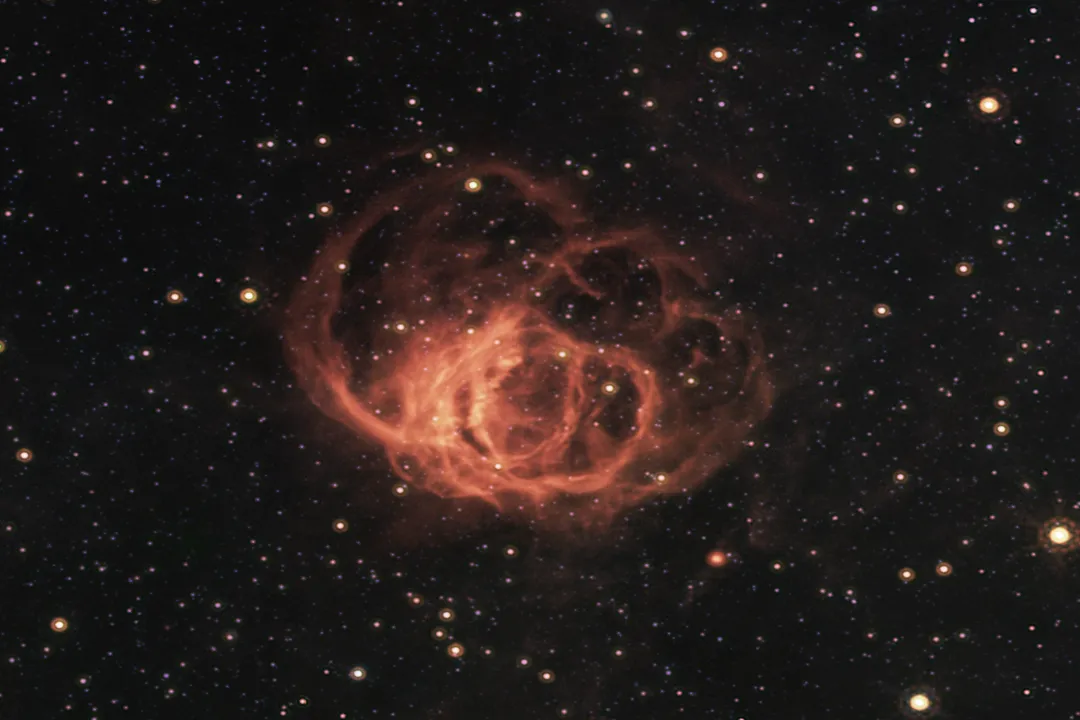
#Videos
WR102. A star that is 200,000 degrees hotter than the Sun. - YouTube
Related Questions
Which spectral class primarily comprises the rare, massive, and short-lived stars with the hottest observable surfaces?What surface temperature estimate is frequently associated with R136a1, located in the Large Magellanic Cloud?What is the estimated core temperature for our Sun, used as a baseline comparison for stellar interiors?What temperature range do models suggest for the cores of the most enormous stars approaching $100 M_ ext{Sun}$?Which fusion process requires central temperatures greater than 18 million K to efficiently fuse hydrogen in massive stars?What state of matter, achieved briefly in particle accelerators like the LHC, reaches temperatures in the trillions of Kelvin?What extreme surface temperature threshold can certain Wolf-Rayet stars possibly exceed near the end of their lives?Core temperatures, unlike surface measurements, are derived primarily from what basis?What fundamental physical characteristic dictates the necessary core temperature for hydrostatic equilibrium in a star?What temperature range defines the hottest sustained thermonuclear centers of stable, hydrogen-fusing celestial objects?