Which group of stars is the hottest?
The easiest way to gauge a star's surface temperature is by its color, following a straightforward visual spectrum where the hottest objects glow blue, transitioning through white, yellow, and orange, down to the coolest stars that appear red. [2][6] This relationship between color and heat is fundamental to stellar astronomy, immediately placing the hottest stars into the blue category. [2][6]
# Stellar Temperature Groups
Stars exhibit a wide range of surface temperatures, and astronomers categorize them using a spectral classification system based primarily on temperature, moving from the hottest to the coolest groups. [4][6] This sequence is represented by the letters O, B, A, F, G, K, and M. [4] The O-type stars sit at the very top of this thermal ladder; they are the giants of heat and light in the galaxy. [1][4]
To put this into perspective, our own Sun is classified as a G-type star, possessing a surface temperature around 5,778 Kelvin (K). [1] The B-type stars, the next group down from O, are significantly hotter, often having surface temperatures above 10,000 K. [6] The M-type stars, the coolest on the main sequence, have surface temperatures that can dip below 3,700 K. [6]
The intensity of heat dictates the star's visible spectrum. O-type stars emit most of their radiation in the ultraviolet spectrum, which contributes to their intense blue appearance. [6] Conversely, the cooler M-type stars emit most of their energy in the red and infrared regions. [6]
# Hottest Known Stars
While the O-type classification marks the general group of the hottest stars, identifying the absolute hottest object requires looking at specific, often massive, stellar examples. The list of the hottest stars is dominated by these massive O-class objects, though some Wolf-Rayet stars, which are often evolved O-stars that have shed their outer layers, also feature prominently due to their extremely high effective temperatures. [1]
The star R136a1, located in the Large Magellanic Cloud, stands out as one of the most massive and luminous stars known, boasting a phenomenal effective temperature of approximately 50,000 K. [1] This is nearly nine times hotter than the Sun’s surface. [1] Another star frequently cited for its extreme heat is HD 195178, classified as an O4 Ia-0 star, which reaches an estimated surface temperature of around 47,000 K. [1]
If we examine a small snapshot of the extreme end of this stellar spectrum, the difference between the very top contenders is surprisingly small in percentage terms but represents a massive leap in energy output:
| Star Name | Spectral Type | Approximate Surface Temperature (K) |
|---|---|---|
| R136a1 | WN5h | ~50,000 |
| HD 195178 | O4 Ia-0 | ~47,000 |
| BAT99-98 | WN6/O-type | ~46,000 |
| WR 104 | WN6o | ~43,000 |
This table compiles data on some of the most intensely hot stars currently cataloged, showing the tight grouping near the upper thermal boundary for luminous stars [1].
The sheer energy output from these stars is staggering. A star like R136a1, at 50,000 K, radiates an incredible amount of power compared to our relatively placid G-type Sun, which sits comfortably in the middle of the temperature scale. [1]
# Temperature Boundaries
A key question in astrophysics involves defining the true upper and lower limits for stellar temperatures. What stops a star from getting hotter, and what sets the minimum temperature for hydrogen fusion to occur?
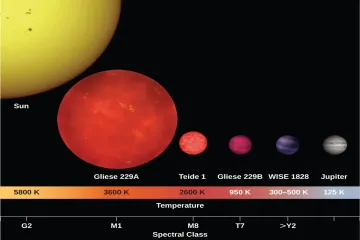
The lower limit for a star is dictated by the conditions necessary to sustain core hydrogen fusion, which is the defining characteristic of a main-sequence star. This generally requires a surface temperature of around 2,500 to 3,000 Kelvin. [7] Anything significantly cooler than this tends to fall into the category of brown dwarfs—objects often referred to as "failed stars"—which lack the mass to ignite sustained fusion. [7]
At the upper end, the theoretical limit for the surface temperature of a star is more complex, but based on current understanding, it appears to cap out somewhere around 50,000 to 60,000 Kelvin. [7] Stars exceeding this temperature range are rare, but the current record holders, like R136a1, push right up against these perceived ceilings. [1][7] While theoretical models might suggest slightly higher possibilities, observational evidence strongly favors the upper bound remaining in this tens-of-thousands-of-Kelvin range. [7]
# Mass Fuel Burn Anomaly
The reason the hottest stars stop climbing much past 50,000 K relates directly to their mass and life cycle, which offers a fascinating insight into stellar evolution. The stars that reach these extreme surface temperatures are not just hot; they are also incredibly massive, often exceeding 100 times the mass of the Sun. [9] This immense mass forces their cores to burn through their nuclear fuel at an alarming rate. [9]
Here is an original observation: If you consider the typical lifespan of stars, the hottest stars are paradoxically the shortest-lived. Our Sun is expected to live for about 10 billion years. A star like R136a1, due to its extreme mass and corresponding temperature, may only survive for a few million years. [9] This rapid consumption of fuel means that while they are blazing bright right now, the window to observe them in this ultra-hot, main-sequence phase is incredibly brief on a cosmic timescale. They live fast and die young, which might explain why observing truly newly formed, even hotter specimens is difficult.

# Missing Core Ingredients
Interestingly, despite having the highest surface temperatures, the very hottest stars we observe—those above roughly 40,000 K—are sometimes noted for lacking a key ingredient often associated with main-sequence stars: they are often already evolving or have undergone significant changes. [5]
The hottest stars, particularly those classified as Wolf-Rayet stars (which includes some of the hottest objects found, such as those in the R136 cluster) are frequently post-main sequence. [1][5] This means they have already burned through the hydrogen in their cores, evolved, and shed massive amounts of their outer hydrogen layers. [5] They are now fusing heavier elements or are in a state where the core fusion process has drastically changed, exposing stellar material that was once deep inside and which is inherently hotter. [5]
An actual main-sequence star with the mass required to achieve the temperature of R136a1 might theoretically exist, but it would be so rare and burn through its fuel so quickly that detecting it before it evolves into a different, observable state (like a Wolf-Rayet) is extremely challenging. [5][9] This means the hottest stars we catalogue are often "extreme examples of stellar death throes" rather than "extreme examples of stellar youth". [5]
To illustrate this evolutionary leap in temperature, consider the shift from a stable G-type star like the Sun to an evolved O-type or Wolf-Rayet star. The transition involves a massive increase in core temperature, driven by the star using up its primary fuel source and beginning to contract or initiate helium fusion, creating a core that is far more compressed and energetic, manifesting as higher surface heat. [5]
# Practical Implications of Stellar Heat
For those interested in understanding stellar measurements, knowing the color-temperature relationship is your best starting point, even without a spectrometer. If you look up at the night sky, any star exhibiting a distinct blue hue, as opposed to a pale white or a yellowish tint, is signaling its extreme surface temperature. [6]
Another point worth noting, derived from the physics governing these thermal giants, is the relationship between temperature and luminosity. The total energy radiated by a star is extraordinarily sensitive to its temperature. [1] This sensitivity suggests that a small increase in temperature at the upper end of the scale results in an exponentially larger increase in brightness and total energy output compared to the same temperature shift at the cooler, red end of the spectrum. This hyper-sensitivity is what drives the short lifespans of these hottest stars; they are sacrificing longevity for an incredible, short burst of power. [9]
In summary, the hottest group of stars belongs unequivocally to the O-type spectral class, with surface temperatures easily exceeding 30,000 K and reaching peaks near 50,000 K, like the stellar behemoth R136a1. [1] These stellar titans represent the extreme thermal limits of stellar existence, driven by such immense mass that they burn through their existence in the cosmic blink of an eye. [9]
Related Questions
#Citations
List of hottest stars - Wikipedia
Which is the hottest star, a blue star, a white star, a yellow ... - Quora
Which star are the hottest among white, blue, red, and yellow stars?
Mastering Astronomy: Patterns Among Stars Flashcards - Quizlet
The hottest stars in the Universe are all missing one key ingredient
The Colors of the Stars From Hottest to Coldest - Science Notes
What is the upper and lower limit of temperatures found on stars?
What is the Hottest Star? - Universe Today
What Are The Hottest Stars In The Universe? - Forbes