What would be found in a nebula?
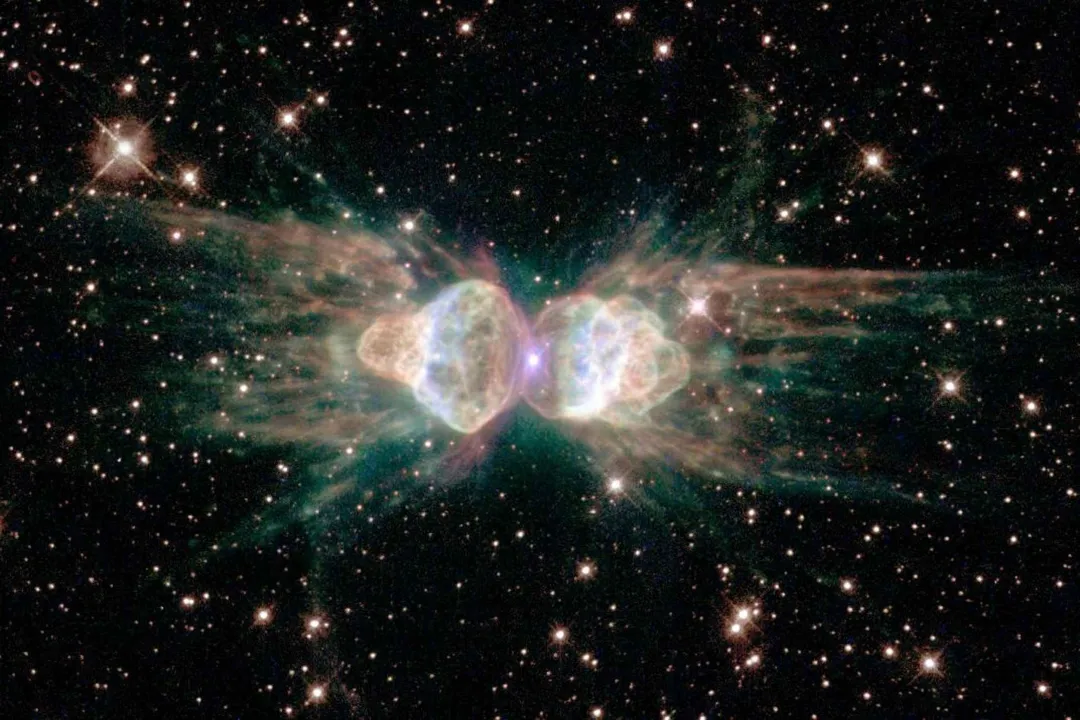
Vast clouds of gas and dust scattered throughout the cosmos define what astronomers call a nebula. [1][2][4][5][8] These aren't solid objects in the way we might picture a cloud on Earth; rather, they are immense interstellar formations where the raw material for stars and planets resides. [1][8] To understand what is found inside one, one must consider that "nebula" is a broad term covering several distinct environments, each with its own inventory of particles and energies. [4]
# Cosmic Composition
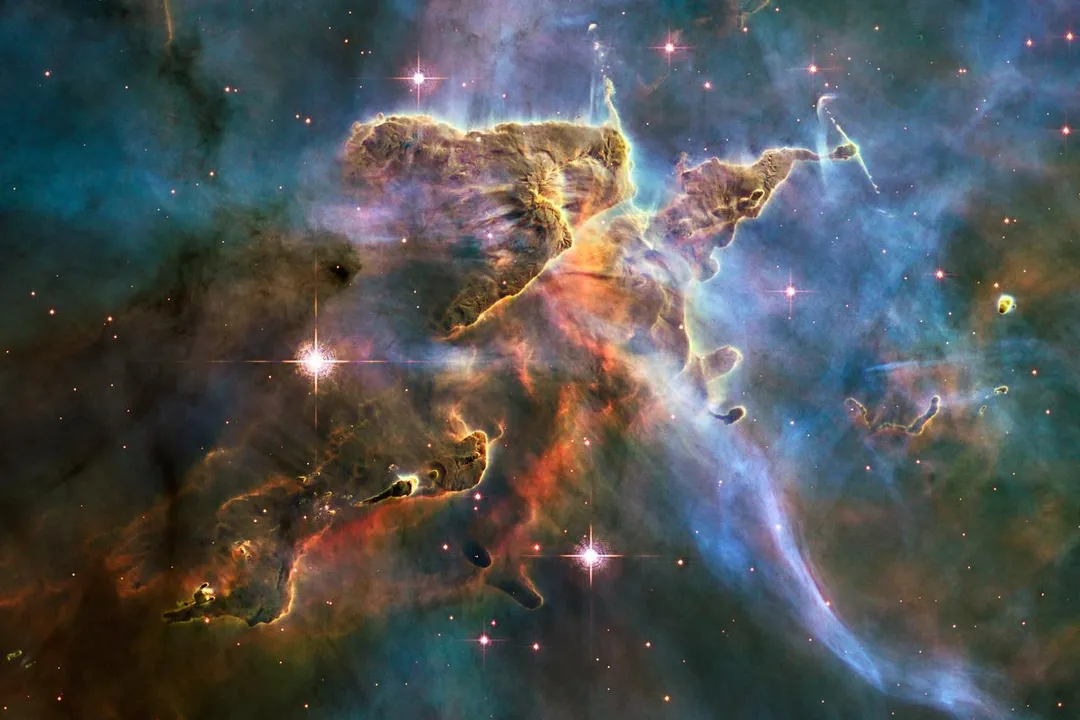
At its most fundamental level, the content of any nebula is dominated by gas, primarily the two lightest elements: hydrogen and helium. [2][4][6] Hydrogen is the fuel for stellar birth and fusion, often making up the vast majority of the mass present. [4] However, these clouds are far from pure gas. Interspersed within the gaseous matrix are tiny grains of interstellar dust. [2][5]
This dust is surprisingly complex, often composed of microscopic particles made of silicates, carbon compounds, and frozen ices—the molecular remnants of previous stellar generations. [6] These dust grains are incredibly small, perhaps only a few hundredths of a micron in size, but their collective presence significantly affects how we observe the nebula. [1] When a nebula is viewed, the light we see—or don't see—is often a direct result of this dust scattering or absorbing background starlight. [1]
# Internal Environment
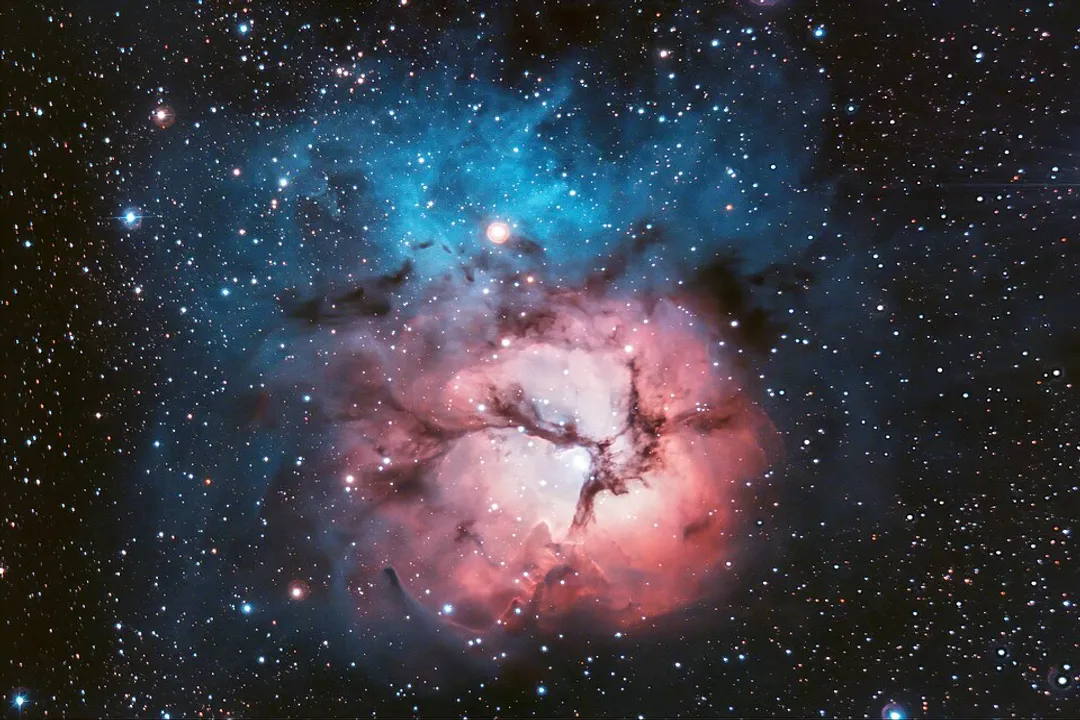
Perhaps the most surprising feature of a nebula's interior is its extreme emptiness. Although nebulae contain colossal amounts of mass spread over light-years, the density of the material is staggeringly low. [1][8] The average density within a typical nebula is far less than the best vacuum achievable in a laboratory on Earth. [3][6] You could travel through a large portion of one without colliding with a single atom, even though the total mass is enough to form thousands of suns. [3]
The temperature varies dramatically depending on the type of nebula and its proximity to energetic stars. [6] Dark molecular clouds, which are dense enough to eventually collapse and form stars, are extremely cold, often just tens of degrees above absolute zero. [6] Conversely, in emission nebulae, intense ultraviolet radiation from very hot, newly formed stars excites the surrounding hydrogen gas, causing it to glow brightly and heat up significantly. [2][4]
The internal physics dictate that structure exists because gravity and pressure are in a constant, slow-motion battle. Within the tenuous gas, pockets of higher density—molecular clumps—begin to coalesce. [1] These clumps are the precursors to star systems.
# Cloud Types
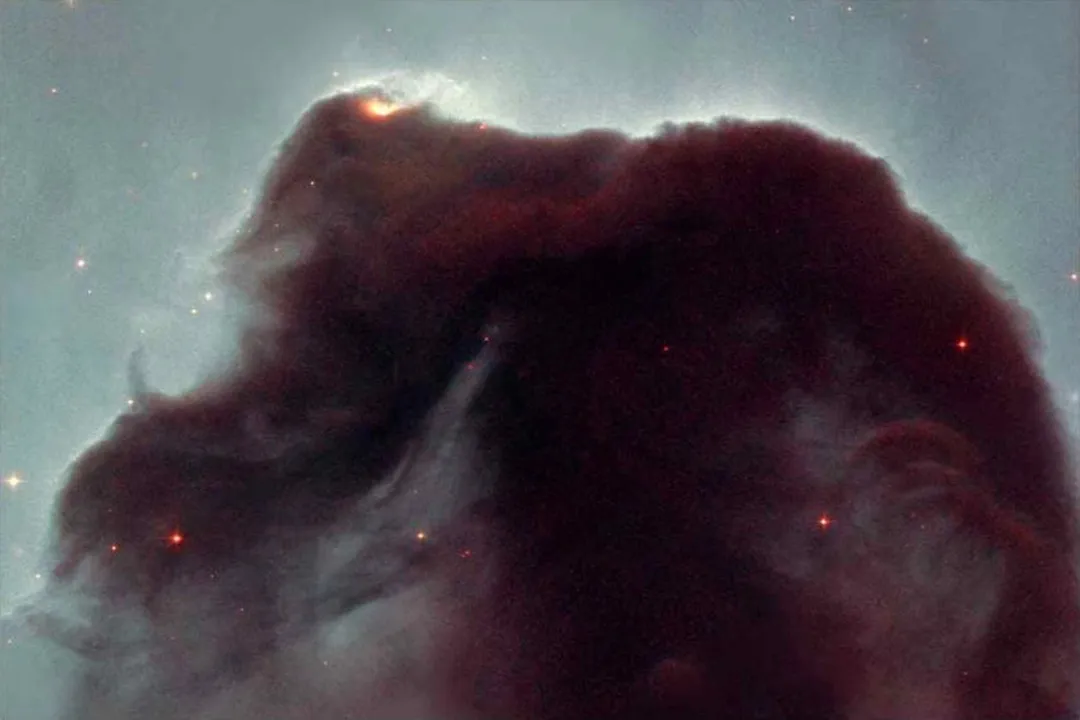
Nebulae are generally categorized by how they interact with light, which directly reflects what they contain and what processes are occurring within them. [5]
# Stellar Nurseries
The most famous nebulae are those actively creating stars, often categorized as emission nebulae or reflection nebulae. [4][5]
- Emission Nebulae: These clouds are near extremely hot, massive, young stars. The stars emit powerful ultraviolet light that strips electrons from the hydrogen atoms in the gas—a process called ionization. [2] When these electrons recombine with the hydrogen nuclei, they emit light, often a distinct reddish hue from ionized hydrogen, making the nebula glow on its own. [2]
- Reflection Nebulae: These clouds do not produce their own light. Instead, they are illuminated by nearby stars that are not hot enough to ionize the gas. [4] The dust within the cloud scatters this starlight towards us. Interestingly, these often appear blue because the smaller dust grains scatter blue light more efficiently than red light, similar to why Earth’s sky is blue. [1][4]
# Stellar Corpses
Not all nebulae result from birth; many are the products of stellar death, representing the end-stage components of stellar evolution. [4]
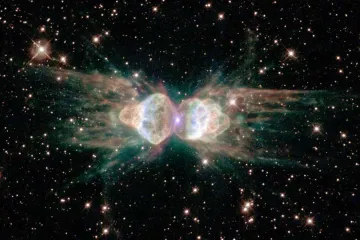
- Planetary Nebulae: Despite the name, these have nothing to do with planets. [7] They are the final stages of stars like our Sun. [7] When a medium-sized star exhausts its fuel, it puffs off its outer layers of gas into space, creating an expanding shell that is illuminated by the hot, exposed core—a white dwarf. [7] These structures are relatively short-lived in cosmic terms. [7]
- Supernova Remnants: These are the chaotic, rapidly expanding debris fields left behind after a massive star explodes in a supernova. [4] These remnants contain heavier elements forged during the star's life and the explosion itself, seeding the interstellar medium with materials crucial for later generations of stars and rocky planets. [4]
When considering the contents, it's useful to think of a nebula as a galactic staging ground, containing everything from pristine hydrogen gas ready for fusion to the complex elemental soot ejected from supernovae. [6] An analogy might be comparing a dense, cold molecular cloud to a massive, unmixed bag of dry ingredients, while a bright emission nebula is that same bag after water (stellar energy) has been added, causing a chemical reaction that releases energy and changes the observable appearance [This offers a simple comparison of the physical states found within different nebular classes].
# Visibility Challenges
What an observer would actually see inside a nebula depends entirely on the surrounding conditions, leading to the contrast between bright, glowing clouds and seemingly empty patches of sky. [9]
If you were floating inside a reflection nebula, the experience would be one of profound darkness punctuated by the scattered light of nearby stars reflecting off the dust surrounding you. [9] If you moved into the heart of a dark nebula—a region so dense with dust that it completely blocks the light from objects behind it—you would see almost nothing but the occasional dim, cold star whose light is too weak to penetrate the opaque barrier. [1][9] The visual effect is one of a void, even though this void holds the material that will eventually form a new star cluster. [1]
The perception of "nothingness" when observing these regions highlights a key scientific challenge: differentiating between actual empty space and a cloud so dense that it appears completely dark against the background light of the galaxy. [9] The dark lanes and patches are not empty vacuum but rather the thickest accumulations of obscuring dust particles. [1]
# Star Formation State
The state of matter within a nebula dictates its potential. The overall inventory—gas, dust, and trace molecules—is merely the inventory; the process defines the nebula's current role. [1][8] We are observing systems frozen in time at different phases of stellar life.
For instance, the Orion Nebula, a famous star-forming region, contains not only vast clouds of glowing gas but also specific dense cores where protostars are actively accreting material from the surrounding cloud envelope. [1][8] In essence, inside that glowing cloud, you would find embryonic stars hidden by their own cocoons of infalling gas and dust, absorbing light that an external telescope might miss without infrared sensitivity. [1]
If you could somehow observe the chemical constituents with perfect precision, you might find complex organic molecules forming on the surfaces of the dust grains in the coldest regions, providing the basic building blocks for future planetary systems long before the central star ignites [This highlights the chemical synthesis occurring in the coldest environments, adding depth to the "dust" component]. The ingredients are being cooked, even in the dark, unlit regions, awaiting the trigger for collapse.
# Observing Conditions
When we view nebulae through ground-based telescopes, we are subject to distortions from Earth's atmosphere, which affects the perceived clarity and color of the structures. [8] Furthermore, because the clouds are so diffuse, long exposure times are necessary to collect enough photons for the eye or sensor to register the faint emission or reflection. [8] This necessity for long integration times means that any image we see represents not a single instant, but the accumulation of light over minutes or hours, effectively painting a picture of the nebula's structure rather than capturing a snapshot of its instantaneous appearance [This point serves as a necessary context for interpreting astronomical images of nebulae]. The experience of "seeing inside" one, therefore, is inherently a composite, time-averaged view of slowly moving gas and dust, lit by stars that may be light-years away from the densest parts of the cloud.
Related Questions
#Citations
What Is a Nebula? | NASA Space Place – NASA Science for Kids
Nebula - Wikipedia
What is the inside of a nebula like? : r/askscience - Reddit
Nebula: Definition, location and variants - Space
What is a Nebula? - National Space Centre
Nebula
Planetary Nebulas - Center for Astrophysics | Harvard & Smithsonian
What is a nebula? - Space Center Houston
What might I see inside of a nebula? - Quora
Nebula interstellar cloud composition and formation - Facebook