How do stars produce naturally occurring elements?
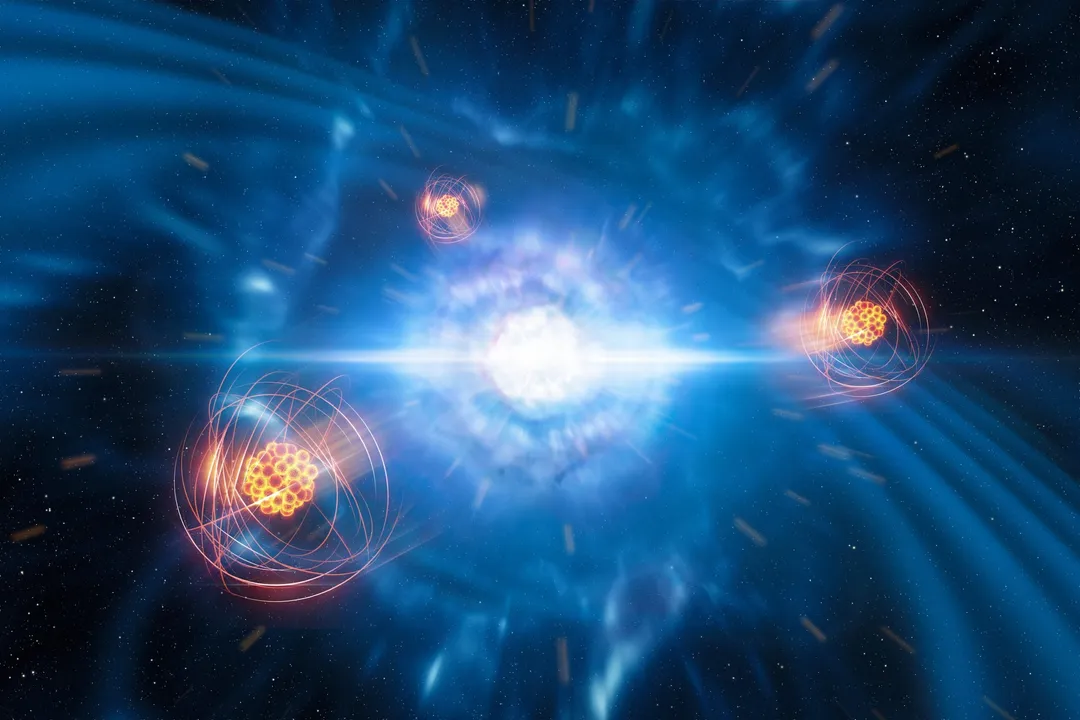
The entire periodic table, minus the very lightest components forged in the universe's first moments, owes its existence to the violent, long-lived processes occurring inside stars. Every atom of carbon in your body, the oxygen you breathe, and the iron in your blood originated from a stellar furnace through a process known as stellar nucleosynthesis. This is not a single event but a continuous series of nuclear reactions, dictated by the star's mass and its current stage of evolution, that transmute lighter atomic nuclei into heavier ones.
# Cosmic Start
Before stars existed, the universe was overwhelmingly composed of the simplest elements: hydrogen, helium, and trace amounts of lithium. These elements were formed during the Big Bang, a period lasting only a few minutes. Stars begin their lives when massive clouds of these primordial materials collapse under gravity until the core becomes hot and dense enough to initiate nuclear fusion. Therefore, the raw material for stellar alchemy is set before the star even ignites its core.
# Main Sequence Fusion
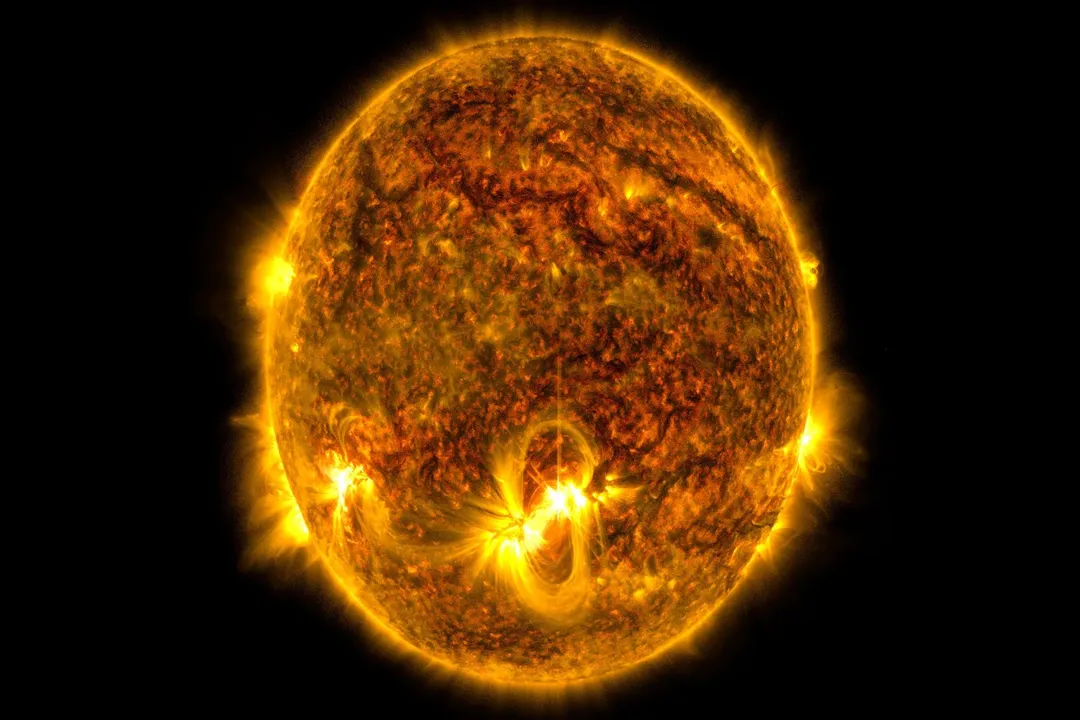
The longest phase of a star's life is the main sequence, where it steadily burns hydrogen into helium in its core. For stars roughly the size of our Sun or smaller, the primary mechanism driving this conversion is the proton-proton (P-P) chain. This is a relatively slow process that requires significant heat and pressure to overcome the electrical repulsion between positively charged protons.
In more massive stars, where core temperatures are significantly higher, the CNO cycle takes over as the dominant source of energy generation. While the end product remains the same—four hydrogen nuclei become one helium nucleus—the CNO cycle is far more temperature-sensitive and utilizes carbon, nitrogen, and oxygen isotopes as temporary catalysts. This difference in pathway means that for stars significantly larger than the Sun, the fusion of hydrogen happens much more rapidly, consuming their fuel supply faster. This catalytic nature of the CNO cycle allows hydrogen fusion to proceed efficiently at a higher temperature floor than the pure P-P chain alone would allow.
# Advanced Cores
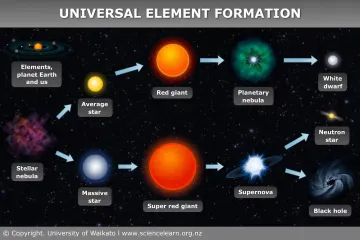
When the hydrogen fuel in the core is finally exhausted, the core contracts and heats up, initiating the fusion of helium. For stars like the Sun, this leads to the red giant phase. Helium nuclei (alpha particles) are fused together in a process specifically termed the triple-alpha process. This process fuses three helium nuclei to create one nucleus of carbon ().
In stars much more massive than the Sun—those beginning their lives with at least eight times the mass of our Sun—the process becomes far more dramatic. After helium burning, the core contracts again, and the temperature rises high enough to ignite carbon fusion, followed by neon, oxygen, and silicon fusion in successive, onion-like shells surrounding the inert core. Each subsequent stage burns for a shorter period as the energy output required to counteract gravity increases.
# The Iron Limit
This fusion chain continues, building heavier and heavier elements, until the core eventually becomes dominated by iron (). Iron represents a crucial boundary in stellar nucleosynthesis. Unlike all the lighter elements, fusing iron nuclei actually consumes energy rather than releasing it. Because fusion is the only mechanism keeping the star stable against its own immense gravitational collapse, the formation of an iron core signals the immediate end of energy generation through fusion for that star. The star has reached its fusion endpoint.
# Heavy Element Forging
Elements heavier than iron cannot be produced through standard, energy-releasing fusion reactions within a stable star's core. Creating these elements requires vastly more energy input or a phenomenal neutron flux.
The creation of elements heavier than iron generally occurs through neutron capture processes. The first pathway, the s-process (slow neutron capture), can occur in aging, thermally pulsing asymptotic giant branch (AGB) stars, such as red giants. In this process, nuclei slowly capture neutrons one at a time, allowing time for unstable isotopes to decay via beta decay into the next stable element before capturing another neutron. This mechanism is responsible for creating roughly half of the elements heavier than iron, up to and including elements like bismuth.
However, the production of the heaviest, most neutron-rich elements—such as gold, platinum, and uranium—requires a far more extreme environment, specifically the r-process (rapid neutron capture). This event happens during the core collapse of a massive star into a supernova or, as recent models suggest, during the merger of two neutron stars. In these cataclysms, the neutron density is so high that nuclei absorb many neutrons in rapid succession before they have time to undergo radioactive decay. This rapid bombardment pushes nuclei far beyond the stable valley, and as the explosion subsides, these highly unstable isotopes decay into the long-lived, heavy elements we observe today.
# Galactic Recycling
Once these elements are forged, they must be returned to the cosmos to seed the next generation of stars and planets. In lower-mass stars, the outer layers are gently puffed away as a planetary nebula, enriching the surrounding space with carbon, nitrogen, and oxygen. In contrast, the violent death of a massive star in a supernova explosion blasts all the synthesized elements—from carbon all the way up through the heaviest r-process elements—outward at incredible speeds. These supernova remnants mix with existing interstellar gas and dust, creating the enriched molecular clouds from which new stars, planets, and, eventually, life, can form. This continuous cycle of stellar birth, life, death, and enrichment is the fundamental engine driving cosmic chemical evolution.
Related Questions
#Citations
Stellar nucleosynthesis - Wikipedia
The universe's guide to creating elements - Astronomy Magazine
Star Basics - NASA Science
Supernovae - The life cycle of a star - AQA - GCSE Physics ... - BBC
The Origin of the Elements | PBS LearningMedia
DOE Explains...Nucleosynthesis - Department of Energy
Origin of the Chemical Elements - T. Rauscher & A. Patkos
Stars dissolve into neutrons to forge heavy elements | LANL
Fusion in Stars (AQA GCSE Physics): Revision Note - Save My Exams
How elements are formed - Science Learning Hub