What happens to a star when it stops fusing iron?
The moment a massive star ceases to fuse iron in its core is not a gradual dimming, but the immediate prelude to cosmic annihilation. Iron, element number 26, sits at a peculiar peak on the nuclear binding energy curve. [7] Up until this point, every fusion step—from hydrogen to helium, then carbon, oxygen, silicon, and finally iron—has resulted in a product nucleus that is more tightly bound than its predecessors, releasing a net amount of energy that pushes back against the crushing force of gravity. [1] Iron is the most stable nucleus known; it is perfectly content as it is. [1]
# Fusion's End
Once the core is predominantly iron, any attempt to fuse iron nuclei together requires an input of energy rather than producing an output. [1][7] This is the critical threshold. The energy that has sustained the star for millions of years—the thermal pressure counteracting gravity—vanishes in an instant. [2][7] The outward radiation pressure ceases, and gravity, unopposed, gains absolute dominion. [2][7]
This situation is fundamentally different from a star like our Sun, which runs out of hydrogen and proceeds to fuse helium into carbon and oxygen, eventually forming an inert carbon-oxygen core, but never hot or massive enough to reach iron. [1][6] For the Sun's mass range, the end is a gentle shedding of outer layers, leaving a cooling white dwarf behind. [6] But for stars significantly more massive, perhaps starting at (Solar Masses) or more, the iron core's termination signals a catastrophe of unimaginable scale. [1]
The internal structure of such a star at this final moment is often described as an onion, with the inert iron core at the center, surrounded by shells of lighter elements that were the "ashes" of the last active fusion stage—silicon and sulfur, then oxygen, neon, carbon, helium, and finally the hydrogen envelope. [1] While these outer shells might still be undergoing fusion, they are simply feeding material onto the already-doomed iron center. [1]
When we consider the lifecycle, it's astonishing to realize that a star can spend millions of years burning hydrogen on the main sequence, yet the final stages—fusing elements as heavy as silicon into iron—can take mere months or even just days. [1] It is a stunning acceleration: from eons of relatively calm power generation to seconds of irreversible collapse. [1] It makes one consider the stellar interior as an hourglass where the sand runs out incredibly slowly at first, then suddenly empties completely.
# Core Implosion
The iron core, no longer supported by thermal pressure, begins to contract. Initially, it is held up by electron degeneracy pressure, the quantum mechanical resistance of electrons being packed too closely together, a force that stabilizes white dwarfs. [1][7] However, in these massive stellar cores, the gravitational weight far surpasses this limit. [1]
The collapse becomes incredibly swift once a critical density, around , is reached. [1] At this density, something unfamiliar to our everyday physics occurs: electrons are forced into the atomic nuclei, combining with protons to form neutrons and releasing a flood of neutrinos. [1] This process, often called neutronization, effectively removes the electron pressure that was temporarily supporting the core. [1][2]
With the primary counter-force gone, the core plunges inward. In under a second, a core that might be a solar mass shrinks from a size comparable to Earth to a diameter of less than . [1] The infalling material reaches speeds approaching a quarter of the speed of light. [1] This is where the remnant mass becomes crucial: if the core remnant's mass is below roughly , the collapse halts again when the density exceeds that of an atomic nucleus, as neutron degeneracy pressure kicks in—neutrons, much like electrons, strongly resist being confined in the same state. [1] If the core mass is low enough, this new force is powerful enough to stop the implosion, stabilizing the remnant as a neutron star. [1][2]
If, however, the iron core was too massive to be supported even by this neutron degeneracy, the collapse continues past this point, resulting in the formation of a black hole. [1] For a star starting with perhaps or more, a black hole is the inevitable endpoint. [1]
# The Rebound Shock
When the inward fall of matter on the nascent neutron star core is abruptly stopped, it creates an immensely stiff surface. [1] The outer layers of the star, still falling inward at tremendous velocity, collide with this incompressible core and rebound. [2][7] This rebound generates a shock wave that attempts to travel outward. [1]
Yet, the initial shock wave is often not enough on its own to eject the star's outer layers. The shock stalls as it encounters the dense, overlying material, essentially using up its energy by tearing apart nuclei into their constituent neutrons and protons. [1] The true engine for the explosion lies in the ghostly particles created during the core's collapse: neutrinos. [1]
The staggering energy carried away by these neutrinos—momentarily outshining all the stars in a billion galaxies—is deposited into the stalled shock region. [1] This sudden, massive injection of energy reverses the infalling material's momentum, driving the star's outer layers explosively outward in a Type II supernova. [1] The overall event is spectacular, capable of briefly outshining an entire galaxy. [1]
This process is inherently wasteful of mass; for stars of initial mass to , at least five solar masses worth of material is typically ejected into space. [1]
# Creating New Atoms
The destruction of the star is paradoxically its greatest act of creation. The supernova explosion is responsible for seeding the galaxy with nearly all elements heavier than iron, enriching the interstellar medium for future generations of stars and planets. [1]
If the star could only fuse up to iron, where does all the gold, silver, uranium, and lead come from? The answer is found in the violence of the explosion itself, through processes that require energy input rather than providing it. [1][4] Two main mechanisms are believed responsible for building these heavier nuclei:
- The r-process (Rapid Neutron Capture): During the core collapse and rebound, there is an overwhelming flux of free neutrons. [1][4] Atomic nuclei in the shock wave are bombarded so rapidly that they capture numerous neutrons before they have time to undergo radioactive beta decay. [1][4] This allows the creation of the heaviest elements, including the naturally occurring, very heavy ones like uranium. [1]
- The s-process (Slow Neutron Capture): This process occurs over longer timescales, often in the late stages of less massive stars (like during their red giant phase), where an atom slowly absorbs neutrons and then decays into a more stable, heavier isotope. [1][4] This process is responsible for building elements between iron and lead. [1]
It is fascinating to realize that the very material of our jewelry—the gold and silver—was forged in the final, fiery death throes of a star that ran out of fuel by making iron. [1] About half of the natural isotopes heavier than iron arise from the rapid, explosive r-process, and the other half from the slower s-process. [1]
# The Aftermath
The fate of the star's core, whether it becomes a neutron star or a black hole, depends entirely on the mass of that collapsed iron core, which must have exceeded the critical mass limit to initiate the collapse in the first place. [1] It is worth noting that the collapse that leads to the neutron star happens when the mass of the degenerate iron core exceeds the Chandrasekhar limit of about , although the processes are more complex than just this limit applying directly to the final remnant mass. [6][7] The star's immense initial mass provides the necessary gravitational pressure to push the core past this point, initiating the sequence of neutronization and rebound. [1]
Consider the contrast in timescales again. A main-sequence star lives for billions of years, slowly converting hydrogen into helium, a predictable, stable burn. [1] Then, the element-building accelerates, culminating in a silicon-burning phase that lasts maybe a day, leading to an iron core that can support itself for perhaps only a second before gravity wins the ultimate battle. [1] This extremely rapid final phase highlights that the star essentially runs out of useful fuel; the iron is simply inert ballast, not a poison that actively stops the machinery, but rather the final product that offers no further energy profit. [7]
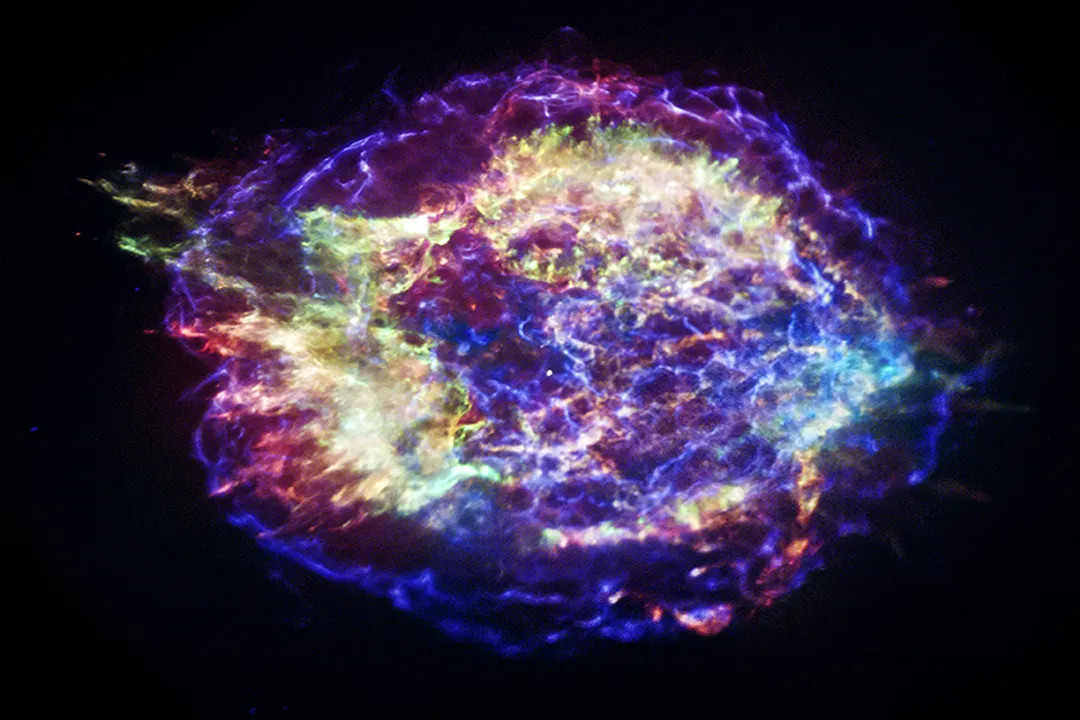
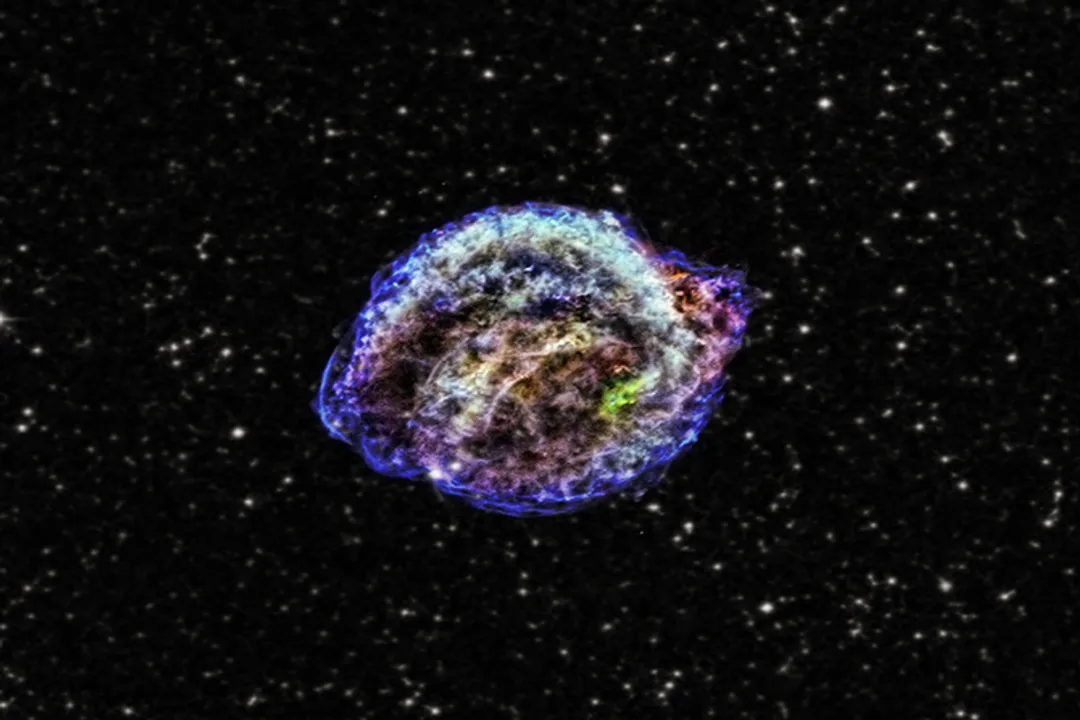
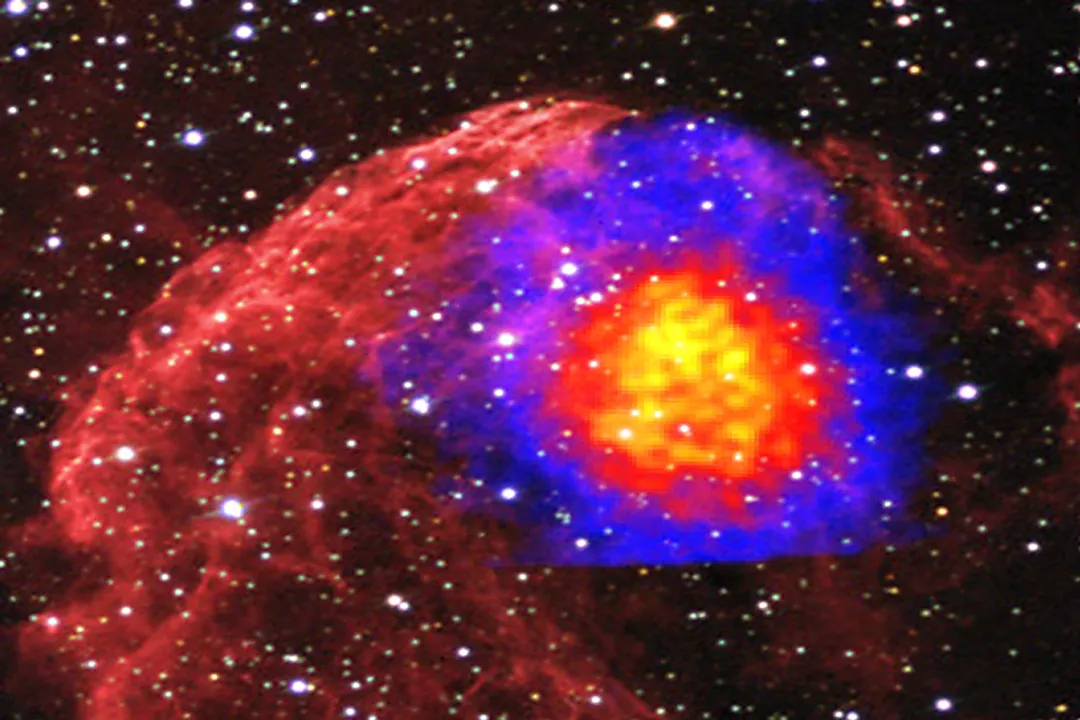
If the resultant neutron star remnant happens to be less than its own theoretical stability limit (which is higher than the white dwarf limit), there’s a slight theoretical possibility it could become unstable, though the extreme conditions generally favor stability or further collapse to a black hole. [2] The incredible energy released during the core-bounce, especially the neutrino burst, is what physically launches the rest of the star into space, sweeping up that newly forged heavy matter along the way. [1] The remnants of this ejected material can be observed centuries later as expanding supernova remnants, glowing brightly in X-rays, rich in the iron that marked the core's final stand. [1] This cycle ensures that every new generation of stars, and everything that forms around them, inherits the chemical legacy of the one that died by reaching the end of the fusion road at iron. [1]
#Videos
Can You Kill A Star With Iron? Why Iron Isn't Poison to Stars - YouTube
Related Questions
#Citations
If stars stop fusion at Iron (Fe) then how did heavier elements come ...
Can You Kill A Star With Iron? Why Iron Isn't Poison to Stars - YouTube
What would happen to a star... - Kerbal Space Program Forums
The Origin and Heating Mechanism of Supernova Remnants
Does iron really kill fusion in stars? - Physics Forums
Evolution of Massive Stars: An Explosive Finish | Astronomy
How do stars produce energy if fusion reactions are not viable for us?