What would happen if I touch a neutron star?
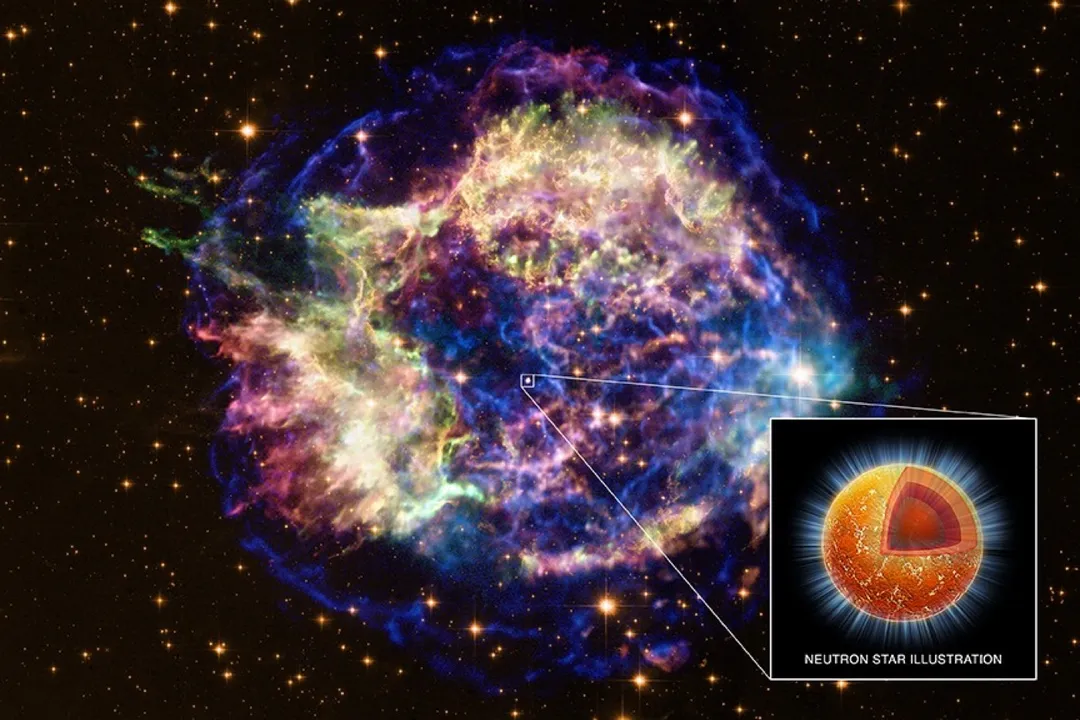
The instant you might imagine making contact with a neutron star, the very idea of "touching" becomes scientifically meaningless. The sheer scale of the forces involved means that long before your hand, or any part of you, could register contact with its surface, you would be subjected to several simultaneous, catastrophic forms of destruction. [1][5] A neutron star is the ultra-dense remnant left after a massive star undergoes a supernova explosion. [5] It packs perhaps one and a half to three times the mass of our Sun into a sphere only about 12 miles (20 kilometers) across, roughly the size of a major city. [4][5][8]
# Tidal Shredding
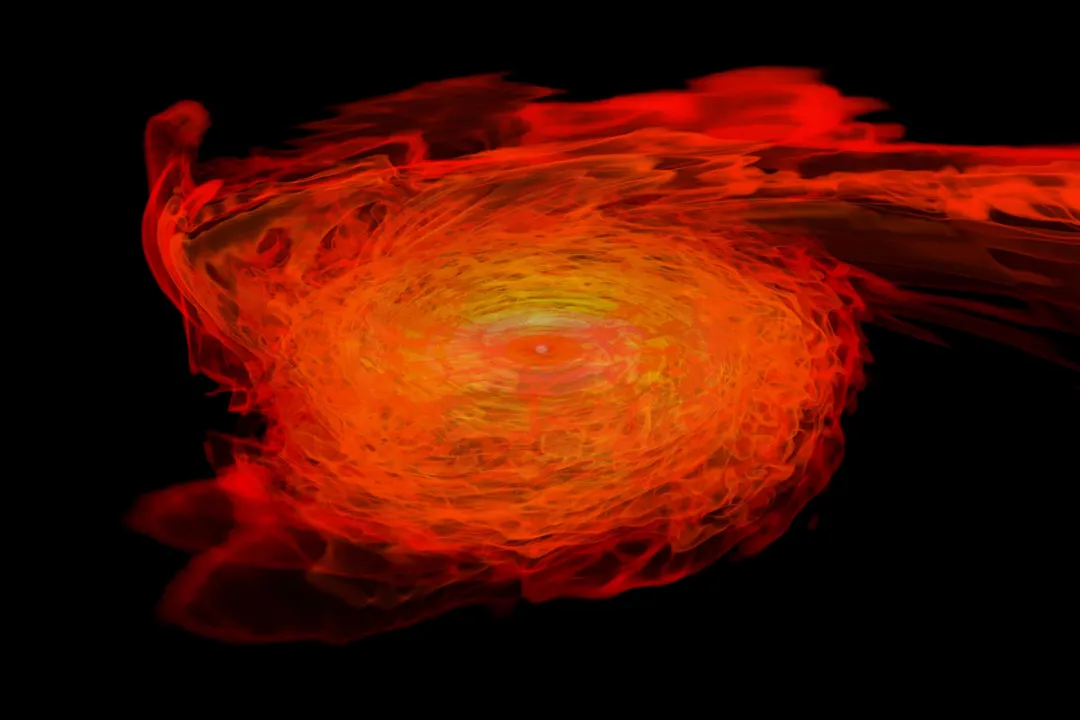
The most immediate and overwhelming factor is the gravity. The surface gravity on a neutron star is staggeringly high, estimated to be about times stronger than Earth's gravity. [5] To conceptualize this, if you were standing on the surface, an object only a few feet taller than you would weigh billions of tons. [4]
However, reaching the surface is impossible due to tidal forces, which are differences in gravitational pull across an object. [5] If you approached feet-first, the gravity pulling on your feet would be vastly stronger than the gravity pulling on your head. [5] This difference would stretch you vertically while simultaneously squeezing you horizontally. [5] This process is often termed spaghettification, but on a neutron star, the effect is so extreme that you would be torn apart into a stream of fundamental particles almost instantaneously, long before you ever made physical contact with the star's crust. [5] You would effectively be disassembled at the atomic or subatomic level by the gravitational gradient itself. [5]
This intense gravitational field also means that the escape velocity—the speed needed to break free from its pull—is an astonishing fraction of the speed of light, often cited as being around half the speed of light. [4] Anything that falls toward the star accelerates toward it at phenomenal rates. [5]
# Stellar Density
The density of the material making up the neutron star is where our everyday understanding of matter completely breaks down. [8] If you could somehow take just one teaspoon of neutron star material and bring it to Earth, that single spoonful would weigh roughly six billion tons. [8] This is comparable to the weight of Mount Everest. [8] This density is achieved because gravity has crushed the star's matter so tightly that the normal atomic structure is gone; protons and electrons are squeezed together to form neutrons. [4][8]
When considering the impact of this density, it's interesting to contextualize the violence of the approach. While the star itself is only about 12 miles wide, the gravitational well it creates extends far into space. [5] The forces that rip you apart happen across a relatively short distance in space near the star, but the rate at which these destructive forces manifest is what is lethal. [5] It is not merely that the gravity is strong everywhere; it is that the change in gravity over a short distance (the tidal gradient) is so immense that disassembly is guaranteed long before reaching the star's physical edge. [5]
# Surface State
If, by some unimaginable mechanism, you survived the tidal shredding and somehow landed on the surface, the environment would still be instantly lethal. [4] Contrary to what one might picture as a cosmic ball of liquid or gas, a neutron star possesses a solid, rigid crust. [4] This crust is only a few centimeters thick, but it is incredibly hard, composed of atomic nuclei (like iron) packed so tightly that they form a crystalline structure. [4] Beneath this thin crust lies the superfluid interior, made primarily of neutrons. [4]
Furthermore, neutron stars are incredibly hot. [4] Their surfaces can reach temperatures of around one million degrees Celsius, or even higher, which is hot enough to vaporize any known material instantly. [4] The interaction wouldn't be a simple bump; it would be an immediate, total phase transition from solid human matter into a super-heated plasma, instantly incorporated into the star’s outer layer. [4]
# Matter Interaction
Some thought experiments amusingly discard the physical realities of gravity and heat to ask a purely theoretical question about how matter interacts at that level. [2] If we hypothetically removed the crushing gravity and the searing heat, would your hand just pass through the star?[2] The answer in this constrained scenario leans toward yes, in a sense. [2] In normal matter, the electromagnetic forces between the electrons in your hand and the atoms of the star create a repulsion that stops you from passing through solid objects. [2] However, a neutron star is not made of normal atoms; it is composed almost entirely of neutrons, which are electrically neutral. [2] Without that electromagnetic repulsion to stop you, your hand would likely continue sinking into the star’s material. [2]
However, this theoretical scenario ignores the overwhelming reality: the Pauli exclusion principle, which governs how neutrons must arrange themselves, would still provide some repulsive pressure, though this pressure is what creates the star's stability in the first place against further collapse. [5] In reality, any attempt to push against the star would meet resistance derived from the degenerate neutron matter, but that resistance would be immediately overwhelmed by the star's gravity. [5]
# Final Moments
Putting the pieces together reveals a scenario that offers no possibility of survival or observation:
- Approach: As you near the star, tidal forces begin stretching you violently. [5]
- Disassembly: Long before reaching the 12-mile radius, the differential gravity tears your body into a plasma stream. [5]
- Impact Equivalent: This stream of super-heated, gravitationally accelerated particles smashes into the star's crust at a significant fraction of the speed of light. [4]
- Absorption: The material making up "you" is immediately vaporized by the millions of degrees of surface heat and absorbed into the incredibly dense stellar material, effectively becoming part of the star's crust or falling deeper into its neutron superfluid interior. [4]
The entire process, from the lethal tidal forces initiating destruction to the final incorporation of your constituent atoms into the neutron star, would occur virtually simultaneously, leaving no discernible pause between the different forms of obliteration. [1][5] The sheer gravitational pull is so strong that the concept of "touching" becomes indistinguishable from "falling into the deepest pit in the universe" at maximum velocity. [4]
#Videos
DO NOT TRY—Seeing How Close I Can Get To a Drop of Neutrons
What Would Happen If You Stood On a Neutron Star? - YouTube
Related Questions
#Citations
Would making contact with a piece of neutron star turn you ... - Reddit
What would happen if you touched a neutron star, assuming ... - Quora
DO NOT TRY—Seeing How Close I Can Get To a Drop of Neutrons
Could you walk on a neutron star? - BBC Science Focus Magazine
What will happen in principle if one tries to push a neutron star?
What if you touched a neutron star? - Facebook
What would happen if a tablespoonful of a neutron star was brought ...
Exploring the Effects of Touching a Neutron Star - TikTok