Why do astronomers have difficulty looking at distant stars?
The light that finally reaches our sophisticated instruments from the farthest reaches of the cosmos has endured an astonishingly long and perilous voyage. Astronomers face a series of fundamental physical limitations and environmental hurdles when attempting to observe these distant stellar beacons, challenges that range from disturbances right here in our own backyard to the sheer mechanics of light traveling across unimaginable gulfs of space. [3] It is not simply a matter of pointing a bigger telescope; the difficulties are deeply rooted in how light interacts with matter and distance.
# Atmospheric Blur
The very air surrounding our planet presents the first, immediate obstacle to clear viewing. Even on the calmest nights, the Earth’s atmosphere is in constant motion, creating pockets of varying temperature and density. [5] This causes the light from a star to be refracted slightly and randomly as it passes through, resulting in the familiar twinkling effect we see with the naked eye. [3] For professional astronomers, this atmospheric turbulence, often called "seeing," blurs fine details and severely limits the resolution an optical telescope can achieve, making distant objects smear together rather than appearing as sharp points. [5]
Furthermore, the atmosphere doesn't just distort light; it also absorbs it. Certain gases and molecules present in the air effectively block specific wavelengths of light from reaching ground-based telescopes. [5] This phenomenon, known as atmospheric extinction, means that observations are inherently biased toward the wavelengths that penetrate the air best, typically visible light and some radio waves, while blocking others like most infrared and all ultraviolet light. [5] A star appearing bright in visible light might have a completely different spectral signature that we cannot access fully from the surface.
While ground-based techniques like adaptive optics actively measure and counteract the atmospheric distortions in real-time—essentially creating a temporary, clearer patch of sky—this technology adds immense complexity and cost. [5] An interesting way to frame these challenges is to separate the temporal blurring from the opacity problem. Twinkling is a time-dependent issue caused by moving air cells scrambling the light path moment by moment, whereas molecular absorption is a fixed filter affecting all observations at a specific wavelength until the instrument is moved into space.
# Dust Veil
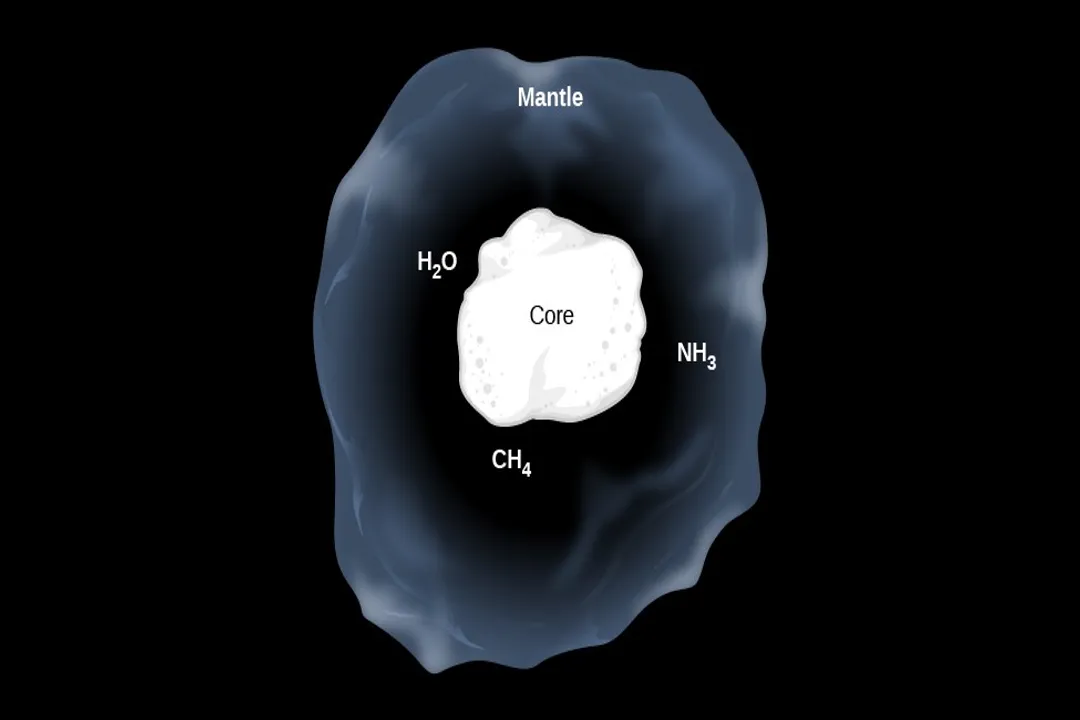
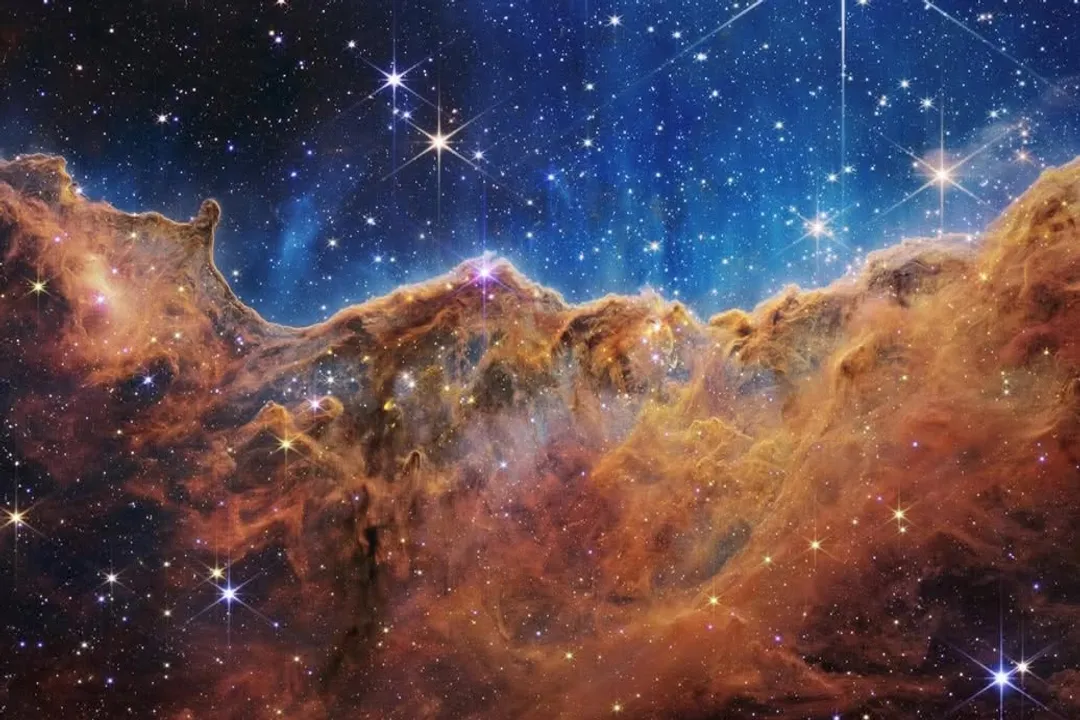
Beyond the protective layer of our atmosphere lies the vast, imperfect vacuum of space, yet even this is not entirely empty. Within our own Milky Way galaxy, and indeed within distant galaxies, there are massive clouds of interstellar gas and microscopic particles—cosmic dust—that impede our view. [8] This dust effectively acts as a cosmic curtain, scattering and absorbing starlight that tries to pass through it, particularly at shorter, bluer wavelengths. [8]
This obscuration is more insidious than simple atmospheric blockage because it is not always uniform. One star might be partially hidden behind a relatively thin, patchy cloud, while another, perhaps even closer but in a different direction, might be completely obscured by a dense molecular cloud. [8] This leads to situations where a star that appears dim might actually be intrinsically bright but heavily obscured, or a fainter star might seem relatively bright because it lies in a relatively clear line of sight. [7] Dealing with this requires astronomers to measure the reddening effect of the dust, which is a key indicator of how much visible light has been stolen or scattered away from the observer. [8]

# Light Fading
The most fundamental difficulty in observing distant stars stems from the geometry of the universe itself. Light spreads out in three dimensions, meaning that as the distance to a star increases, the energy we receive decreases proportionally to the square of that distance—the inverse-square law. [9] For stars billions of light-years away, the amount of light arriving at Earth is minuscule, often registering as just a few photons per second, if that. [3]
This extreme attenuation means that the apparent brightness drops off so rapidly that even the most massive, luminous stars at great distances become incredibly difficult to detect against the background noise of the cosmos. [9] Adding to this, when we look at an object millions or billions of light-years away, it appears tremendously small in the sky, occupying a tiny angular area. [9] Telescopes must capture this faint, small point source across a wide aperture, but even with immense mirrors, capturing enough signal to analyze the light meaningfully takes long exposure times, and the resulting image is just that—a point, lacking any discernible size or structure as one might see with nearby stars. [9]
# Verification Hurdles
Knowing that a faint smudge is a star is one thing; knowing its true distance and nature is another, often presenting equal difficulty. Astronomers rely on a sequence of overlapping methods, often called the cosmic distance ladder, to gauge remoteness. [6] The rungs of this ladder depend on identifying objects whose intrinsic luminosity, or absolute magnitude, is known—standard candles like Cepheid variables or Type Ia supernovae. [6]
However, if the initial rungs of this ladder—the distances to nearby stars measured by parallax, for instance—have even a small percentage of error, that error is magnified exponentially as the measurement is extended to farther and farther galaxies. [6] For example, estimating the distance to a structure in the early universe relies on calibration from objects only visible across a few hundred million light-years, whose own measurements are sensitive to dust and local conditions. [6][7]
This dependency means that small inconsistencies in how we measure brightness or how we correct for the intervening dust can lead to significant discrepancies in the calculated distances to the farthest objects. [7] Researchers constantly refine these calibrations because errors that seem negligible on a stellar scale translate into millions or even billions of light-years when applied across the universe. To manage this, modern observational campaigns require an almost unbelievable level of precision in photometry—the measurement of light intensity—simply to pin down the location of a distant star cluster with confidence. [7] The difficulty is less about seeing the light and more about trusting the quantity of light we receive to accurately map the universe's scale.
Related Questions
#Citations
How do astronomers know so much about a distant space object just ...
Earth Science Unit 2 Flashcards - Quizlet
What makes it so difficult to see certain stars in our Galaxy, and how ...
When astronomers look at distant objects—far away in both space ...
Factors That Hinder Astronomical Observations on Earth - Lesson
Extragalactic Distance Scale | Center for Astrophysics | Harvard ...
Cosmic Dust | Astronomy - Lumen Learning