How do astronomers detect distant galaxies?
Glimmering specks in the night sky, the most distant galaxies offer snapshots of the universe when it was vastly younger than it is now. Astronomers don't just see these objects; they measure their incredible distances, a feat that relies on a combination of geometry, physics, and an ever-improving set of tools. The sheer scale involved means that detecting a galaxy is one thing, but accurately ascertaining how far away it truly is requires a sophisticated understanding of light itself and the expansion of the cosmos. [1][2]
# Faint Signals
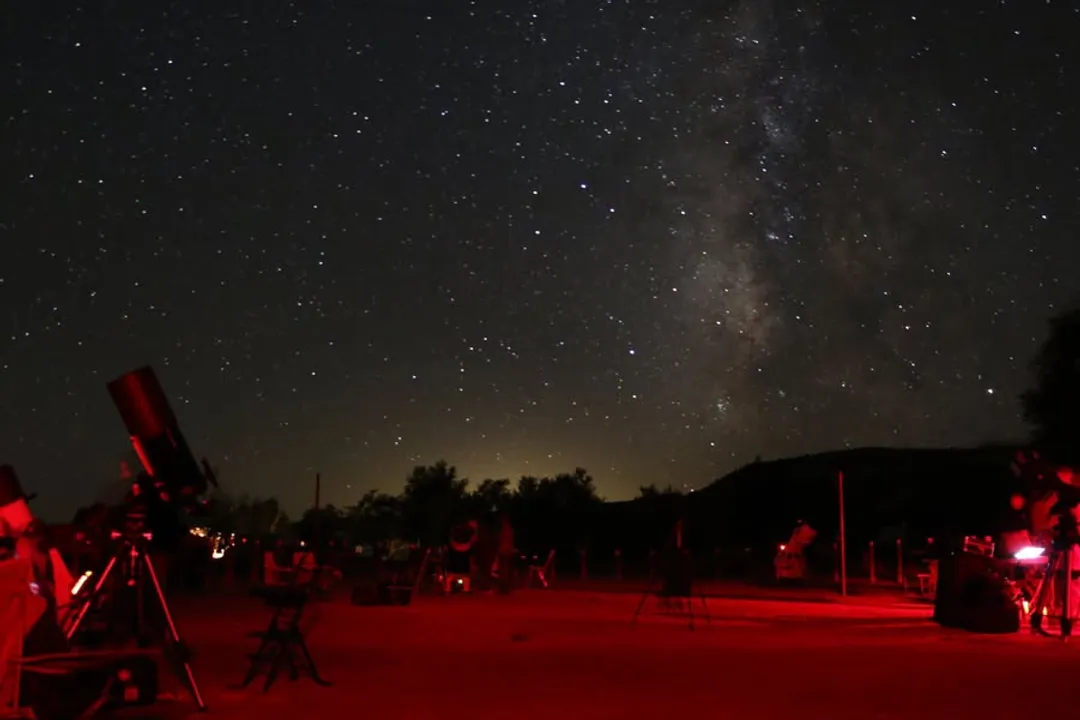
The most immediate hurdle in observing distant galaxies is their apparent faintness. Light intensity diminishes rapidly with distance—specifically, by the inverse square of the distance. [7] When an object is billions of light-years away, the amount of light reaching even our most powerful telescopes is minuscule. [7] Therefore, the first step in "detection" is gathering enough photons to form a measurable signal. This is accomplished using large, sensitive optical telescopes that focus light onto specialized electronic detectors, like Charge-Coupled Devices (CCDs). [7]
However, a faint, fuzzy patch of light could be a distant galaxy or, theoretically, a cluster of nearby stars or even an uninteresting dust cloud. Astronomers must apply checks to confirm its nature. If an object's apparent brightness is extremely low, but its angular size (how much of the sky it takes up) is also extremely small, this combination strongly suggests immense distance, ruling out a nearby star cluster. [5] A key differentiator comes from analyzing the spectrum of that light, which reveals the object's chemical makeup and motion, offering far more conclusive evidence than mere brightness alone. [3]
# Spectral Shifts
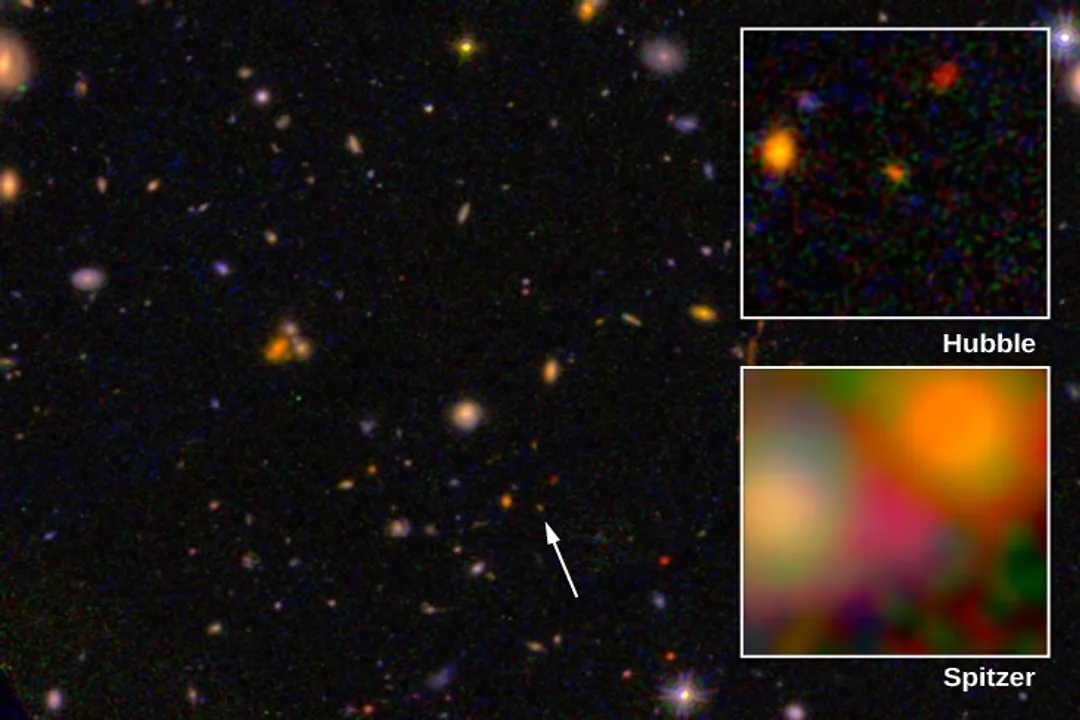
The crucial piece of evidence that confirms a galaxy is indeed distant and helps calculate that distance is the phenomenon known as redshift. [1][2] This concept stems from the Doppler effect, which we commonly associate with sound—a siren's pitch drops as it moves away from you. [1] Light behaves similarly: as a light source moves away from an observer, its wavelengths are stretched, shifting the light toward the red end of the electromagnetic spectrum. [2]
For very distant galaxies, this stretching is significant. Astronomers examine the light by splitting it into its component colors using an instrument called a spectrograph. [1] They look for known absorption or emission lines—unique patterns created by specific chemical elements like hydrogen or calcium—that serve as an astronomical fingerprint. [2] In a stationary source, these lines appear at specific, known wavelengths. In light from a receding galaxy, the entire pattern is shifted toward the red end of the spectrum. [1][2] The amount of this shift directly relates to the galaxy's recession velocity. [2]
This recession velocity is then linked to distance through Hubble's Law, which states that the farther away a galaxy is, the faster it appears to be moving away from us. [2] This relationship, pioneered by Edwin Hubble, is the cornerstone of modern extragalactic distance measurement. [1] The measured redshift, often denoted by the letter , can be quite large for the most ancient galaxies, signifying extreme recession speeds that are a byproduct of the universe's expansion, not just the galaxy moving through space. [2] For example, a galaxy exhibiting a high redshift value is not just farther away, but we are seeing it as it was much earlier in cosmic history. [3]
# Measuring the Cosmos
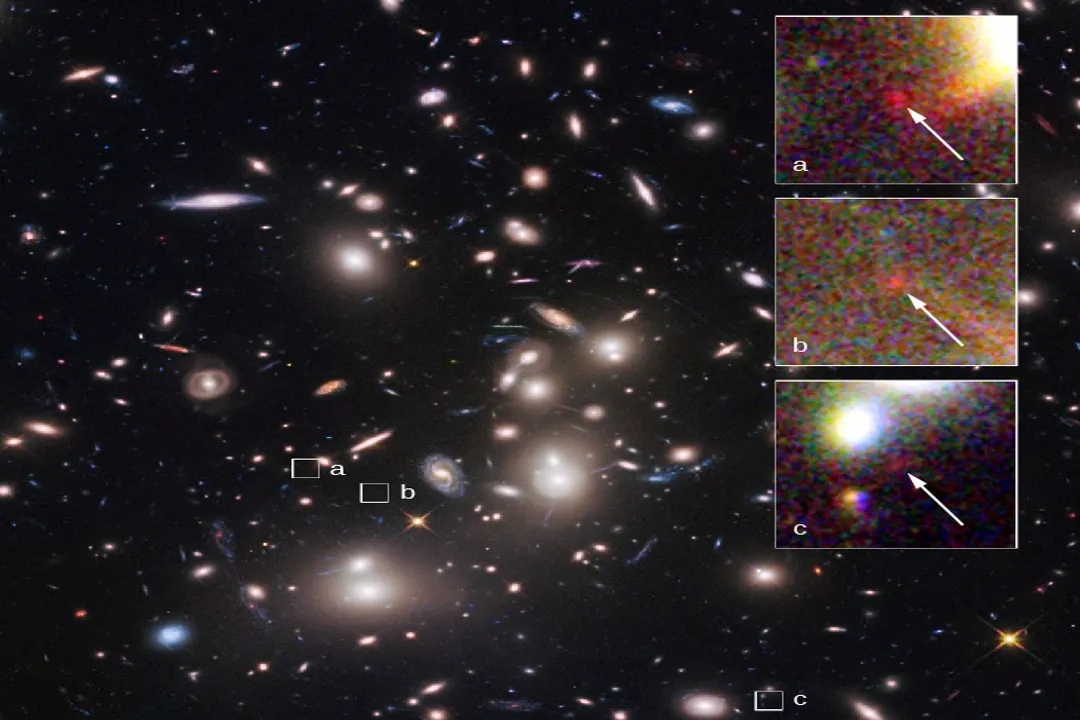
While redshift tells us about motion relative to us, astronomers still need independent methods to calibrate the Hubble constant and to measure distances to closer galaxies that haven't undergone the dramatic redshift of the furthest objects. This creates a cosmic distance ladder, where each rung helps calibrate the next. [1]
# Standard Candles
One essential rung relies on Standard Candles—objects whose true, intrinsic brightness (luminosity) is known or can be accurately estimated. [1] Once you know how bright an object actually is, you can compare that to how bright it appears from Earth, and from that difference, calculate the distance. [1]
The most famous standard candles are Cepheid variable stars. [1] These stars pulsate, brightening and dimming in a predictable cycle. The crucial discovery was that the period of pulsation is directly related to the star's absolute luminosity. [1] By measuring the period of a Cepheid in a relatively nearby galaxy, astronomers determine its true brightness, and by comparing it to its observed brightness, they determine its distance. [1] For even greater distances, Type Ia supernovae are employed as standard candles. These explosions of white dwarf stars have a remarkably consistent peak luminosity, allowing them to be seen across vast cosmological distances where individual Cepheids would be too faint to resolve. [1]
# Standard Rulers
Another powerful technique, which complements the candle method, involves Standard Rulers. [1] Instead of relying on intrinsic brightness, this method uses physical size. If astronomers know the true physical diameter of an object (or a feature within an object), they can measure its angular size on the sky. [1] The relationship between physical size, angular size, and distance allows for a distance calculation. [1] For instance, the size of the central bulge in certain types of spiral galaxies can sometimes be used as a standard ruler, provided the type of galaxy can be reliably identified. [1]
It's interesting to consider that these distance measurements are often chained together. For example, Cepheids are used to measure distances to nearby galaxies where Type Ia supernovae have also been observed, thus calibrating the supernovae's true brightness. This calibrated supernova scale is then used to measure distances to galaxies far enough away that we cannot resolve individual Cepheids. [1]
| Distance Measurement Rung | Primary Observable | Calibration Reliance | Useful Range (Conceptual) |
|---|---|---|---|
| Parallax | Nearby Stars | Direct Geometry | Local/Milky Way |
| Cepheid Variables | Pulsation Period | Supernovae in same galaxy | Nearby Galaxies |
| Type Ia Supernovae | Peak Brightness | Cepheids in host galaxies | Cosmological Distances |
| Redshift | Spectral Line Shift () | All preceding rungs for Hubble constant calibration | Very Distant Universe |
The sheer elegance of this system is in its reliance on multiple, independent physical principles that consistently point to the same cosmological distances.
# Beyond the Blur
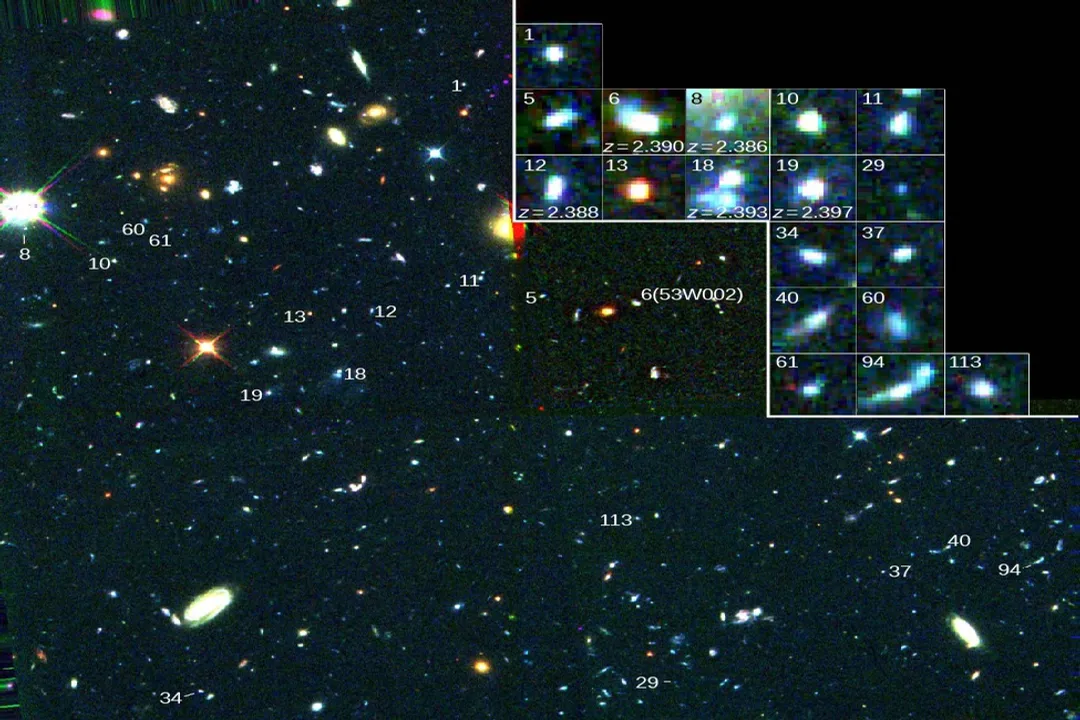
A common point of confusion arises when considering how astronomers can be sure these distant objects aren't actually collections of bright, local stars mimicking the appearance of a distant galaxy. This is where the power of detailed observation steps beyond simple brightness comparison. [5]
When astronomers use spectroscopy, they are not just checking for a redshift; they are looking at the integrated light from billions of stars and gas clouds within the object. [3] This integrated light produces a composite spectrum characteristic of a galaxy, containing features like the combined light from an older stellar population alongside emission lines from ionized gas clouds where star formation might be occurring. [3] A nearby star cluster, conversely, would show the sharp, distinct spectrum of a few dominant stars. [5] Even if a nearby star cluster were somehow perfectly arranged to mimic the angular size and brightness of a distant galaxy, its spectrum would not match the complex, integrated signature of an entire stellar population undergoing various life stages across vast interstellar distances. [5] The ability to resolve the emission lines from nebulae within the object further solidifies the identification as a collection of stars and gas—a galaxy—rather than a single, albeit powerful, nearby star. [3]
Furthermore, the very premise of the redshift measurement relies on the observed light having traveled an immense distance through space. If the object were nearby, the observed redshift would be zero, or a small blueshift, corresponding only to that object's peculiar motion within the local group, which is orders of magnitude smaller than the cosmological redshift observed for distant galaxies. [1][5]
# Instrumental Reach
This entire enterprise—from collecting faint light to measuring tiny spectral shifts—is fundamentally dependent on technological advancement. [8] Modern ground-based and space-based telescopes are engineered to capture light across the spectrum, from infrared to visible light, which is crucial because the light from the most distant objects is often heavily redshifted, pushing their visible light into the infrared where the atmosphere is less obstructive. [7] Telescopes like the James Webb Space Telescope (JWST) are specifically designed to excel in the infrared range to probe these very early, highly redshifted galaxies. [7]
The instruments mentioned in some contexts, like radio telescopes, are essential for mapping the neutral hydrogen gas that permeates galaxies, an element crucial for understanding their structure and evolution, even if the visible light is too faint to see. [6] In essence, observing the distant universe is an exercise in engineering sensitivity and spectral precision. [8] We are essentially reading the oldest available letter sent from the dawn of time, and we need incredibly precise instruments to decipher the faded ink. [8]
# Insights Into Cosmic History
The value of detecting and measuring distant galaxies goes far beyond simply mapping where things are in space; it is about looking back in time. [3] Because light takes time to travel, observing a galaxy 10 billion light-years away means we are seeing it as it existed 10 billion years ago. [7]
When astronomers study the spectra of these ancient systems, they are studying the building blocks of the early universe. [3] The chemistry of these ancient galaxies tells us about the first generations of stars that lived and died, enriching the interstellar medium with heavier elements. A galaxy with a very low metallicity (low abundance of elements heavier than helium) is almost certainly one of the universe's earliest inhabitants. [3] Analyzing the ratios of different elements in the light allows experts to build models of galactic evolution, understanding how these primitive clumps of matter coalesced into the grand spirals and ellipticals we see nearby today. [3][6] This comparison between the young, distant systems and the mature, local ones provides a continuous record of cosmic development.
When we consider the limitations of the methods described, an interesting point arises about the nature of our knowledge. Since all distance measurements for objects beyond our immediate local group rely on extrapolation—the distance ladder—our understanding of the largest scales is inherently tied to the accuracy of the smallest scale measurements (like parallax and Cepheids). [1] A slight miscalibration in the brightness of a Type Ia supernova, for example, would cause a systematic error in the calculated distances to billions of galaxies, subtly skewing our understanding of the universe’s overall size and expansion rate. This constant refinement of the distance scale underscores the "trust" factor in astronomical knowledge; it is built not on one observation, but on multiple interlocking physical constants. [5] The collective agreement between redshift measurements and standard candle/ruler determinations across cosmic time gives us the confidence to state that these objects are, indeed, billions of light-years away, and not just a few million. [5]
#Videos
How Do Astronomers Locate Distant Galaxy Clusters? - YouTube
Related Questions
#Citations
How do astronomers measure distances to stars and galaxies?
Far, Far Away: Just How Distant Is That Galaxy?
How do astronomers know so much about a distant space object just ...
Distant Universe - UW-Madison Astronomy
How do astronomers know that distant galaxies aren't actually ...
How Do Astronomers Locate Distant Galaxy Clusters? - YouTube
Observations of Distant Galaxies | Astronomy - Lumen Learning
How do astronomers know what distant space looks like even when ...
How do astronomers know so much about distant stars? - Facebook