What did Hubble find out about the most distant galaxies?
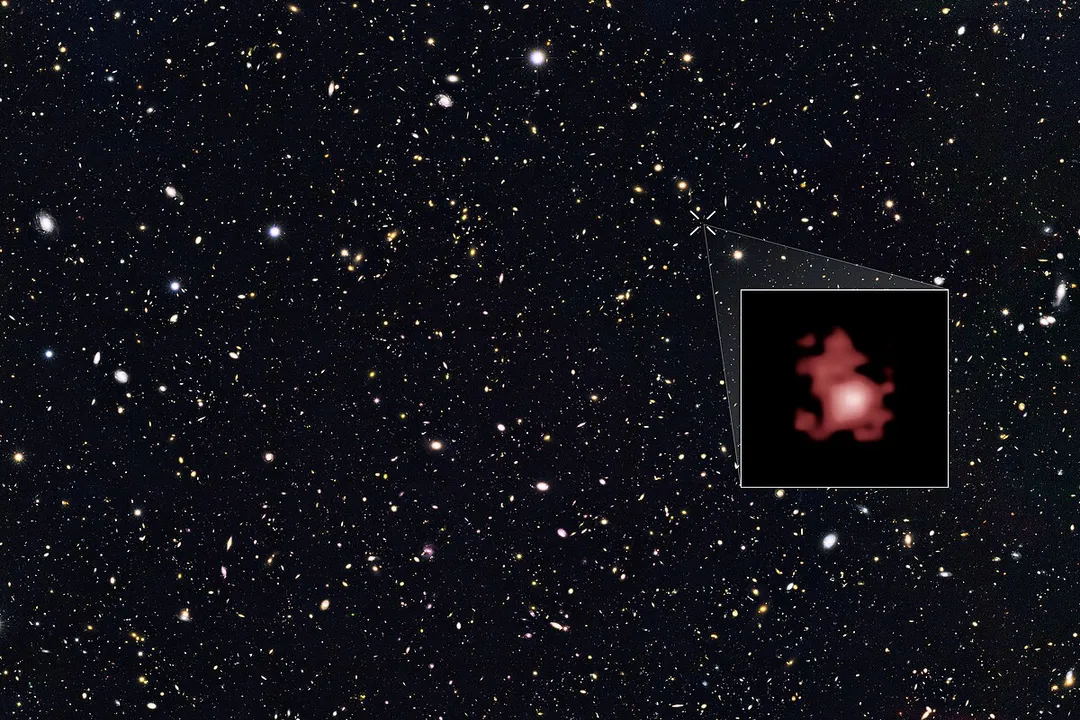
The light reaching us from the farthest galaxies has traveled across nearly the entire age of the cosmos, offering us an unprecedented look at the universe when it was just a cosmic infant. For decades, the Hubble Space Telescope has been the primary instrument capable of capturing these faint whispers from the deep past. Its mission to probe the earliest structures in the universe revealed galaxies that existed far sooner after the Big Bang than many early models predicted. These observations have fundamentally reshaped our understanding of cosmic evolution, showing that star and galaxy formation began remarkably quickly.
# Looking Back in Time
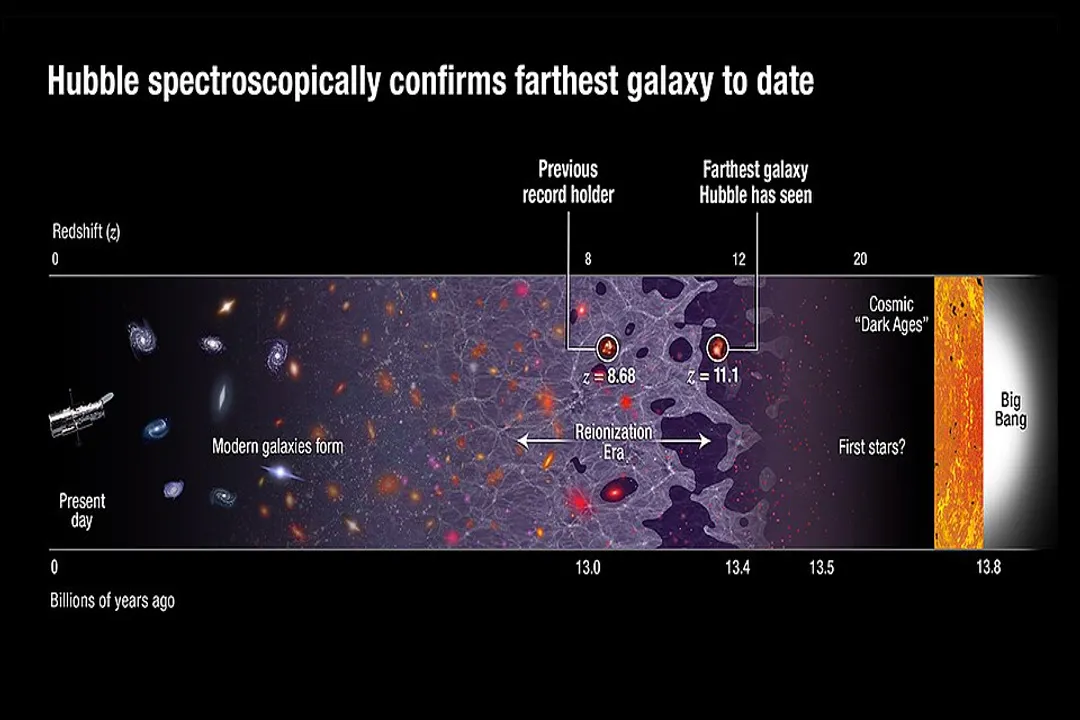
When astronomers speak of the "most distant" galaxy, they are speaking about the most ancient light they can detect, which corresponds to the greatest look-back time. The farther away an object is, the longer its light has spent crossing the expanding void of space to reach our telescopes. This distance is often quantified using a concept known as redshift (). Light from objects moving away from us is stretched to longer, redder wavelengths—this is the Doppler effect applied to light, known as cosmological redshift.
Hubble's primary success in this realm hinged on identifying objects with extremely high redshifts. For instance, the galaxy GN-z11, which held the record for a significant period, was confirmed to have a redshift of . This value translates to an incredible look-back time. While the exact age determination can involve complex modeling of the universe's expansion history, a redshift of means we are seeing the galaxy as it appeared roughly 400 million years after the Big Bang. To put that into perspective, the universe is currently about 13.8 billion years old; Hubble was effectively looking back over 96% of the universe's history.
# Record Galaxy Discoveries
The quest for the most distant galaxy was characterized by a continuous string of broken records, each one pushing the frontier closer to the Big Bang. Hubble didn't just find one faint smudge; it systematically pushed the limits of detection, relying on very long exposures and the sensitivity of its instruments, like the Wide Field Camera 3.
The galaxy GN-z11 is perhaps the most celebrated of Hubble’s distant finds in the later part of its operational prime. Its immense distance was confirmed through spectroscopic analysis, which measures the exact shift in its light spectrum, providing a robust measurement of its redshift. What made this discovery so startling was not just its age, but its surprising brightness and complexity for such an early object. It was observed to be a relatively small galaxy, shining with the light of around 100 million suns, and it appeared to be forming stars at an intense rate. It was much more luminous than expected for a galaxy existing so early in cosmic history.
It is worth noting that when we analyze the data from Hubble, we are often looking at images taken through different color filters, essentially stacking the detection of light that has been redshifted into visible wavelengths from ultraviolet light that was originally emitted by the young stars.
# The Faintness Challenge
Finding a galaxy 13 billion light-years away is akin to spotting a single candle flame across the entire continent of North America. The sheer faintness of these objects presents an enormous observational hurdle. Many of the candidates Hubble spotted were so dim that they initially appeared as mere smudges in deep-field images.
The process to confirm these finds was painstaking. Initial discovery often came from broad photometric surveys (measuring brightness in different color filters), but definitive confirmation required spectroscopy—splitting the light into its constituent colors to measure the precise redshift. Spectroscopic confirmation is much harder because it requires focusing the telescope on a tiny patch of sky for a very long time, collecting the scarce photons.
Hubble’s success wasn't solely guaranteed by its location above the atmosphere; it was the long duration of its mission and the meticulous calibration of its instruments that allowed astronomers to accumulate enough light over many hours of observation to pull these faint signals out of the background noise. In fact, the team that confirmed GN-z11 was incredibly lucky, as the galaxy was positioned in a rare alignment that boosted its light, a phenomenon called gravitational lensing.
A fascinating aspect of these early universe surveys is the role of cosmic luck. When a distant, faint galaxy happens to lie directly behind a closer, massive galaxy cluster, the cluster's gravity acts like a natural magnifying glass, bending and amplifying the background light. Without this fortunate cosmic alignment—where a background object is magnified by a foreground object—many of the most distant confirmed galaxies might have remained too faint for Hubble to ever observe, even with its incredible capabilities. This dependence on rare alignments suggests that the average properties of galaxies at might still be slightly underestimated based only on the gravitationally lensed examples we have confirmed so far.
# Early Galaxies Versus Later Ones
The galaxies Hubble revealed in the early universe—those existing when the universe was less than a billion years old—possessed characteristics strikingly different from grand spirals like our own Milky Way.
The common picture derived from Hubble’s deep views suggests:
- Size and Structure: They were generally small and likely irregular in shape, having not yet merged into the large, ordered spirals or ellipticals we see today.
- Star Formation Rate: They appear to have been forming stars at a much faster rate relative to their total mass than modern galaxies. This high rate of production meant they burned through their available gas quickly.
- Chemical Composition: Being so young, these galaxies had experienced far fewer generations of stars dying and enriching the interstellar medium with heavy elements (anything heavier than hydrogen and helium). They were chemically primitive compared to galaxies today.
These findings challenged older cosmological models that sometimes predicted a slower build-up of galactic structure. Hubble proved that the "cosmic dawn," the period when the first stars and galaxies lit up the universe, occurred surprisingly early.
# Observing Individual Stars
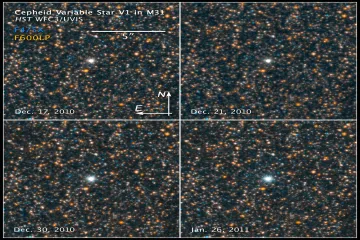
While the primary focus was on entire galaxies, Hubble also managed to achieve something even more specific: isolating the light from a single star in the distant universe. This achievement is technically separate from the record for the most distant galaxy, but it demonstrates the absolute peak of Hubble’s resolving power in looking back through time.
In 2018, Hubble spotted a star, later named Earendel, whose light traveled for about 13 billion years to reach us. This means we see Earendel as it existed around 900 million years after the Big Bang. This star is seen through a massive cluster, WHL0137-08, whose gravity magnified the starlight by a factor of at least 4,000 times, making it visible to Hubble. Earendel is an extreme rarity—a single object seen at a time when the universe was only 7% of its present age.
This observation offers a unique target for studying the physics of the very first generations of stars, which are hypothesized to have been much more massive and hotter than the stars forming today.
# Measuring Cosmic Time
To fully appreciate the numbers involved, it helps to establish a reference point for what these redshifts mean in terms of elapsed time. The universe started expanding from a hot, dense state—the Big Bang.
| Redshift () | Approximate Lookback Time | Cosmic Epoch |
|---|---|---|
| ~7.7 billion years ago | Universe is half its current age | |
| ~11.1 billion years ago | Peak star formation era | |
| ~12.5 billion years ago | End of the 'Dark Ages' | |
| (GN-z11) | ~13.4 billion years ago | million years post-Big Bang |
If we consider the current age of the universe to be billion years, the lookback time for a galaxy at redshift is not simply minus the light travel time, but rather the time elapsed since the light was emitted, which depends on the precise cosmological model (the CDM model). For instance, a light travel time of 13.4 billion years means the universe itself had only existed for about 400 million years when that light started its trip. This is a crucial distinction; we are not just measuring the distance, but the actual age of the emitting region relative to the Big Bang singularity.
# Hubble's Legacy and the Next View
Hubble’s observations of these ultra-distant galaxies established the initial baseline for the study of early galaxy formation. The data it collected confirmed the existence of structure surprisingly early, providing essential targets and constraints for theoretical cosmologists.
However, as impressive as Hubble’s achievements were, its view of the earliest universe remained somewhat limited, especially in the infrared spectrum. The light from the very first galaxies, even those at moderate redshifts, is often stretched so far by expansion that it shifts entirely out of Hubble's optimal visible/near-infrared range and into the mid-infrared.
This is where the next generation of instruments, like the James Webb Space Telescope (JWST), excels. JWST is specifically designed to look much deeper into the infrared, allowing it to observe objects that Hubble could only infer existed, or those that had redshifts too high for its detectors to properly analyze. Hubble mapped the terrain; JWST is now exploring the deepest valleys within that terrain. The legacy of Hubble is ensuring that when JWST looks out, it has a set of established high-redshift objects to compare its new, deeper data against, building upon the foundation laid by the aging but still productive space telescope. Hubble truly set the standard for what "distant" meant in astronomy for nearly three decades.
#Videos
NASA's Hubble Finds Most Distant Galaxy Candidate Ever Seen in ...
Related Questions
#Citations
NASA's Hubble Telescope Observes Most Distant Galaxy
Did Hubble find the most distant galaxy? - CERN Courier
How Lucky Was Hubble To Find The Most Distant Galaxy Ever?
Most distant galaxy: Hubble breaks cosmic distance record
GN-z11 - Wikipedia
Hubble Telescope Reveals Most Distant Galaxies Ever Found
NASA's Hubble Finds Most Distant Galaxy Candidate Ever Seen in ...
Hubble helps find candidate for most distant object in the Universe ...