By what factor was the light from the star Earendel magnified by the cluster WHL0137-08?
Answer
At least 4,000 times
The star Earendel represents an extreme achievement in observational astronomy, requiring massive amplification to be seen by the Hubble Space Telescope. The text specifies that the star was viewed through the massive cluster WHL0137-08, and the gravity of this foreground cluster acted to magnify the starlight originating from Earendel. This magnification factor is stated explicitly to be substantial, reaching 'a factor of at least 4,000 times,' which was necessary to pull the light from an object that existed when the universe was only 7% of its current age into the detectable range of Hubble's instruments.
#Videos
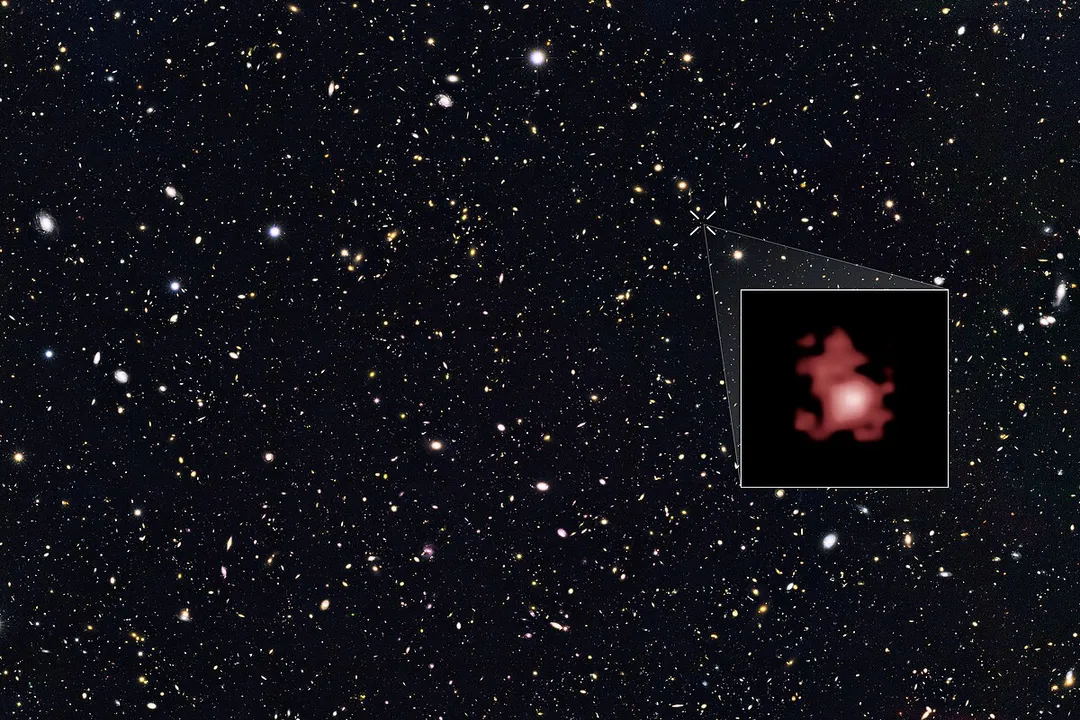
NASA's Hubble Finds Most Distant Galaxy Candidate Ever Seen in ...
Related Questions
What redshift (z) corresponds to galaxy GN-z11 appearing approximately 400 million years after the Big Bang?What physical effect causes light from objects moving away from us to stretch to longer, redder wavelengths?What structural description applies to galaxies Hubble revealed existing when the universe was less than a billion years old?How are the chemical compositions of early galaxies compared to galaxies observed today?What process confirmed the immense distance of galaxy GN-z11 by measuring the exact shift in its light spectrum?What phenomenon, described as a natural magnifying glass, aided the observation of Earendel?By what factor was the light from the star Earendel magnified by the cluster WHL0137-08?What was startling about the galaxy GN-z11 regarding its characteristics for such an early object?In which specific spectrum must JWST excel to observe objects that Hubble struggled to analyze due to extreme redshift?What was the primary instrumentation Hubble used, often employed in long exposures, to push the limits of detection for faint galaxies?