How did Edwin Hubble prove that Andromeda is not a nebula in our galaxy?
The fuzzy patch in the sky known as the Andromeda Nebula had perplexed astronomers for generations. It was one of several "spiral nebulae," objects that seemed to possess structure far beyond the mere gas clouds thought to inhabit the boundaries of our own Milky Way galaxy. For many established scientists, these nebulae, including Andromeda, were simply rotating whorls of gas within our own cosmic island, a long-standing assumption in the early 20th century. The scientific world was deeply divided on this issue, leading to what became known, quite dramatically, as the Great Debate: Were these spirals other galaxies entirely, or were they merely local phenomena?.
# Cosmic Scale Question
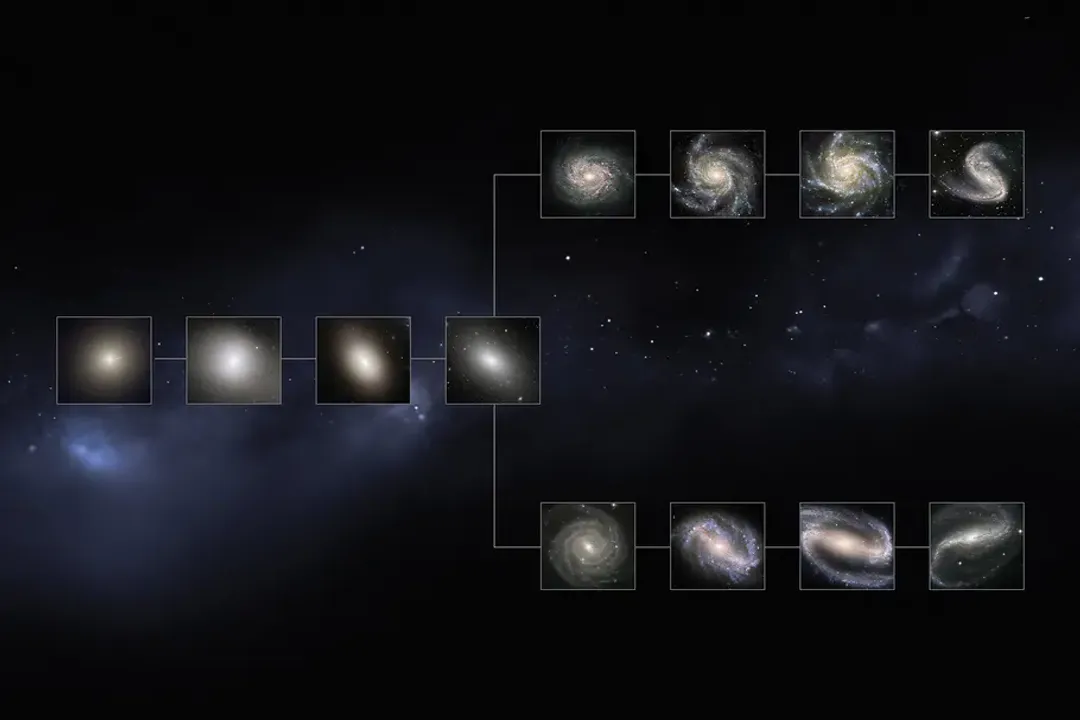
The reigning view, supported by many eminent figures, held that the Milky Way constituted the entirety of existence—a vast but singular entity. If Andromeda were a separate system of stars, it would have to be unimaginably distant, forcing a radical revision of the known size of the cosmos. This was a conceptual hurdle many were unwilling or unable to clear based on the evidence available before the mid-1920s.
Edwin Hubble, working with the magnificent 100-inch Hooker Telescope atop Mount Wilson, possessed the sheer light-gathering power necessary to probe these distant smudges in unprecedented detail. His expertise lay not just in observing, but in meticulously analyzing the faint, flickering light coming from these very objects.
# Finding Standard Candles

Hubble’s definitive proof hinged on identifying a specific class of star: the Cepheid variable. Henrietta Swan Leavitt had previously established a crucial relationship concerning these stars. Cepheids are intrinsically bright stars that pulsate, meaning their luminosity waxes and wanes in a regular, predictable cycle. Leavitt discovered that the longer the period it took for a Cepheid to go from bright to dim and back again, the brighter its true, intrinsic luminosity actually was.
This discovery provided astronomy with its first reliable "standard candle". If you know how bright something truly is (its absolute magnitude) and you measure how bright it appears from Earth (its apparent magnitude), you can use the inverse-square law of light to calculate the distance to that object with surprising accuracy. The challenge with Andromeda was that the individual stars were too faint to resolve until Hubble pointed the powerful Hooker telescope at it.
# Pinpointing Andromeda
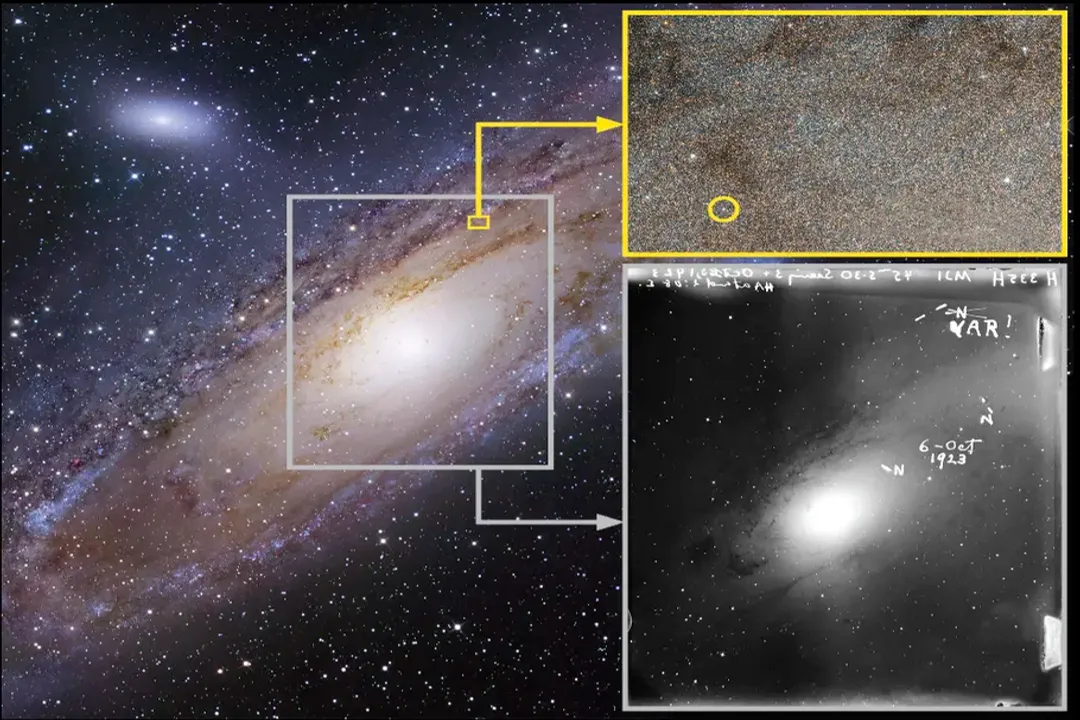
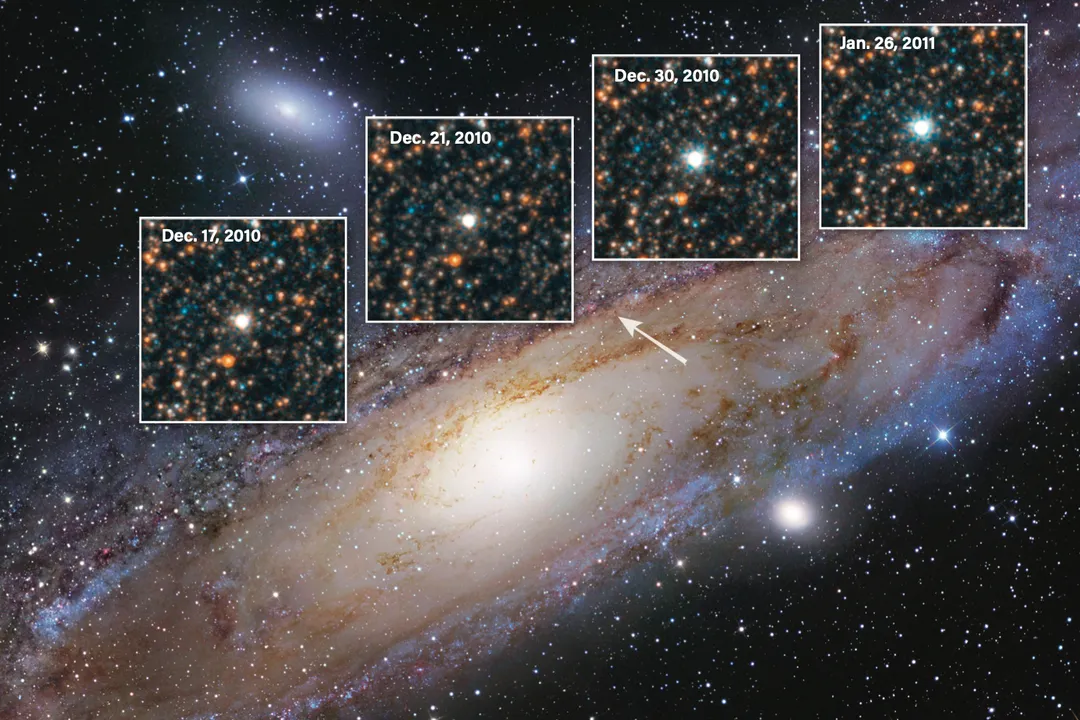
Sometime in late 1923 or early 1924, Hubble focused his attention on the Andromeda Nebula (designated M31) with the express purpose of finding one of these critical variable stars. It was during this concentrated photographic survey that he identified a faint, yet clearly pulsating, star within the spiral arms of the nebula.
Imagine the painstaking process: taking long-exposure photographs night after night, comparing them, and realizing that one specific speck of light was not just a static point, but a star breathing in and out of visibility over a known period. After tracking the star for sufficient time to establish its period of variation, Hubble could unlock the secret of Andromeda's location in the universe.
His initial findings, presented in 1924, revealed a Cepheid in Andromeda whose apparent brightness, when combined with the established Period-Luminosity Relation, placed it so far away that it could not possibly reside within the known boundaries of the Milky Way. The distance calculation placed Andromeda hundreds of thousands of light-years away, firmly establishing it as an extragalactic system—a galaxy in its own right.
This single star, flickering faintly across millions of light-years, shattered the established, self-centered view of the universe held by most of his contemporaries.
# The Calculation's Implication
To grasp the magnitude of this proof, consider the implied scale shift. Before Hubble's work, the accepted diameter of the Milky Way was roughly 30,000 light-years. When Hubble placed Andromeda hundreds of thousands of light-years away, he didn't just add a new object to the map; he revealed that the map itself was vastly undersized. The Milky Way suddenly went from being the universe to being just one member of a population of countless "Island Universes".
| Parameter | Pre-Hubble Estimate (Milky Way) | Post-Hubble Andromeda Distance |
|---|---|---|
| Nature | The entire known universe | An independent galaxy |
| Estimated Size | ~30,000 Light-Years Across | Hundreds of thousands of Light-Years Away |
| Key Tool | Parallax (limited to near objects) | Cepheid Period-Luminosity Relation |
This breakthrough relied on a surprisingly linear logic applied across incomprehensible gulfs of space. The steps were:
- Identify the marker: Spot a Cepheid variable in the target object (Andromeda).
- Measure the cycle: Determine the time it takes for the star's brightness to repeat (the Period).
- Determine intrinsic brightness: Use Leavitt's Law to assign the star its true power output (Absolute Magnitude).
- Measure apparent brightness: Record how bright the star looks from Earth (Apparent Magnitude).
- Calculate distance: Compare absolute vs. apparent magnitudes to solve for distance..
The elegance of this proof lies in its reliance on a fundamental physical law—the steady pulsation of a star—to overcome a conceptual barrier built on assumption. It was an exercise in expertise demonstrating that meticulous observation, paired with theoretical understanding, can redefine reality.

# New Universe Opened
The confirmation that Andromeda was an island universe had immediate and profound consequences for astronomy. It immediately validated the "Island Universe" hypothesis championed by astronomers like Heber Curtis, who had argued against the conventional view during the Great Debate.
This event wasn't just about Andromeda; it was about the multiplicity of galaxies. If one nebula was another galaxy, it stood to reason that others were as well, vastly expanding the scale of creation. While Hubble continued his work, including the later discovery that the universe is expanding, this initial proof regarding Andromeda provided the necessary foundation—the sheer distance scale—upon which all subsequent cosmological findings would rest. The Mount Wilson Observatory, in that moment, ceased being the observer of the local neighborhood and became the window to a universe teeming with galaxies.
What Hubble achieved was more than just solving a local astronomical puzzle; he transformed our place within reality. Before 1924, we lived in a universe measured in thousands of light-years; after 1924, we lived in a universe measured in millions, with the promise of billions beyond. This forced shift in perspective, driven by tracking the tiny pulse of a single star, remains one of the great triumphs of observational science.
Related Questions
#Citations
How did Edwin Hubble prove Andromeda was a galaxy?
NASA Celebrates Edwin Hubble's Discovery of a New Universe
How Edwin Hubble discovered galaxies outside our own - Vox
How did Hubble determine that the Cepheid was actually located ...
95 years ago this month, Edwin Hubble presented his evidence that ...
Discovering Mount Wilson Chapter 8: Discovery of the True Nature ...
In 1923 Edwin Hubble used the 100-inch Hooker telescope at Mount ...
Hubble finds proof that the universe is expanding - PBS
Who is the Man That Discovered the Universe?