What did Edwin Hubble notice about the movement of galaxies?
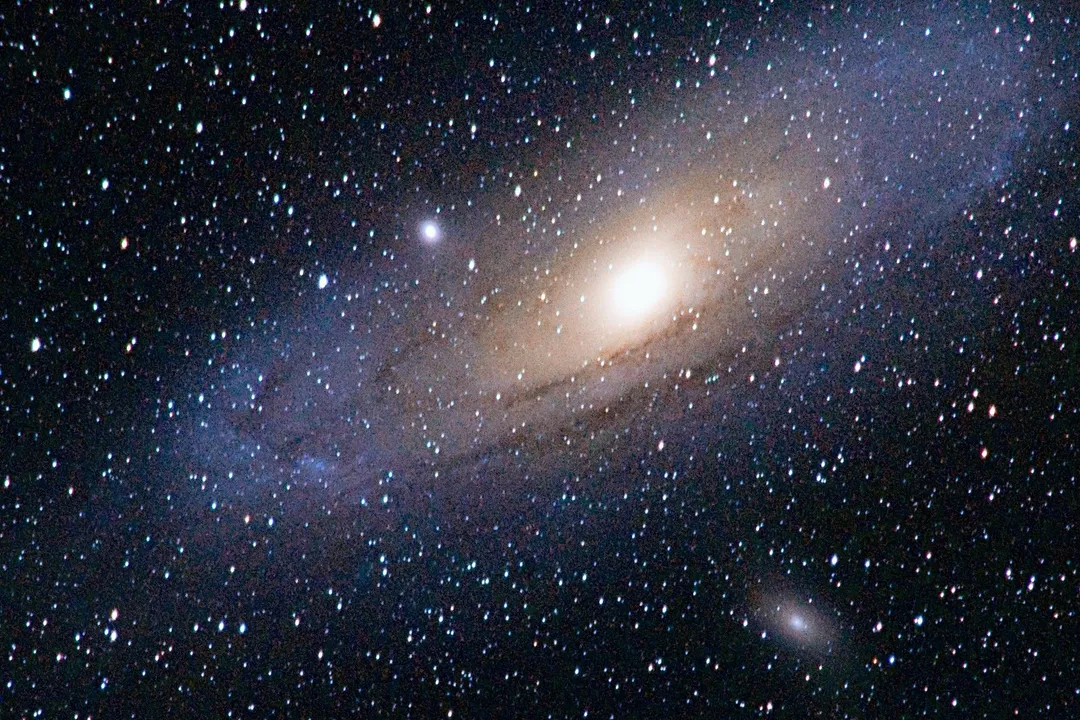
The most profound realization Edwin Hubble brought to astronomy was the stark departure from the idea of a static, eternal cosmos. He noticed something mathematically precise about how the pinpricks of light we now know as galaxies were behaving: they were not stationary observers in the vastness; they were systematically moving away from us, and the rate at which they retreated was directly tied to how far away they were. [1][8] This observation fundamentally reshaped cosmology, suggesting the universe was dynamic, evolving, and likely had a beginning.
# Measuring Distance

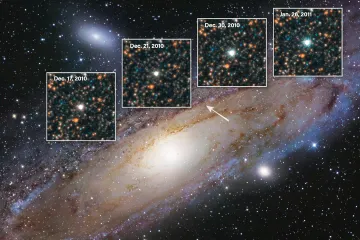
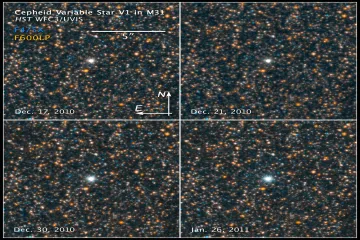
Before Hubble could quantify movement, he needed a reliable way to determine how far away these fuzzy spiral nebulae actually were. Without accurate distance measurements, any observation of their light would just confirm they were moving, but not how their movement related to their location. The key breakthrough came from recognizing certain stars within these nebulae as Cepheid variables. [4]
Cepheid variables are stars whose intrinsic brightness (luminosity) fluctuates in a highly predictable cycle. [4] Henrietta Swan Leavitt had previously established the crucial period-luminosity relationship for these stars: the longer it takes a Cepheid to complete one cycle of brightening and dimming, the intrinsically brighter the star is. [4] By measuring the period of variation in a Cepheid within a distant galaxy, astronomers could determine its true luminosity. Comparing this true brightness to how faint it appeared from Earth allowed for a precise calculation of its distance, confirming that these nebulae were, in fact, entirely separate stellar systems existing far outside the Milky Way. [4] This established the necessary scale for the subsequent velocity measurements.
# Light Shifting
The second critical component involved analyzing the light arriving from these distant galaxies. The light signature from any object is characterized by specific spectral lines—dark or bright bands corresponding to the elements present in the object's atmosphere (like hydrogen or calcium). [5] These spectral lines appear at specific wavelengths when the source is stationary relative to the observer. [6]
When an object moves relative to an observer, the light waves it emits are either compressed or stretched, a phenomenon described by the Doppler effect. [1][6] If a galaxy were moving toward us, its spectral lines would be shifted toward the shorter, bluer end of the spectrum—a blueshift. [6] If it moves away from us, the light waves are stretched, shifting the spectral lines toward the longer, redder end of the spectrum—a redshift. [1][6]
Vesto Slipher had already performed extensive spectroscopic work on these nebulae in the early 1900s and had found that the vast majority exhibited redshift. [2] However, at the time, this was often interpreted simply as random motion within a static universe, or perhaps motion induced by gravitational attraction toward our own galaxy. [2] Hubble’s genius lay in systematically combining Slipher’s velocity measurements with his own, newly calculated distances.
# Velocity Relation
Hubble’s most significant finding occurred when he plotted the measured recessional velocity (derived from the redshift) against the calculated distance for dozens of galaxies. [8]
What he noticed was not random scatter, but a striking, near-perfect proportionality. [1] Galaxies that were twice as far away were moving away roughly twice as fast. Galaxies three times as far away were receding three times as fast. This implied a universal rule governing galactic motion. [2]
This relationship is the essence of Hubble’s Law, often written mathematically as , where is the recessional velocity, is the distance, and is the Hubble Constant, representing the current rate of expansion. [2][10]
To illustrate the direct correlation Hubble observed, consider a simplified representation of the relationship between distance and recession speed, though the actual calculated values involved complex measurements:
| Galaxy Designation | Approximate Distance (Millions of Light-Years) | Measured Recession Velocity (km/s) | Ratio (Velocity/Distance) |
|---|---|---|---|
| M31 (Andromeda) | (Blueshift) | Anomaly/Local Motion | |
| Galaxy A | |||
| Galaxy B | |||
| Galaxy C |
The table highlights the core finding: excluding galaxies in our immediate local group (like Andromeda, which appears blueshifted due to local gravitational interactions), the ratio of recession velocity to distance remains nearly constant, confirming the linear dependence. [2][8] This constancy—that the rate of recession is proportional to the distance—is what defined the expansion of space itself, rather than galaxies simply rushing outward from a central point in space. [1]
If we consider the inverse of the Hubble Constant, , it gives an estimate of the time since the expansion began, providing a measurable age for the universe based purely on observable motion. [8]
# Universe Expanding
The direct proportionality observed by Hubble carried an astonishing implication: the expansion was not centered on the Milky Way. If we were at the center of an explosion, objects farther away would certainly recede faster. However, if we looked from any other galaxy, we would observe the exact same pattern—all other galaxies receding from us at a speed proportional to their distance. [1]
This pattern is best described by imagining points painted on the surface of an expanding balloon. As the balloon inflates, every dot sees every other dot moving away from it, and the farther apart the dots are, the faster the distance between them increases. [1] Hubble’s observation provided the crucial empirical evidence that the universe was expanding uniformly everywhere. [2] His initial data, while showing a clear trend, was based on a limited number of measurements and was subject to the instrumental uncertainties of the time. [3] Nonetheless, the pattern of increasing recession velocity with increasing distance was undeniable. [8]
# Law Nuances
While the term "Hubble's Law" suggests a perfect, timeless constant, modern astronomy recognizes that the initial observation was a simplification of a far more complex reality. [3] Hubble's initial work confirmed linearity in the observable range accessible at the time, but this linearity depends heavily on the value assigned to , which has been revised many times as measurement techniques improve. [9]
One important consideration, which might be seen as a critique of the early "law," is that the expansion rate is not perfectly constant over cosmic history. [3] The presence of dark energy, for instance, suggests that the expansion rate is actually accelerating over time. [9] Therefore, a galaxy receding from us today at a rate predicted by the Hubble Law based on its distance might have been receding slower billions of years ago, or might recede faster in the distant future. [9] The simple linear relationship observed by Hubble is an excellent approximation for distances within the local observable universe, but it smooths over the intricate evolution of the cosmos. [3]
It is instructive to compare the observed redshift to what would happen if one incorrectly assumed only the Doppler effect applied within a static spatial container. If the universe were static, a redshift would primarily indicate gravitational interaction or random movement relative to us. [6] Hubble’s insight was realizing that the uniformity of the relationship across the sky pointed toward the space between the galaxies stretching, carrying the light waves along with it, rather than the galaxies moving through static space. [1][5] This distinction between motion through space and the expansion of space is the conceptual leap that cemented his contribution. [1]
# Legacy and Measurement
Hubble's observation didn't just describe movement; it provided the first real, empirical evidence for an evolving universe, moving away from the steady-state model favored by some at the time. [8] His work, alongside the theoretical models developed by Georges Lemaître, built the foundation for the Big Bang theory. [2]
The measurement of redshift itself, denoted by the redshift parameter , is a quantitative measure of how much the light has been stretched. [5] For relatively nearby galaxies where recession speed is much slower than the speed of light (), the redshift can be approximated as , meaning the velocity is simply times the speed of light (). [5][7] As distances increase, this simple approximation breaks down, requiring more complex relativistic calculations that account for the expansion of the metric of space itself. [1][5]
Hubble’s legacy is therefore built on three pillars: confirming the extra-galactic nature of nebulae, developing the distance ladder to measure them, and finally, quantifying the relationship between that distance and their apparent velocity. He noticed that distance dictated recession speed in a predictable, linear fashion, making the universe demonstrably larger and younger than previously assumed. [8]
Related Questions
#Citations
Hubble Cosmological Redshift - NASA Science
Hubble's law - Wikipedia
Edwin Hubble's FALSE Law - Open Scientific Publishers
Hubble finds proof that the universe is expanding - PBS
Hubble's Law | ASTRO 801: Planets, Stars, Galaxies, and the Universe
ESA - What is 'red shift'? - European Space Agency
Red-shift Exam Questions Flashcards - Quizlet
Hubble's law: Why are most galaxies moving away from us? - Space
Hubble's Law and the expanding universe - PNAS
Hubble Expansion