What did Hubble notice about the spectrum?
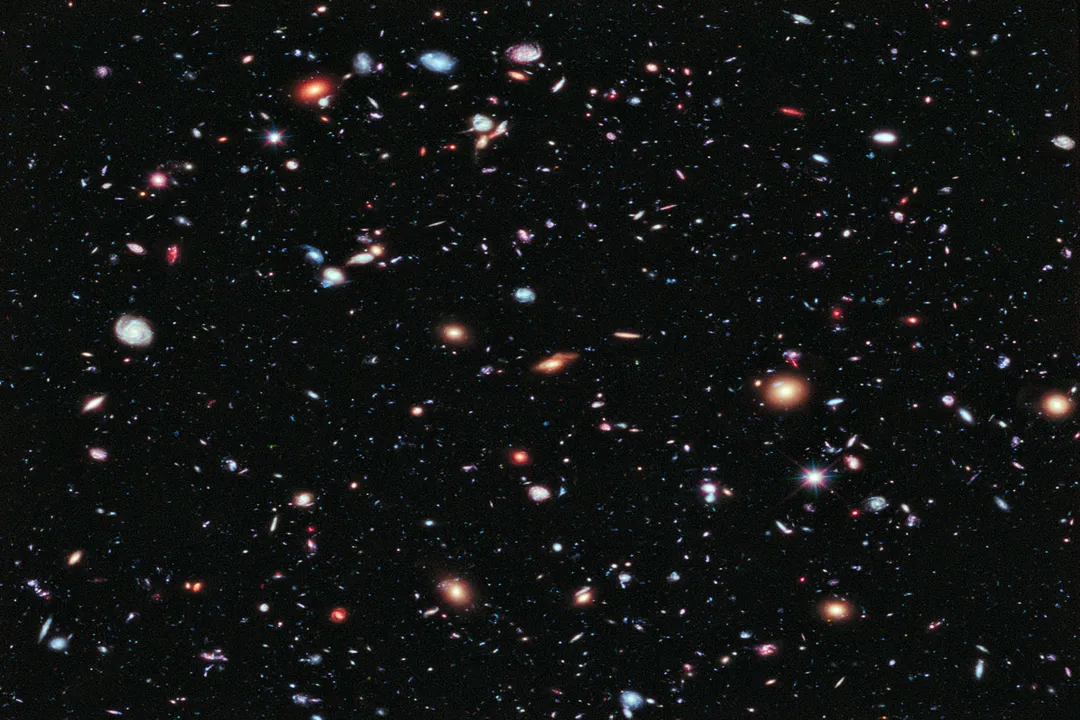
The story of how Edwin Hubble deciphered the secrets hidden within the light from distant galaxies fundamentally changed our perception of the cosmos. It began not with a grand vision of an expanding universe, but with meticulous measurements of light itself—specifically, how that light appeared to shift when analyzed through a spectroscope. To understand what Hubble noticed, one must first appreciate the tool he was using: the spectrum. Light, when passed through a prism or a diffraction grating, separates into its constituent colors, forming a spectrum, much like a rainbow.
# Light Wavelengths
Different elements, when heated or energized, emit or absorb light at very specific, unique wavelengths, creating characteristic patterns of bright or dark lines in the spectrum, known as spectral lines. These lines act as cosmic fingerprints, telling astronomers the chemical composition, temperature, and motion of the source object. If a star or galaxy is moving toward the observer, its spectral lines appear shifted slightly toward the blue end of the spectrum—a phenomenon called blueshift. Conversely, if the object is moving away, those same spectral lines shift toward the red end, resulting in a redshift.
# Analyzing Starlight
Hubble’s real expertise lay in applying this spectroscopic technique to the faint, fuzzy patches of light identified as "spiral nebulae," which were then debated as being either small star clusters within our own Milky Way or entirely separate, distant galaxies. To determine their nature and motion, Hubble needed to measure their spectral lines accurately. The method involved collecting the light from these targets and passing it through a spectrograph attached to the telescope, which separated the light into its spectrum.
The critical data point he sought was the amount of shift in these known spectral lines—for instance, the sharp emission lines produced by hydrogen. This measurement, the redshift (), directly indicated the velocity at which the galaxy was moving relative to Earth, based on the principles of the Doppler effect.
It is worth pausing here to consider the sheer technical difficulty involved, even with the power of the 100-inch Hooker Telescope. Analyzing the light from objects millions of light-years away meant dealing with incredibly faint signals. While the established physics of the Doppler effect provided the relationship between the shift and velocity, the precision required to distinguish a meaningful redshift from instrumental noise or atmospheric distortion was immense. Hubble’s early success, often done in collaboration with Milton Humason, was not just in seeing the shift, but in achieving the necessary observational rigor to measure it reliably across dozens of targets.
# Systematic Shift Noticed
What Hubble noticed, after meticulously collecting and analyzing the redshifts for numerous galaxies, was profoundly systematic. It wasn't random; almost every single galaxy he measured showed a redshift, meaning nearly all of them were moving away from us. Furthermore, this recession speed wasn't uniform across the sky.
The staggering realization was that the amount of redshift—and thus the speed of recession—was directly proportional to the galaxy's estimated distance. The farther away a galaxy was, the greater its spectral lines were shifted toward the red. This linear relationship was the tangible evidence Hubble observed in the spectrum that suggested the entire observed universe was in motion, expanding away from our position.
# Velocity Distance Link
This observed proportionality between recession velocity () and distance () became codified as Hubble’s Law. Mathematically, it is expressed as . The term , the Hubble Constant, represents the rate of expansion and is the proportionality constant derived directly from the measurements of the spectral shifts plotted against distance estimates.
To truly appreciate this finding, consider a hypothetical data table that Hubble would have constructed:
| Galaxy Target | Estimated Distance (Mpc) | Measured Redshift () | Calculated Recession Velocity () |
|---|---|---|---|
| Galaxy A | 1 | Small | Low |
| Galaxy B | 5 | Medium | Medium |
| Galaxy C | 10 | Large | High |
| Galaxy D | 20 | Very Large | Very High |
| [^cite: 1] |
If the universe were static, or if galaxies were just randomly moving within a fixed space, you would expect velocities to be scattered regardless of distance. The pattern of increasing velocity directly with distance, derived solely from spectral analysis, provided the first strong observational proof against a static universe model.
If we consider the implications of this initial finding, we can make a conceptual approximation. If we take Hubble’s earliest derived rate (which was significantly different from modern values but conceptually derived the same way) and use it to calculate an age, the result points toward a finite history for the universe. For instance, if one could somehow measure the value today to be roughly , then the inverse of that value () gives an age scale of approximately $14$ billion years. This direct link from a spectral measurement (the shift) to a profound statement about cosmic age illustrates the power of Hubble's spectral observations.
# Stretching Space
The interpretation of this spectral redshift was debated, but the conclusion Hubble's observations strongly supported involved the nature of the expansion itself. Initially, the shift was interpreted purely through the classical Doppler effect, implying galaxies were flying away from a central point like shrapnel from an explosion. However, the cosmological interpretation, which is what Hubble’s data strongly suggested, is far stranger: the space between the galaxies is expanding.
This means that the light emitted by a distant galaxy is stretched while traveling across the expanding intervening space. The photons themselves are not gaining energy; rather, the distance they have to travel increases while they are in transit, causing their wavelength to elongate toward the red end of the spectrum. This is fundamentally different from a source moving through stationary space. The distinction matters greatly because if it were merely Doppler motion, the universe would still have a center point (where everything flew away from). Since the expansion is a stretching of space itself, every observer in any galaxy would see all other galaxies receding, without any unique central point.
# Cosmic Scale
Hubble’s observation about the spectrum allowed astronomers to transform the faint smudge in the eyepiece into a quantifiable distance marker. By measuring the redshift, one can accurately determine how far away an object is and, consequently, how far back in time one is looking. A large redshift means the light has been stretched significantly, implying a great distance and a longer travel time.
The initial findings spurred the development of more precise techniques to measure and refine our understanding of cosmic expansion history. Later telescopes and instruments, building upon Hubble’s foundation of spectroscopy, have pushed this science into the realm of dark energy—the mysterious force currently accelerating this expansion—by observing extremely distant galaxies whose redshifts are even more pronounced than what Hubble first found. Hubble noticed the spectral fingerprint of motion; modern astronomy seeks to understand the cause of the acceleration behind that motion.

Related Questions
#Citations
Hubble Cosmological Redshift - NASA Science
How did Hubble know the red shift difference between "moving ...
ESA - What is 'red shift'? - European Space Agency
In 1929 Edwin Hubble was observing the galaxies in his 100 inch ...
How Astronomers Discovered the Universe Is Expanding - History.com
Hubble's law - Wikipedia
The Hubble Deep Fields
Ep. 279 Hubble Constant - Astronomy Cast