What does the Hubble Deep Field show?
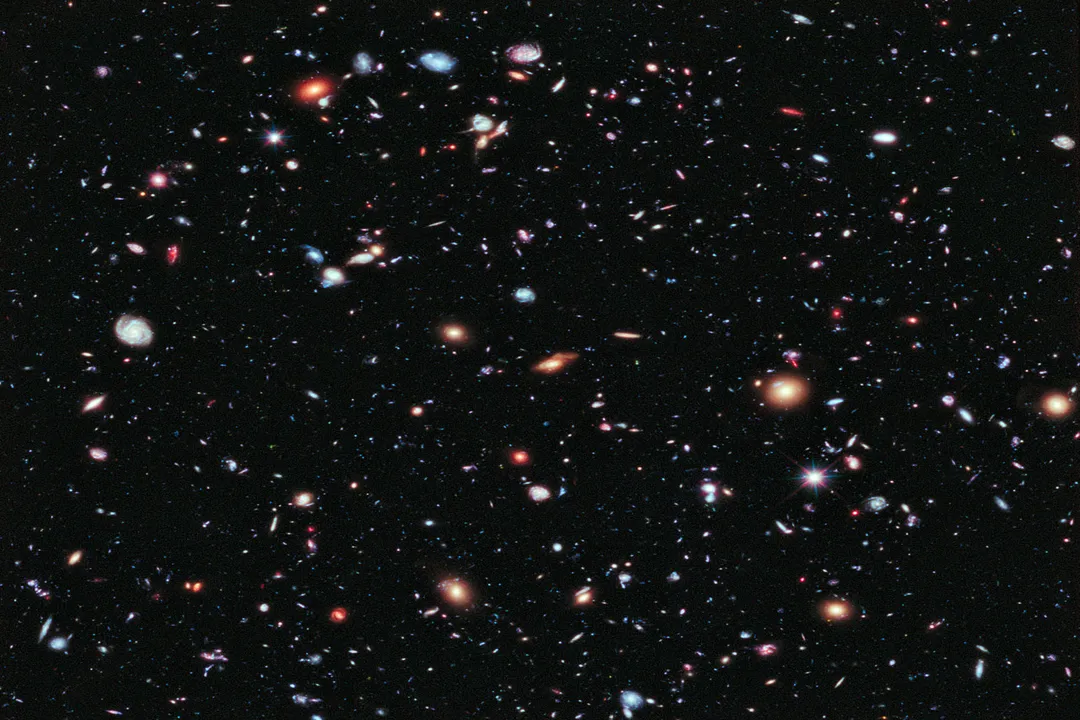
The common impression of the night sky is one of vast, profound emptiness, punctuated by the familiar, bright pinpricks of nearby stars. Yet, the most significant discoveries about the universe often come from staring intently at what appears to be nothing at all. This is precisely what the Hubble Deep Field (HDF), and its successor, the Hubble Ultra Deep Field (HUDF), represent: a revolutionary way of seeing cosmic history by focusing the Hubble Space Telescope's vision on an apparently blank patch of sky. [3][2]
The resulting images are not just pictures; they are deep-time portals, revealing a chaotic, crowded early cosmos that starkly contrasts with the organized structures we observe locally today. [1][4] By pooling the light of incredibly distant, faint objects over many days, these observations provided the first clear census of galaxies in their infancy, fundamentally altering cosmology. [4][2]
# Pointing at Nothing
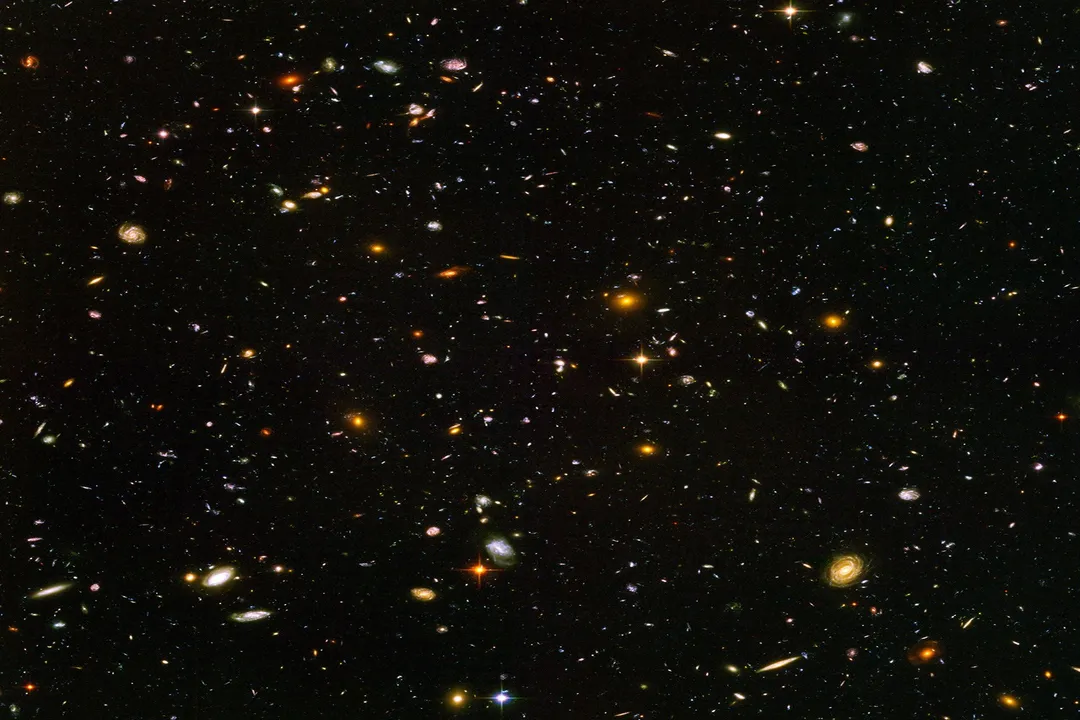
The initial concept behind the Deep Fields was audacious: to dedicate a significant portion of Hubble’s precious observation time—the Director's Discretionary Time, in the case of the first HDF—to stare at one specific, tiny location for days on end. [2][3] The goal was to capture the faintest objects possible, which, due to the speed of light, meant looking back in time to the universe's youth. [3]
The target selection for the original Hubble Deep Field (HDF), observed in 1995, was highly methodical. Astronomers needed a region that was:
- At a high galactic latitude to avoid the obscuring dust and overwhelming light from our own Milky Way plane. [2]
- Free from bright foreground stars or excessive emissions across different wavelengths to ensure the faint background galaxies wouldn't be washed out. [2]
- Located in Hubble’s continuous viewing zones to allow for uninterrupted observation periods. [2]
The chosen spot, located in the constellation Ursa Major, was so small that it is often described as being the angular size equivalent of holding a pinhead at arm's length. [2][3] To put that scale into a more modern context, the area covered by the original HDF was roughly one-quarter the width of the full Moon across, or about one 24-millionth of the entire sky. [2] If the Moon appeared that size in the sky, that tiny spot of darkness would be about the size of a tennis ball viewed from 100 meters away. [2] The fact that such a small, seemingly barren patch yielded thousands of galaxies remains astonishing. [2]
# Gathering Faint Light
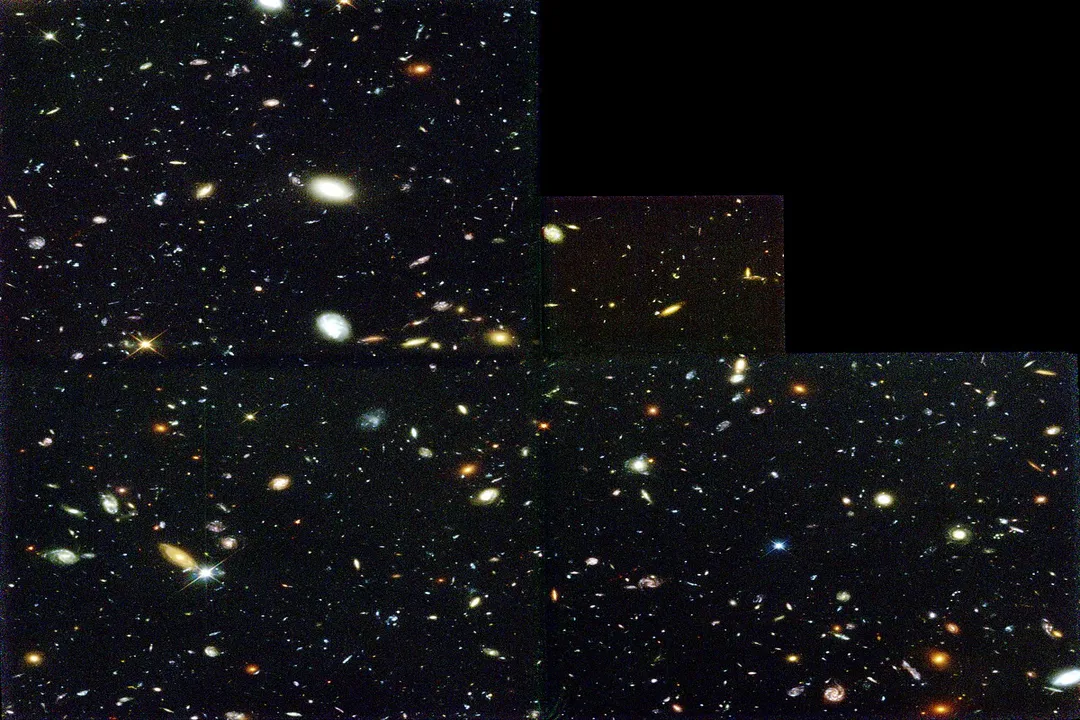
The secret sauce to the Deep Fields was exposure time. While a typical Hubble exposure might last only a few hours, the HDF required 342 separate exposures taken over ten consecutive days in December 1995. [2] The total integration time added up to more than 100 hours. [4] This extreme duration was necessary because the light from the most distant galaxies arrives as a mere trickle—sometimes as little as one photon per minute—whereas nearer galaxies send millions of photons per minute. [1]
This process of collecting light over a prolonged period forced scientists to develop sophisticated data processing techniques, including "drizzling," which involved minutely varying the telescope's pointing direction between exposures to boost the final image resolution beyond the detector’s native pixel size. [2]
The original HDF used the Wide Field and Planetary Camera 2 (WFPC2) and captured light across four broadband filters: near-ultraviolet (), blue (), red (), and near-infrared (). [2]
This initial success spurred immediate follow-ups. In 1998, the Hubble Deep Field South (HDF-S) was observed in the southern sky, largely confirming the initial findings and bolstering the cosmological principle—the idea that the universe looks statistically the same everywhere on large scales. [2][4]
# The Ultra Deep Leap
The true jump in sensitivity came in 2004 with the Hubble Ultra Deep Field (HUDF). [3] Following a servicing mission that installed the more sensitive Advanced Camera for Surveys (ACS), astronomers dedicated months of observing time to the same region, creating a million-second exposure. [1][4] The HUDF revealed an estimated 10,000 galaxies. [1] This image showed galaxies as they existed only 400 to 800 million years after the Big Bang, a period when the universe was just getting over its "dark ages". [1][4]
The capability was further pushed into the infrared using the Near Infrared Camera and Multi-object Spectrometer (NICMOS) in 2009. [3] Since the expansion of the universe stretches the light from the earliest galaxies from visible wavelengths into the longer, redder infrared spectrum—a phenomenon called redshift—infrared vision is essential for looking back that far. [4] These infrared views hinted at galaxies existing just 600 million years after the Big Bang. [4] The 2012 Hubble eXtreme Deep Field (XDF) then combined nearly a decade of these observations into one image, containing about 5,500 galaxies within that same tiny area, pushing the visible-light frontier back nearly 13.2 billion years in time. [3]
# A Gallery of Galaxies
What the deep fields showed was a cosmos far removed from the mature spirals and stately ellipticals we see nearby, like our own Milky Way. [1] The most striking feature of the HDF and HUDF was the sheer variety of shapes present in the early universe. [4][5]
The galaxies appearing farthest away—the faintest and reddest—were often small and irregular. [2][4] They looked like "toothpicks," "links on a bracelet," or were clearly interacting in "box matches". [1][3] This was the visual evidence supporting the theory that large, structured galaxies, like spirals, grow over cosmic time through the merger and coalescence of these smaller, primordial clumps. [1][4] The early universe, as seen in the HUDF, was demonstrably more chaotic. [1]
The colors in the images provided crucial data. Generally, bluer objects contained younger stars or were closer, while redder objects contained older stars or were significantly farther away. [3] By analyzing the colors and corresponding redshifts, astronomers could chart the universe’s history, estimating that the peak rate of star formation occurred about 8–10 billion years ago, having dropped by a factor of about ten since then. [2]
If we consider the original HDF image, which contained about 3,000 galaxies in a patch the size of the sky, and then extrapolate that density across the entire celestial sphere, the sheer number of galaxies in the observable universe becomes almost mathematically incomprehensible. It suggests that the "emptiness" we see is merely a perspective trick caused by the immense distances involved; nearly every point in the sky holds a deep, ancient cosmic city. [2]
# Cosmic History Revealed
The Deep Fields were, as an ESA publication noted, a "core sample of the Universe". [3] They allowed scientists to transition from observing mostly mature galaxies to witnessing the assembly process itself. [4] Hubble showed galaxies as "toddlers" undergoing rapid development within the first billion years after the Big Bang. [1]
Furthermore, follow-up observations using other instruments revealed synergies:
- Infrared (Spitzer): Detected dust-enshrouded galaxies forming stars intensely within the HDF. [2]
- X-ray (Chandra): Found active galactic nuclei and elliptical galaxies within the HDF sample. [2]
- Radio (VLA/MERLIN): Mapped radio sources corresponding to the optical galaxies. [2]
The comparison between the HDF/HUDF and later views, such as those from the James Webb Space Telescope (JWST), is now the next chapter in this story. [1][4] JWST is specifically designed to see even further back than Hubble’s visible light limit by observing in longer infrared wavelengths, targeting the very first stars and galaxies that emerged from the cosmic dark ages. [3] The success of the Deep Fields, however, set the exact targets and data challenges that guided the design of Webb. [1] The way large astronomical projects share this nonproprietary data, pioneered by the HDF team, has itself become a model for democratizing astronomical research. [3]
# Successor Visions
While Hubble established the baseline by revealing galaxies a billion years post-Big Bang, its legacy now feeds directly into newer missions. The Frontier Fields campaign utilized Hubble alongside the Spitzer and Chandra Great Observatories to study structures called gravitational lenses—massive galaxy clusters that naturally magnify the light of objects far behind them. [3] This technique allowed astronomers to detect galaxies 100 times fainter than those in the HUDF by using gravity as a natural telescope aid. [3]
The Deep Fields confirmed that structure building is hierarchical—small things merge to make big things—and provided the necessary target list for infrared specialists like JWST. The HDF and its descendants proved that even the darkest corner of the sky is teeming with an astonishing history, waiting only for enough patience to reveal itself. [4]
Related Questions
#Citations
Hubble's Deep Fields - NASA Science
Hubble Deep Field - Wikipedia
The Hubble Deep Fields