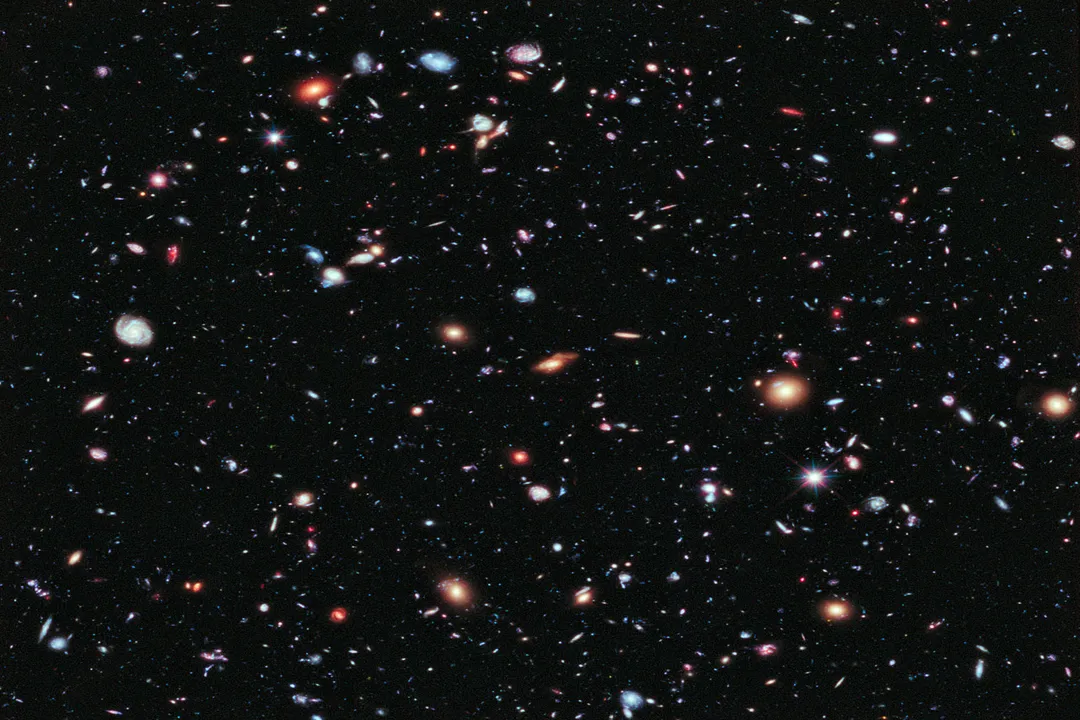
What theory regarding galaxy formation is supported by the observation that early galaxies were small and irregular?
Large, structured galaxies grow over cosmic time through the merger and coalescence of smaller, primordial clumps.
The visual evidence gathered from the HDF and HUDF images—showing the earliest, most distant galaxies as small and irregular clumps—is a key piece of supporting evidence for the hierarchical model of structure formation in cosmology. This theory posits that the large, highly organized galaxies observable in the present-day universe, such as spiral and grand elliptical types, did not simply appear maturely formed. Instead, they are the end products of billions of years of cosmic evolution, built up through the continuous process of merger and coalescence, where smaller, primordial structures gradually combine and accrete matter to form larger, more stable systems over cosmic time.