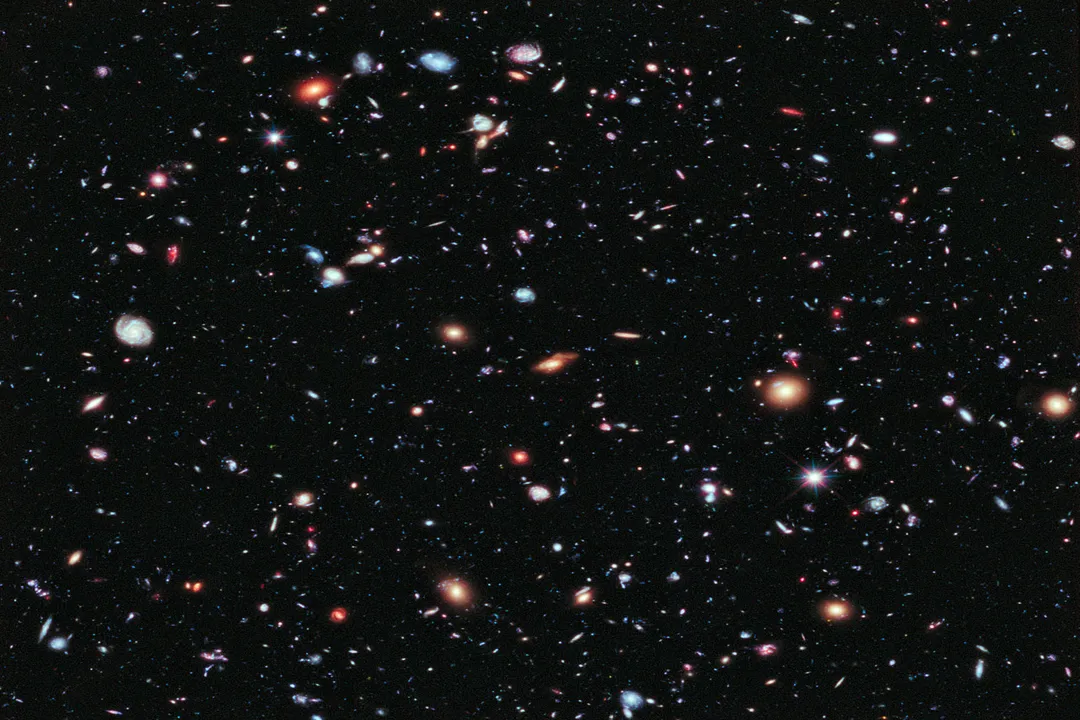
Why was infrared vision essential for pushing the observational limits beyond the initial HUDF in 2009?
Cosmic expansion stretches light from the earliest galaxies into the longer, redder infrared spectrum via redshift.
To see objects incredibly far away, astronomers must account for the expansion of the universe, a concept formalized by redshift. As light travels across expanding space from the earliest galaxies, its wavelength is physically stretched. Light that was originally emitted in the visible or ultraviolet spectrum is stretched so much that by the time it reaches Hubble, it is shifted into longer, redder wavelengths that fall within the infrared range. Therefore, infrared vision, utilized by instruments like NICMOS in 2009, is absolutely essential for looking back to the most ancient times, such as detecting hints of galaxies existing just 600 million years after the Big Bang, as visible light from those epochs is redshifted beyond Hubble’s visible spectrum capabilities.