What fundamental law established by Henrietta Swan Leavitt links Cepheid period to brightness?
Answer
Period-Luminosity Relationship
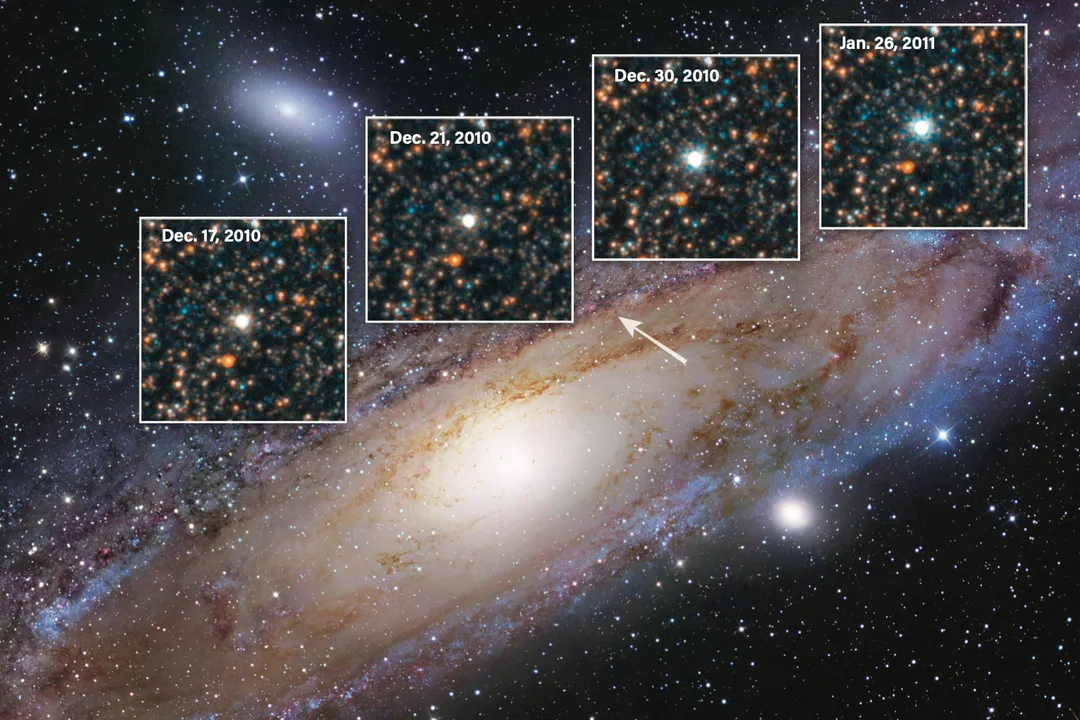
The Period-Luminosity Relationship is the fundamental law discovered by Henrietta Swan Leavitt that governs Cepheid variables. This relationship states there is a direct correlation between how long a Cepheid takes to complete one cycle of brightening and dimming (its period) and its true, intrinsic brightness (its absolute magnitude). Specifically, the longer the period, the more luminous the star inherently is. This mathematically reliable link transformed the Cepheid from a mere curiosity into the primary tool for measuring cosmic distances, enabling its function as a standard candle.
Related Questions
What did Edwin Hubble's measurement of the Andromeda Nebula definitively prove?What specific type of pulsating star did Hubble rely on to gauge the distance to M31?What fundamental law established by Henrietta Swan Leavitt links Cepheid period to brightness?What powerful ground-based telescope did Hubble use at Mount Wilson Observatory for his measurements?What was Hubble's initial calculated distance to Andromeda around 1924-1925?What term describes a Cepheid variable used because its true luminosity (absolute magnitude) is known?What two magnitudes must be compared to calculate the distance using the difference in brightness?By establishing Andromeda as external, by what approximate factor did Hubble's measurement expand the known universe?What fundamental system of measurement relies on the Cepheid variable technique as its first rung?What technical difficulty did Hubble overcome when observing variable stars within M31?What did Hubble need to ensure about the Cepheids observed in Andromeda besides just measuring their period?