How do you measure the mass of a galaxy?
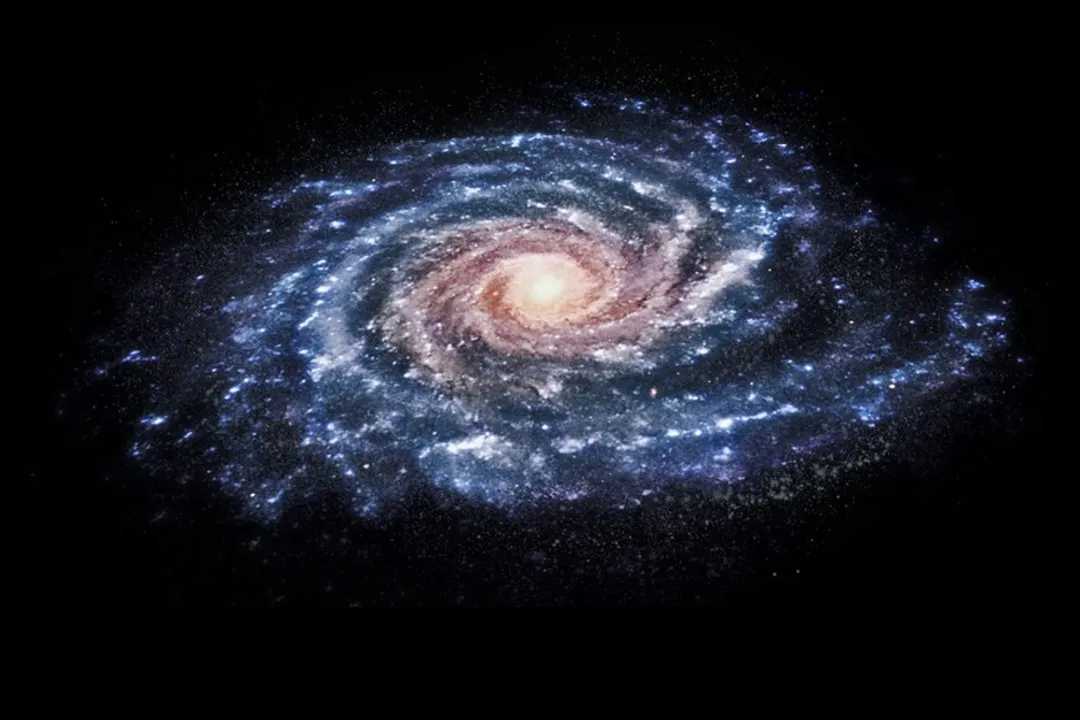
Weighing something as enormous and distant as a galaxy requires a clever application of the laws of physics, relying entirely on observing motion and light, rather than stepping onto a cosmic scale. Astronomers cannot directly measure the bulk of a galaxy; instead, they infer its mass by watching how its constituent parts—stars, gas clouds, and neighboring galaxies—respond to the gravitational pull exerted by the total mass within a specific region. [2][7]
# Orbital Speeds
The most common and direct method for determining the mass of a spiral galaxy involves analyzing its rotation curve. [2][9] Think of it like applying Newton's laws of gravity to a spinning merry-go-round, except the gravitational pull comes from all the mass inside the orbit, not just a central pivot point. [1][5] By observing the galaxy, astronomers measure the speed at which stars and, more effectively, clouds of hydrogen gas orbit the galactic center. [6][7] This is achieved by measuring the Doppler shift of the light or radio waves they emit; light shifted toward the blue end of the spectrum means an object is moving toward us, while redshift indicates movement away. [6]
Once the orbital velocity () and the distance () from the center are known, one can estimate the enclosed mass () using a variation of Kepler's Third Law derived from Newtonian physics. [1][5] The basic premise is that the centrifugal force required to keep an object in orbit is balanced by the gravitational force exerted by the mass inside that orbit. [5]
A crucial finding emerges when plotting these speeds: for most spiral galaxies, the rotational velocity does not decrease as one moves further out in the disk, where visible matter trails off. [2] If the visible mass (stars and gas) accounted for everything, the orbital speeds should drop significantly far from the core, much like the outer planets in our solar system orbit slower than the inner ones. [5] The fact that the rotation curve remains surprisingly flat strongly implies that there is a vast amount of unseen mass—dark matter—extending far beyond the luminous edge of the galaxy, holding those outer stars in their fast orbits. [2][5][7]
When considering the Milky Way specifically, we are somewhat fortunate. We can observe the movement of neutral hydrogen gas clouds in our own disk using the characteristic 21-centimeter radio wave emission. [5] This allows for a relatively detailed mapping of our local gravitational environment, giving us a clearer picture of the mass distribution close to home compared to looking at a distant, unresolved blob of light. [3][5]
# Visible Mass
While rotation curves reveal the total mass, including the mysterious dark component, another measurement focuses only on the visible stuff: the stars, dust, and gas. This is the stellar mass. [3][4] Astronomers estimate this by measuring the total light output, or luminosity, of the galaxy across various wavelengths. [3]
The calculation isn't as simple as just adding up the stars; instead, it relies on an assumed Mass-to-Light ratio (). [3] This ratio depends heavily on the age, color, and composition of the stellar population within the galaxy, as older, redder stars produce less light per unit of mass than younger, blue stars. [3][4] By modeling the galaxy's stellar population synthesis, scientists can generate an educated guess for the ratio and then divide the measured luminosity by this ratio to get the stellar mass. [3]
When you see published figures for galaxy mass, it is imperative to understand the context. If the quoted mass is labeled (M-star), that figure represents only the mass locked up in stars and gas, derived from light modeling. [5] If the figure is labeled or , that value includes the dark matter halo inferred from dynamical measurements, and this figure will almost always be significantly larger, often by a factor of ten or more, than the stellar mass component. [5] Understanding this distinction is essential for comparing data across different astrophysical studies.
# Random Movements
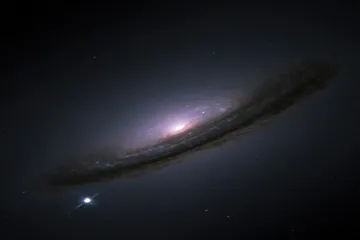
Not all galaxies rotate in an orderly, disk-like fashion. Elliptical galaxies, for instance, are generally composed of stars moving in more random, disordered orbits. [6] Since a simple rotation curve based on ordered motion isn't available, astronomers must rely on a technique related to velocity dispersion. [6][9]
Velocity dispersion measures the random spread of velocities among the stars within the galaxy relative to the galaxy's center of mass. [6][9] A galaxy with high velocity dispersion has stars moving in highly chaotic paths, suggesting a powerful gravitational field is needed to keep them bound together. [6] Similar to how the orbital speeds of galaxies within a massive cluster can be used to estimate the cluster's total mass via the Virial Theorem, the velocity dispersion within an elliptical galaxy allows for a dynamical mass calculation. [5][6]
# Bending Light
A completely independent method that bypasses the need for direct stellar or gas kinematics is gravitational lensing. [2] According to Einstein’s General Relativity, any mass—visible or dark—warps the fabric of spacetime around it. [2] When light from a very distant background object passes near a galaxy, the galaxy's gravity bends that light, distorting or magnifying the background image, much like a flawed lens. [2]
By carefully measuring the degree of distortion, astronomers can reconstruct the mass distribution of the foreground galaxy acting as the lens. [2] This technique is particularly powerful because it is sensitive to all mass, regardless of whether it emits light, and it provides a spatial map of where that mass is concentrated, offering geometric confirmation of the mass distribution inferred from rotation curves. [2]
In essence, weighing a galaxy is an exercise in gravitational detective work. Whether we are monitoring the steady, orderly rotation of a spiral disk, measuring the chaotic jitter of stars in an elliptical blob, or analyzing the subtle warping of light from a distant quasar, every technique converges on the same realization: the visible stars we see are merely the bright tracer particles embedded within a much more massive, invisible gravitational scaffolding made of dark matter. [2][5][7]
Related Questions
#Citations
How does one measure the mass of a galaxy? And other such large ...
How Do You Weigh a Galaxy? - AAS Nova
How can we measure the stellar mass of galaxies? : r/astrophysics
25.3: The Mass of the Galaxy - Physics LibreTexts
Measuring the mass of galaxies. - University of Oregon
l10S7 - JILA
How do astronomers measure galaxies' mass? - Quora
Galaxy Masses - The MOSFIRE Deep Evolution Field Survey
mass distribution in disk galaxies
Masses of Galaxies - Astronomy Notes