What specific radio emission allows for a relatively detailed mass mapping of the Milky Way's local environment?
Answer
Characteristic 21-centimeter radio wave emission from neutral hydrogen gas.
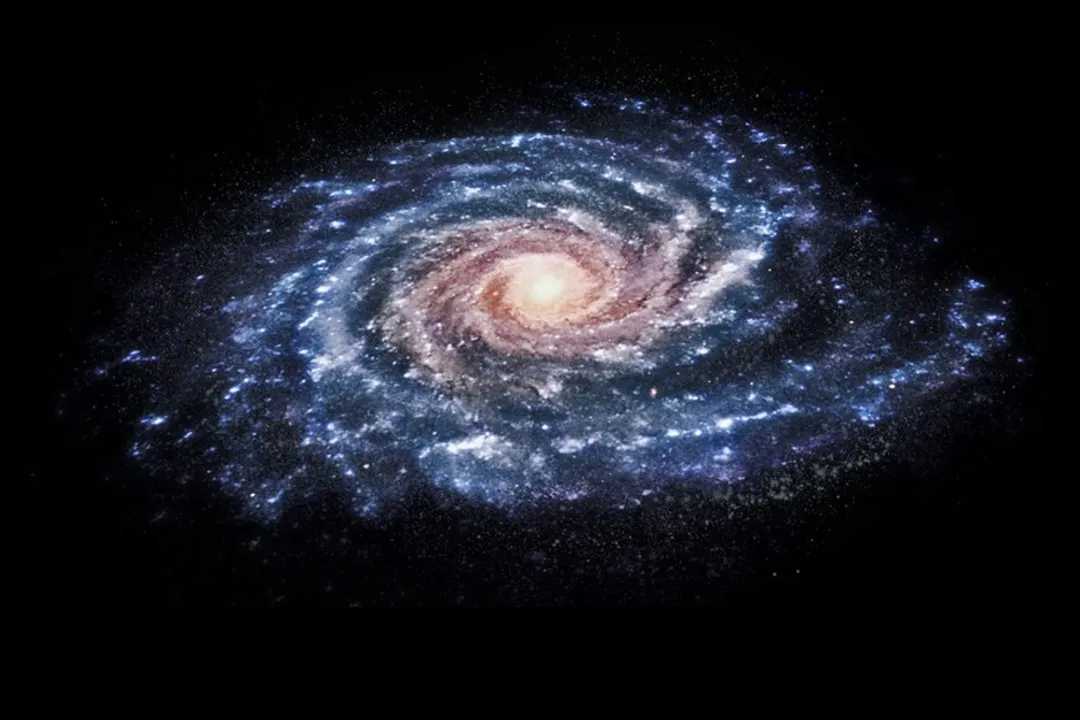
Astronomers can observe the movement of neutral hydrogen gas clouds in the Milky Way disk by measuring their characteristic 21-centimeter radio wave emission.
Related Questions
How do astronomers primarily determine the mass of a distant galaxy?What property is measured using the Doppler shift of emitted light or radio waves from orbiting objects?What does a surprisingly flat rotation curve for a spiral galaxy strongly imply?In Newtonian physics calculations for orbital mass, what two forces are assumed to be balanced?If a mass figure for a galaxy is labeled $M_*$, what component does that figure represent?The Mass-to-Light ratio ($M/L$) used to estimate stellar mass depends heavily on what factors?What technique must astronomers rely on for elliptical galaxies that lack orderly rotation curves?High velocity dispersion within a galaxy indicates what about its stellar motion?Gravitational lensing is considered an independent method because it is sensitive to which type of mass?Which mass label, $M_{ ext{total}}$ or $M_{ ext{virial}}$, includes the dark matter halo inferred from dynamical measurements?What specific radio emission allows for a relatively detailed mass mapping of the Milky Way's local environment?