What did Edwin Hubble's measurement of the Andromeda Nebula definitively prove?
Answer
Andromeda was a separate "island universe" beyond the Milky Way
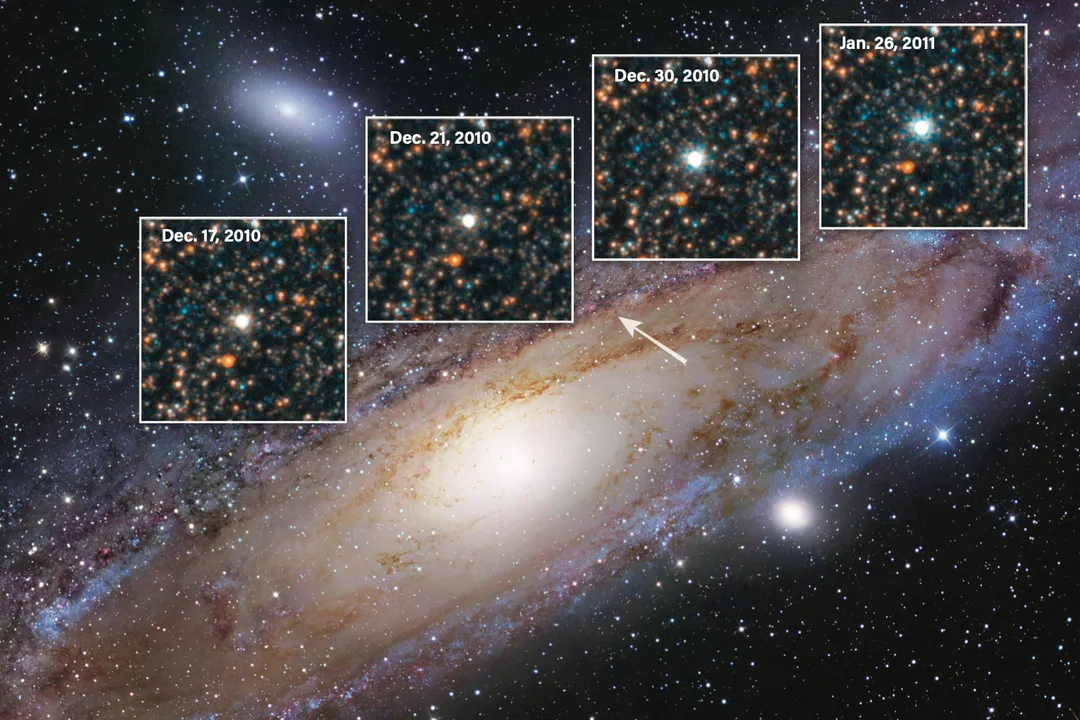
Hubble's work successfully settled the profound debate regarding the nature of objects like the Andromeda Nebula (M31). Before his confirmation, astronomers argued whether these objects were simply gas and dust clouds situated inside our own Milky Way galaxy, or if they represented entirely separate, distant 'island universes' composed of billions of stars. By accurately measuring the distance to Andromeda and finding it far exceeded the accepted diameter of the Milky Way (around 100,000 light-years), Hubble proved the latter hypothesis, establishing M31 as an extragalactic system separate from our own.
Related Questions
What did Edwin Hubble's measurement of the Andromeda Nebula definitively prove?What specific type of pulsating star did Hubble rely on to gauge the distance to M31?What fundamental law established by Henrietta Swan Leavitt links Cepheid period to brightness?What powerful ground-based telescope did Hubble use at Mount Wilson Observatory for his measurements?What was Hubble's initial calculated distance to Andromeda around 1924-1925?What term describes a Cepheid variable used because its true luminosity (absolute magnitude) is known?What two magnitudes must be compared to calculate the distance using the difference in brightness?By establishing Andromeda as external, by what approximate factor did Hubble's measurement expand the known universe?What fundamental system of measurement relies on the Cepheid variable technique as its first rung?What technical difficulty did Hubble overcome when observing variable stars within M31?What did Hubble need to ensure about the Cepheids observed in Andromeda besides just measuring their period?