Is there a black hole in the middle of the Andromeda galaxy?
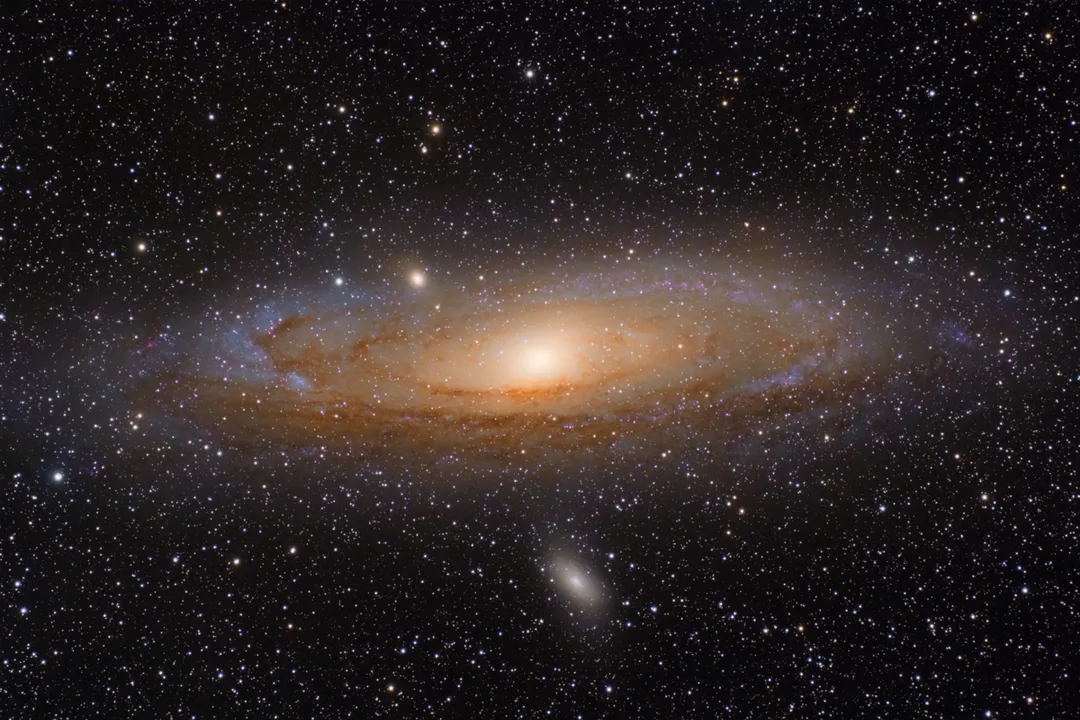
The question of what resides at the gravitational heart of the Andromeda galaxy, our colossal galactic neighbor, has long captivated astronomers. It is now well-established that deep within the central region of Messier 31 (M31), as Andromeda is formally known, lies a supermassive black hole. This object governs the dynamics of billions of stars packed tightly around it, making its study essential for understanding how large galaxies evolve. Andromeda itself, residing about $2.5$ million light-years away, is the nearest major galaxy to our own Milky Way, meaning its central engine provides a crucial nearby laboratory for studying galactic nuclei.
# Galactic Neighbor
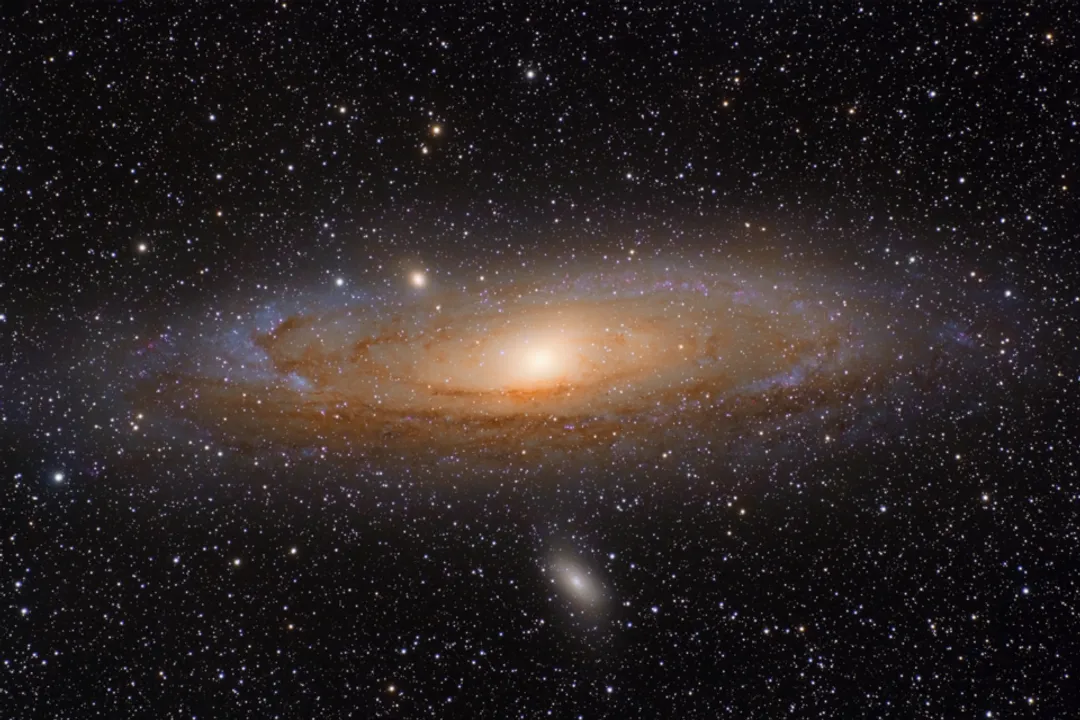
Andromeda dominates the Local Group of galaxies, possessing a stellar mass significantly larger than the Milky Way's, estimated to be around solar masses. While it is generally moving toward us, a collision—or more accurately, a merger—is predicted billions of years in the future. The light we capture from M31 today reveals its structure, including the densely packed core where the supermassive black hole resides.
# The Core Mass
The central engine of M31 is a behemoth, but pinning down its exact mass has required decades of observation. While precise measurements vary slightly depending on the observational technique, the object is definitively classified as supermassive, meaning its mass is millions of times that of our Sun. Some discussions on astrophysics forums even look to confirm the official nomenclature for this central object, often simply designated as the center of M31 or M31*. What is clear is that its gravitational influence dictates the motion of the stars and gas closest to the galaxy's core.
# Accretion Dynamics
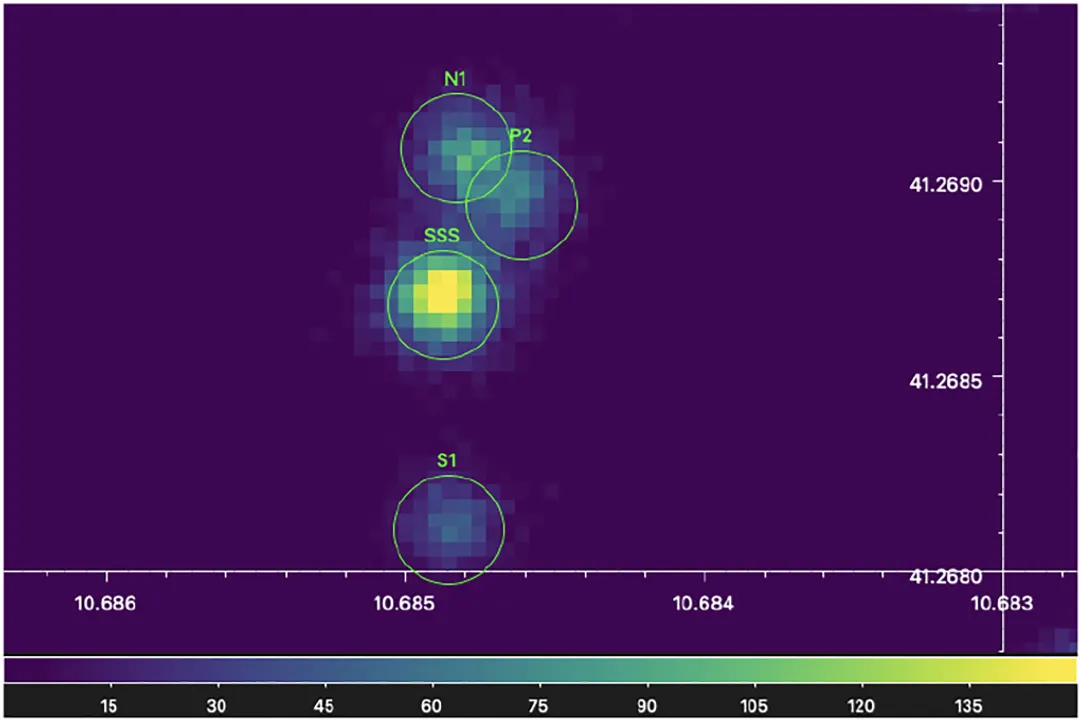
Unlike some active galactic nuclei (AGN) that blaze across the universe, M31’s central black hole appears relatively quiet on a cosmic timescale, accreting matter at a low rate. However, "quiet" in this context does not mean "static." Over the past fifteen years of continuous X-ray monitoring, observations have demonstrated significant variability in the X-ray output emanating from the vicinity of the black hole. This variability has led to the black hole being described poetically as "winking" at us.
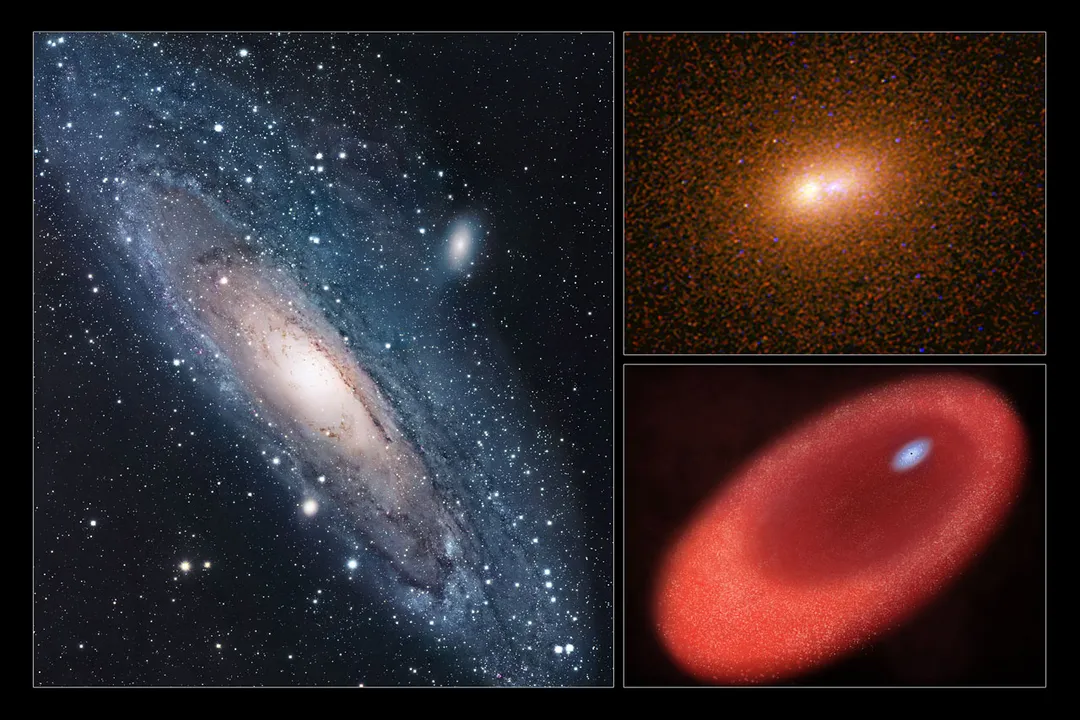
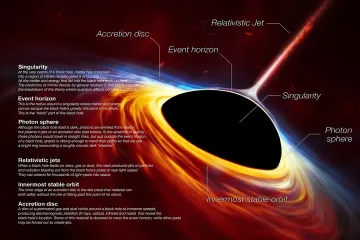
The evidence suggests that this black hole experiences episodic feeding events. Astronomers using the Spitzer Space Telescope have found a considerable reservoir of cold dust and gas concentrated near the galactic center. This material is likely fuel for the black hole, suggesting that the accretion process is not smooth but punctuated by larger intake events. When this material falls in, it forms an accretion disk, heating up and emitting radiation that we detect, particularly in the X-ray spectrum observed by missions like Chandra. The observation of this cold dust reservoir is key; it shows that the fuel supply for the galaxy's hungry giant is present and available for future meals.
# Nucleus Structure
The visual appearance of Andromeda’s nucleus, captured by telescopes like Hubble, reveals a complex environment that defies simple expectations. Early observations suggested a single, bright central point. However, detailed analysis showed that the central structure is not a singular concentration of light but features a secondary, off-center peak of starlight surrounding the true gravitational center occupied by the black hole. This structure implies that the accretion disk itself, or the surrounding stellar population influenced by the black hole's gravity, creates this apparent dual structure. The presence of the central black hole profoundly shapes the orbits and distribution of stars within the innermost few light-years of the galaxy.
# Comparing Galactic Engines
While Andromeda’s supermassive black hole is massive, it operates on a very different activity schedule than the one at the heart of our own Milky Way, Sagittarius A* (Sgr A*). Sgr A* is significantly less massive, weighing in at roughly four million solar masses compared to M31's central object, which is estimated to be several tens of millions of solar masses. Intriguingly, despite being significantly larger, M31’s black hole appears currently far less active in terms of steady-state accretion than Sgr A* has been observed to be in recent years. This difference suggests that the efficiency of gas inflow or the local stellar population density—the environment surrounding the black hole—plays a much larger role in determining how we see the black hole than its sheer mass alone. For instance, M31 appears to have a much larger reservoir of cold fuel available, yet its X-ray output suggests it is currently consuming it slowly, perhaps in infrequent bursts, whereas Sgr A*'s immediate environment may be slightly denser in warmer gas fueling a more continuous, albeit faint, emission.
# Long-Term Monitoring Value
The detailed 15-year timeline of X-ray flux data is immensely valuable because it moves the study of M31's black hole from a snapshot view to a time-domain study. Understanding the periodicity, if any, of these "winks" or accretion flares offers scientists the chance to correlate the energetic output with other phenomena, such as the passage of orbiting stars or clouds of gas near the event horizon. If the X-ray variations prove to follow a predictable cycle, it would strongly imply that the fueling mechanism is tied to a specific, orbiting structure—perhaps a remnant stellar core or a dense clump of gas—that circles the black hole on a fixed timescale. Such a discovery would provide an unprecedented look into the immediate orbital mechanics surrounding a supermassive black hole outside of our own galaxy. Furthermore, comparing these accretion patterns with gravitational wave detections from merging black holes could one day provide a multi-messenger picture of how these extreme objects interact with their surroundings.
Related Questions
#Citations
What is the name of Andromeda's central supermassive black hole?
Observers measure how Andromeda's central black hole is fed
Andromeda Galaxy - Wikipedia
Our neighboring galaxy's unusual core - ESA/Hubble
Astronomers confirm intermediate-mass black hole in Andromeda ...
Fifteen Years of X-Rays from Andromeda's Supermassive Black Hole
NASA Images Help Explain Eating Habits of Massive Black Hole
Andromeda's Black Hole is Winking at Us - Universe Today
Chandra Finds a "Cool" Black Hole at the Heart of the Andromeda ...