Is the black eye galaxy redshift or blueshift?
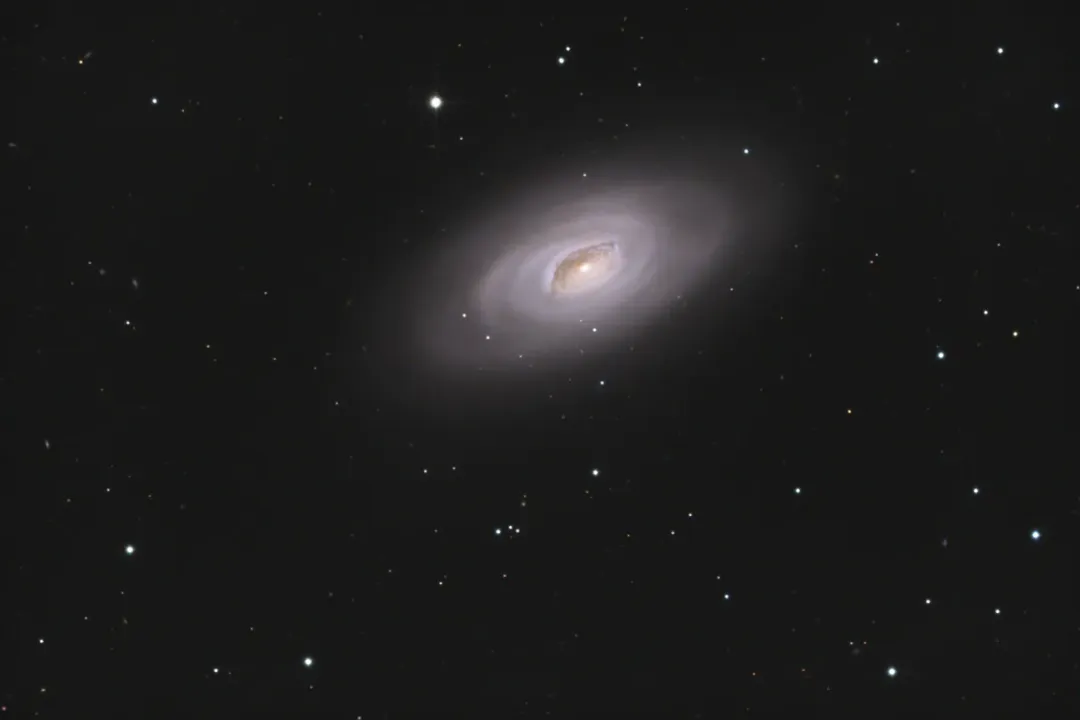
The distinctive sight of Messier 64, often called the Black Eye Galaxy, immediately draws the eye of any observer, amateur or professional. Its striking appearance, dominated by a dark lane of dust obscuring the bright core, prompts deeper questions about its nature and its place in the cosmos. When we turn our gaze to distant galaxies, one of the most fundamental properties we seek to determine is their motion relative to our own vantage point here on Earth. This motion is categorized by whether the light we receive is stretched toward the red end of the spectrum, indicating recession, or compressed toward the blue end, indicating approach. For the Black Eye Galaxy, the evidence points clearly in one direction.
# Appearance And Structure
The visual signature of M64 is what secured its place in Charles Messier’s famous catalog. This galaxy is classified as an Sa spiral galaxy. Its nickname, the Black Eye Galaxy, comes from the prominent band of dark dust that sweeps across its face, giving the impression of a bruise or an eye patch over the brighter nucleus. This dusty lane is a feature of immense interest to astronomers studying galactic evolution.
Interestingly, observations, particularly those made with advanced instruments like the Hubble Space Telescope, reveal a dual nature to the gas and stars within M64. While the outer regions of the galaxy rotate in one direction, the inner part, specifically the dusty area, appears to be rotating in the opposite direction. This counter-rotation is a key feature studied by astrophysicists, suggesting a past event, perhaps a merger with a smaller satellite galaxy, disrupted the system's original dynamics. The entire object is quite large, spanning approximately $60,000$ light-years across.
# Celestial Address
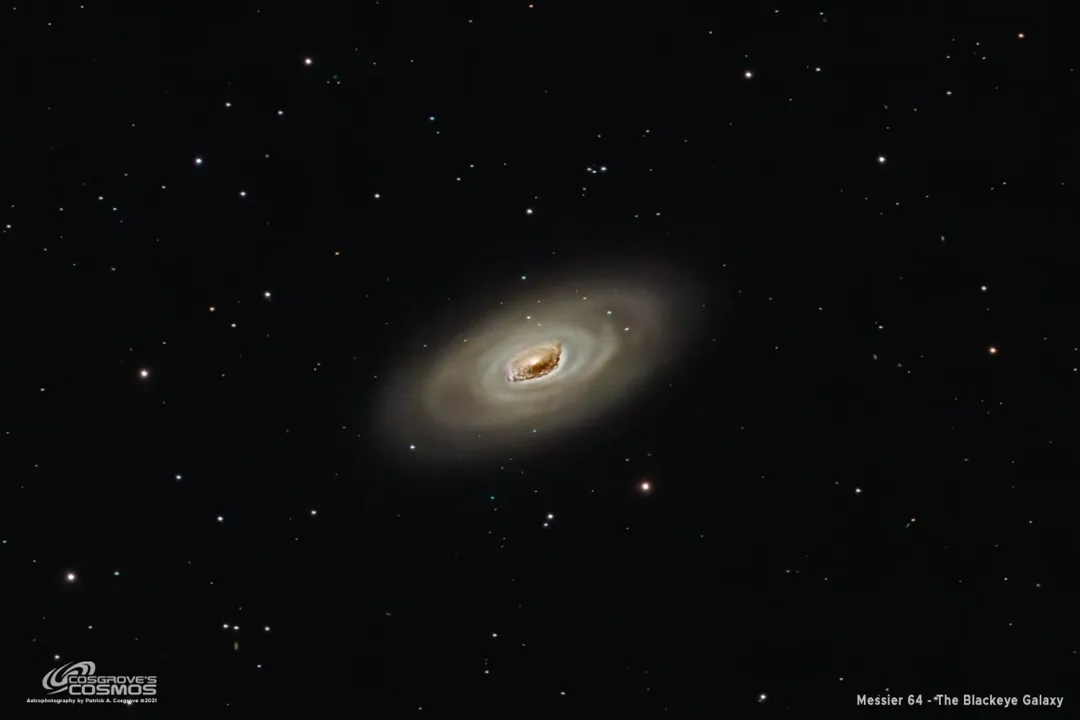
Pinpointing M64 in the night sky is achievable even with modest equipment. It resides in the constellation Coma Berenices. For those tracking down Messier objects, its apparent brightness, or magnitude, is listed around $9.4$. While not among the brightest deep-sky targets, it is certainly visible through amateur telescopes under dark skies.
When we discuss its distance, the numbers provided by different surveys show a slight range, which is common in extragalactic measurements. Some reports place it about $24$ million light-years away, while others suggest a slightly closer $22$ million light-years, and yet others cite a figure around $17$ million light-years. This variation, spanning several million light-years, is a subtle reminder that measuring cosmic distances is inherently complex, relying on various stellar "standard candles" whose calibrations are always being refined. Even for a well-studied object like M64, the precise light-travel time is subject to ongoing astrophysical interpretation.

# Cosmic Motion Explained
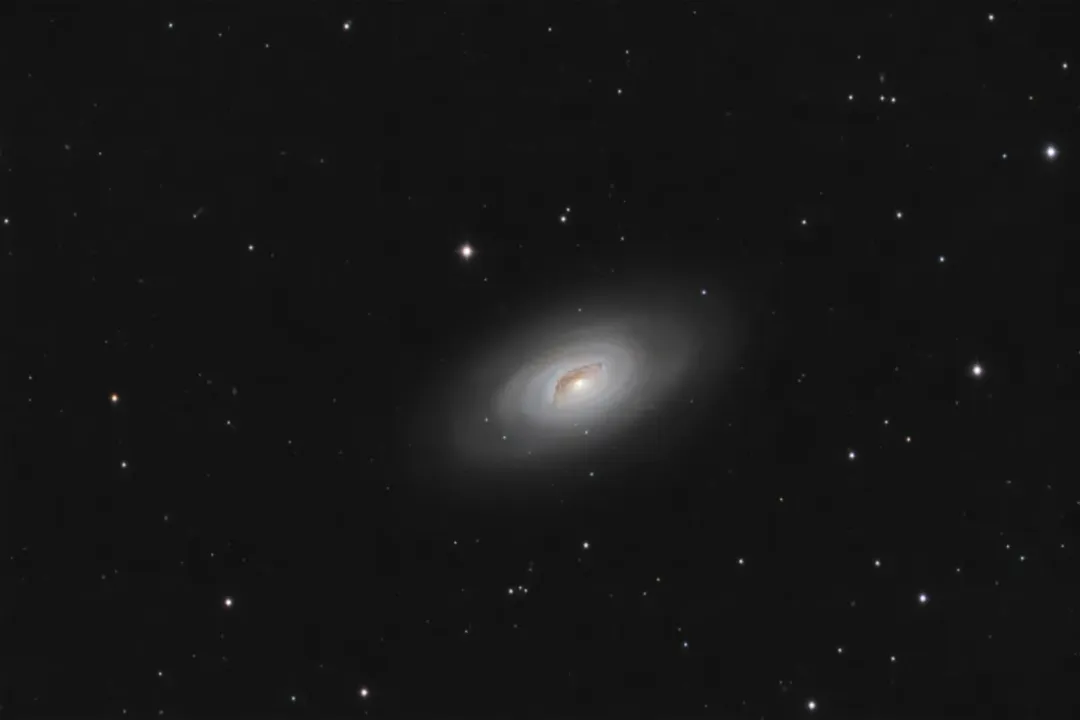
To understand the Black Eye Galaxy’s movement, one must first grasp the concept of the Doppler effect as applied to light. When a light source moves away from an observer, the wavelengths of its emitted light are stretched, causing the light to shift toward the longer, redder end of the electromagnetic spectrum—this is redshift. Conversely, if a source moves toward the observer, the wavelengths are compressed, resulting in a blueshift.
For nearby galaxies within our Local Group, like Andromeda, we observe a blueshift because they are gravitationally bound to the Milky Way and are moving toward us. However, for the vast majority of galaxies observable outside our immediate neighborhood, the effect of the universe's expansion—the stretching of spacetime itself—dominates the local gravitational tugs. This cosmic expansion causes almost all distant galaxies to exhibit redshift.
# The Black Eye Shift
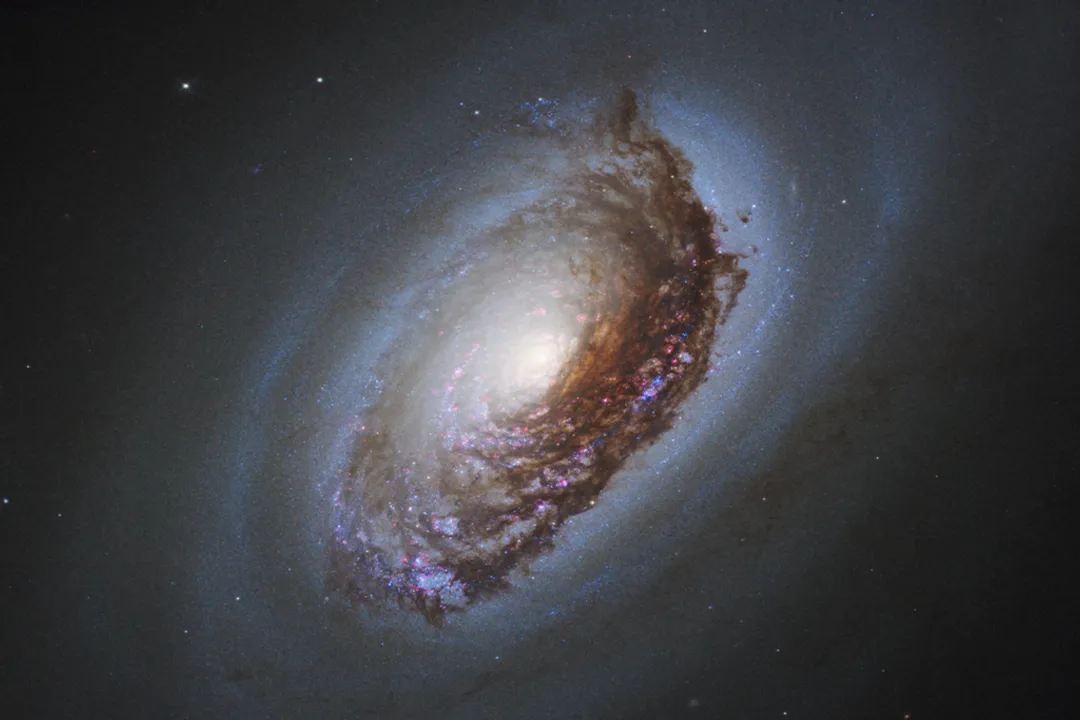
The crucial finding regarding Messier 64’s velocity is that it is receding from us. Because it is moving away, the light arriving at Earth from the Black Eye Galaxy is demonstrably redshifted. This places M64 firmly in the category of objects that confirm the overall expansion of the universe, known as the Hubble flow, rather than an exception influenced only by local gravitational attraction.
The fact that M64 is redshifted, meaning it is moving away, is what allows astronomers to assign a distance to it using the relationship between recessional velocity and distance first quantified by Edwin Hubble. In essence, measuring the degree of redshift tells us how fast it is moving away, and knowing that speed allows us to calculate how far away it must be. The consistent observation of redshift across nearly all distant galaxies, including M64, forms the bedrock of modern cosmological models describing an expanding universe. While the exact velocity measurement is a technical figure derived from spectral analysis, the conclusion—recession—is clear from the data describing its motion.

# Measuring The Cosmos
The ability to measure this shift is an exercise in precise spectroscopy. Astronomers analyze the light from M64, looking for characteristic patterns—the spectral lines created when specific elements absorb or emit photons at known wavelengths. When the galaxy is moving, these lines are systematically shifted from their laboratory-measured positions. If the shift is toward the red end, the galaxy is moving away.
This method of determining recessional velocity is significantly more reliable for calculating vast distances than relying solely on apparent brightness, which is heavily affected by the dust within M64 itself and any intervening cosmic dust lanes. The dark lane that makes M64 so visually appealing is precisely the kind of structure that complicates simple brightness-based distance estimates, making the spectral redshift measurement the more authoritative marker of its separation from us.
If we were to imagine a scenario where M64 showed a blueshift, it would imply that the gravitational influence of our Local Group of galaxies was strong enough to overcome the expansion of space over a distance of tens of millions of light-years, which is an extremely unlikely scenario for a galaxy outside that immediate group.
# Imaging Insights
For those who photograph M64, understanding its structure informs the imaging process. Astrophotographers often seek to capture the contrast between the bright spiral arms and the dense, dark dust lane. Since the galaxy spans about $60,000$ light-years, capturing both the core and the full extent of the structure requires careful planning regarding focal length and tracking. Furthermore, because M64 is a relatively bright target at magnitude $9.4$, it responds well to both visual observation and modest exposure times in astrophotography, allowing enthusiasts to gather significant data relatively quickly. The effort put into processing images often centers on enhancing the subtle contrast that reveals the galaxy’s famous "black eye" feature.
The reddish shift observed for M64 is a standard cosmological indicator, linking this specific spiral galaxy in Coma Berenices to the universal expansion seen in nearly every other galaxy observed beyond our immediate neighbors. It confirms M64’s status as a member of the distant, expanding universe, rather than a local gravitational captive.
Related Questions
#Citations
Blackeye Galaxy (Messier 64) | Deep⋆Sky Corner
The Black Eye Galaxy - Facts & Features - The Planets
Messier 64 black eye galaxy information - Facebook
Messier 64 - The Black Eye Galaxy - 2.6 hrs in LRGB
The Black Eye Galaxy, self-processed using fairly recent Hubble ...
Messier 64 (The Black Eye Galaxy) - NASA Science
101 Must-See Cosmic Objects: The Blackeye Galaxy
M64: The Black Eye Galaxy - Astronet.ru