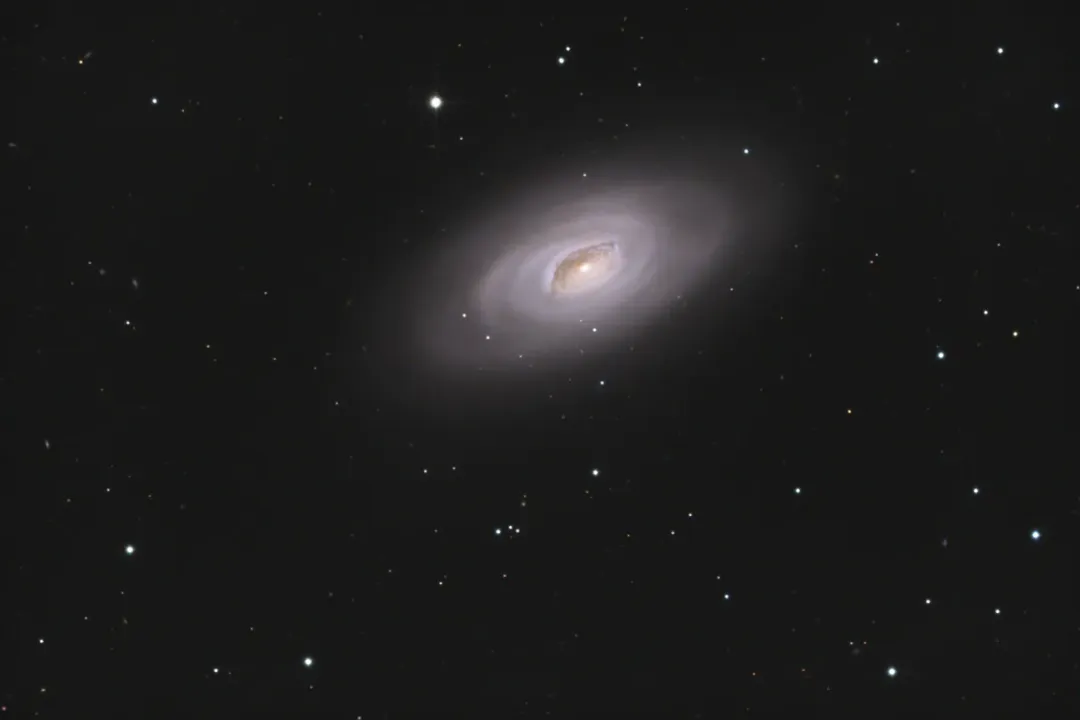
Why is spectral redshift measurement more reliable than apparent brightness for M64's distance?
Internal dust complicates brightness estimates.
Spectral redshift measurement is considered the more authoritative method for determining the distance to Messier 64 because it mitigates the severe complications introduced by the galaxy's visual structure. M64 possesses a dense, dark lane of dust sweeping across its face. This internal dust significantly absorbs and scatters the light coming from the brighter core, thus making the galaxy appear dimmer than it truly is if distance were judged by apparent brightness alone. Since redshift is determined by analyzing the shift in spectral lines caused by recessional velocity, it bypasses the variable absorption effects caused by M64’s obscuring dust lane and any intervening cosmic dust, leading to a more accurate calculation of its separation from Earth.