Why is the proper motion of a distant star difficult to measure?
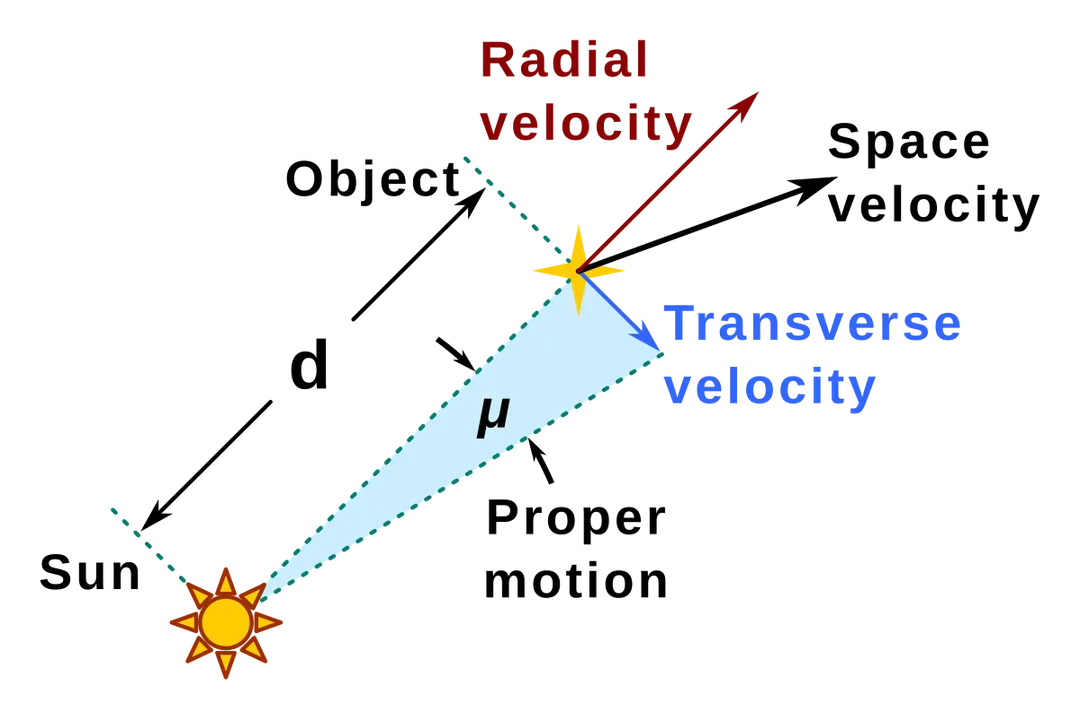
The challenge of accurately charting the true motion of a star located millions or billions of light-years away stems from the fundamental geometry of measuring movement across the vast, seemingly static backdrop of the night sky. What astronomers call proper motion is simply the apparent change in a star's position on the celestial sphere over time. [1][9] This movement is the projection of the star's actual transverse velocity—its speed moving perpendicular to our line of sight—onto the plane of the sky. [1] While we can observe this angular shift, determining why it’s difficult to measure for distant stars requires understanding the relationship between angular movement, physical speed, and the immense distances involved.
# Angular Movement
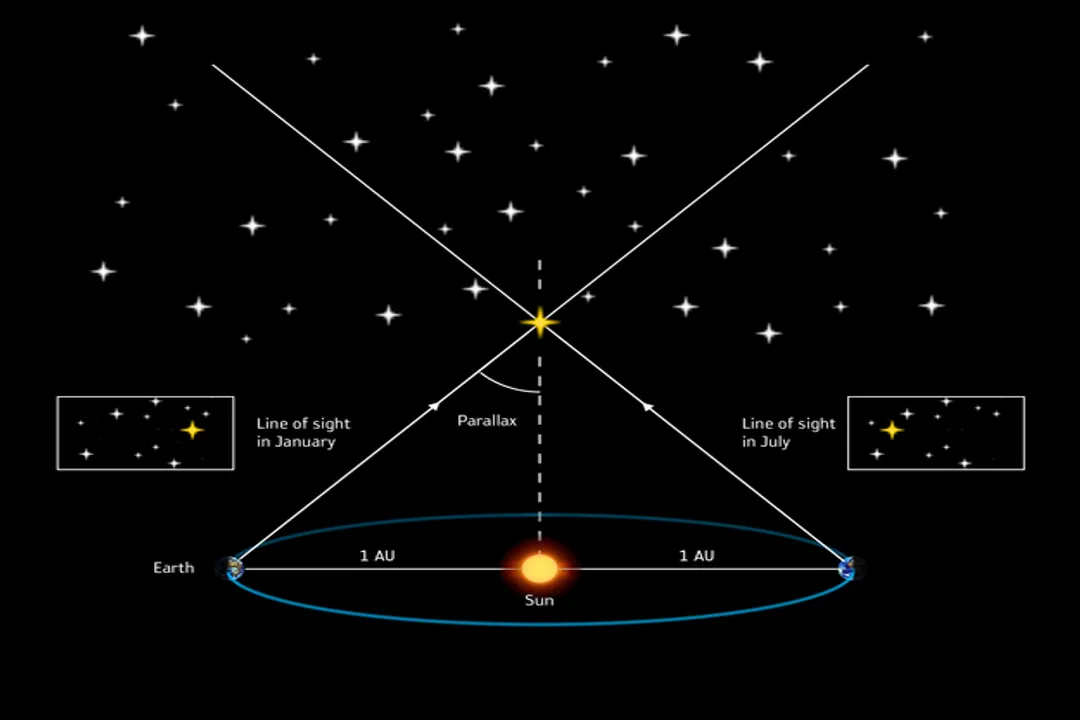
Proper motion is quantified in arcseconds per year (). [1] This measurement tells us how many arcseconds the star appears to have moved across the celestial sphere over the span of a year. [9] For nearby stars, this motion can be substantial; for instance, Barnard's Star is famous for having one of the largest proper motions known, shifting noticeably over the course of a human lifetime. [6]
The immediate problem with distant objects is that the angular shift becomes incredibly small, often shrinking to magnitudes that challenge the finest instruments currently available. [4] Even if a star is barreling through space at an immense speed, if it is very far away, that speed translates into an almost imperceptible angle change when viewed from Earth. [4] A star moving at $100$ kilometers per second might have a measurable proper motion if it is close, but if you double its distance, that proper motion halves, assuming all else remains equal. [1]
# Distance Impact
The true physical speed of a star, its tangential velocity (), cannot be gleaned from the proper motion () alone; distance () is the essential missing variable. [1] The relationship is linear: . [1] If we are trying to map the kinematics of the galaxy or understand stellar populations, knowing the true space velocity is crucial. Therefore, the difficulty in measuring proper motion for distant stars is intrinsically linked to the difficulty in independently measuring their distance. [1][5]
If a star is too far away, its proper motion will be so small that it becomes completely swamped by observational noise or systematic errors in measurement, making the resulting value statistically unreliable. [4] Without a reliable , we cannot calculate unless we have an incredibly accurate .
# Distance Limits
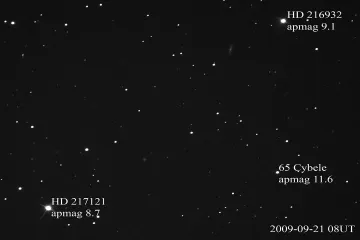
To determine the distance () required to convert the observed angular shift into a physical speed, astronomers rely on stellar parallax. [2] Parallax works by observing a star's apparent shift against the distant background stars as the Earth orbits the Sun, using the diameter of Earth's orbit—about $2$ Astronomical Units (AU)—as the baseline for triangulation. [2][3]
However, the parallax angle () follows the inverse law: , where is measured in parsecs and in arcseconds. [2] For very distant stars, the parallax angle becomes vanishingly small. [4] For example, the furthest stars measurable accurately by ground-based parallax techniques might only exhibit an angle of $0.01$ arcseconds or less. [5] Even with sophisticated instruments, there is a practical limit to how small an angle can be measured reliably before atmospheric distortion (for ground-based telescopes) or inherent instrumental precision limitations render the measurement useless. [2] If the parallax is too small to measure, the distance remains uncertain, which cascades into an uncertainty in the calculated tangential velocity derived from the proper motion. [5]
A comparison of the required observation baselines highlights the temporal separation of these techniques. Measuring parallax relies on geometry over a known, fixed baseline—the Earth's orbit—requiring observations separated by about six months to capture the maximum angular shift from opposite sides of the orbit. [3][5] Measuring proper motion, conversely, relies on motion over time. [6] Even if we could measure the parallax for a distant star, the proper motion calculation still requires observations spanning many years, perhaps decades, to accumulate enough angular travel to rise above the noise floor inherent in the position measurements. [6]
Consider the practicalities of early astrometry. Early determinations of proper motion often involved comparing photographic plates taken decades apart. [6] For a distant star, the angular displacement over, say, twenty years, might only amount to a few thousandths of an arcsecond. If the error margin in measuring the position on each plate is arcseconds, measuring that tiny displacement accurately becomes statistically precarious, even when averaging the errors over the two decades.
# Observation Span
The second major hurdle, independent of the distance/parallax problem, is the sheer amount of time needed for any proper motion measurement, especially for faint or distant targets. Stellar motion is constant, but it is slow when viewed across the cosmos. [1]
For a relatively close star, a few years might suffice to show a clear shift. For one farther out, a human lifetime might not be long enough to see a movement substantial enough to confidently separate it from measurement noise, especially when using older photographic techniques. [6] Even modern space-based astrometric missions, which provide superior angular resolution, still require careful observation campaigns spanning years to establish the drift accurately. [1]
This necessity for long observational baselines places significant constraints on our ability to update stellar catalogs. Unlike measuring a star’s orbital velocity around the galactic center, which changes on timescales of millions of years, proper motion is about local stellar kinematics, but the measurement timescale is limited by our available historical data and the instrument's positional accuracy. [1]
If we analyze the required sensitivity, an instrument must be capable of measuring angular differences on the order of micro-arcseconds () over a decade to map the motions of stars even moderately far away, assuming they have a typical transverse velocity. For stars in the outer halo or in other galaxies, the necessary precision exceeds what is currently feasible across the required observation period, essentially rendering their proper motion effectively unmeasurable for routine cataloging.
# Astrometric Precision
The success in measuring proper motion today, particularly for cataloging the Milky Way, rests almost entirely on advancements in astrometry driven by space missions. Ground-based measurements are frequently hampered by atmospheric refraction, which causes stars to appear to shimmer and shift position randomly due to turbulence in the air. [2] While sophisticated adaptive optics can correct for some of this effect, it cannot entirely eliminate the baseline errors needed for high-precision, long-term proper motion studies.
Space telescopes, by observing above the atmosphere, eliminate this dominant source of error. [2] Missions like Hipparcos and, more recently, Gaia, have provided the generational leaps in accuracy needed to measure proper motions for stars much further away than previously possible. [1] Gaia's astrometric data provides positional measurements accurate down to micro-arcseconds. [1]
The practical difficulty, therefore, shifts from "Can we see the motion?" to "Can we measure the position twice with sufficient identical accuracy over the required time?" The inherent noise floor of any measuring device dictates the minimum measurable proper motion for a given time baseline. If the star is distant, its expected proper motion might be . If our instrument can only guarantee a positional accuracy of at any given time, we need to wait about five years just to observe a total shift equal to the error in a single measurement, making any precise calculation challenging until that period is significantly exceeded.
# Synthesis of Measurement Challenges
The difficulty in measuring the proper motion of a distant star is thus a threefold predicament, where each component exacerbates the others:
- Distance Attenuation: The farther the star, the smaller the physical motion translates into angular motion (). [1]
- Distance Determination Dependency: To interpret as a meaningful physical speed (), we need the distance (), which usually requires measuring parallax (). [2]
- Parallax Limits: Distant stars yield tiny parallax angles (), pushing measurement technology to its limits. [4][5]
If we only look at the proper motion measurement itself, the issue is the time constraint. We need decades to capture a measurable shift for very distant targets, which challenges the continuity of historical records and the longevity of research projects. [6] If we consider the need to derive the true velocity, the issue is the distance constraint, as the distance measurement (parallax) fails for the farthest objects, leaving the proper motion value as an isolated, uncontextualized angular shift. [4] In essence, for distant stars, we are often left with an extremely small angular change occurring over a very long period, where our ability to measure the initial position and the final position with the required precision over that elapsed time is severely tested by both physics and engineering constraints.
Related Questions
#Citations
Proper motion
Stellar Parallax
Why do we have to wait half a year to measure stellar ...
Why does parallax method cannot be employed for ...
Can someone help me understand Parallax? (method for ...
What factors limit the accuracy of the parallax method in ...
Astronomy 1144: Lecture 6
Did you know that… astronomers find it much more difficult to ...
Proper Motion - eSky