What is the second major hurdle, independent of distance, for measuring the proper motion of a distant star?
Answer
The sheer amount of time needed for observation spanning years or decades
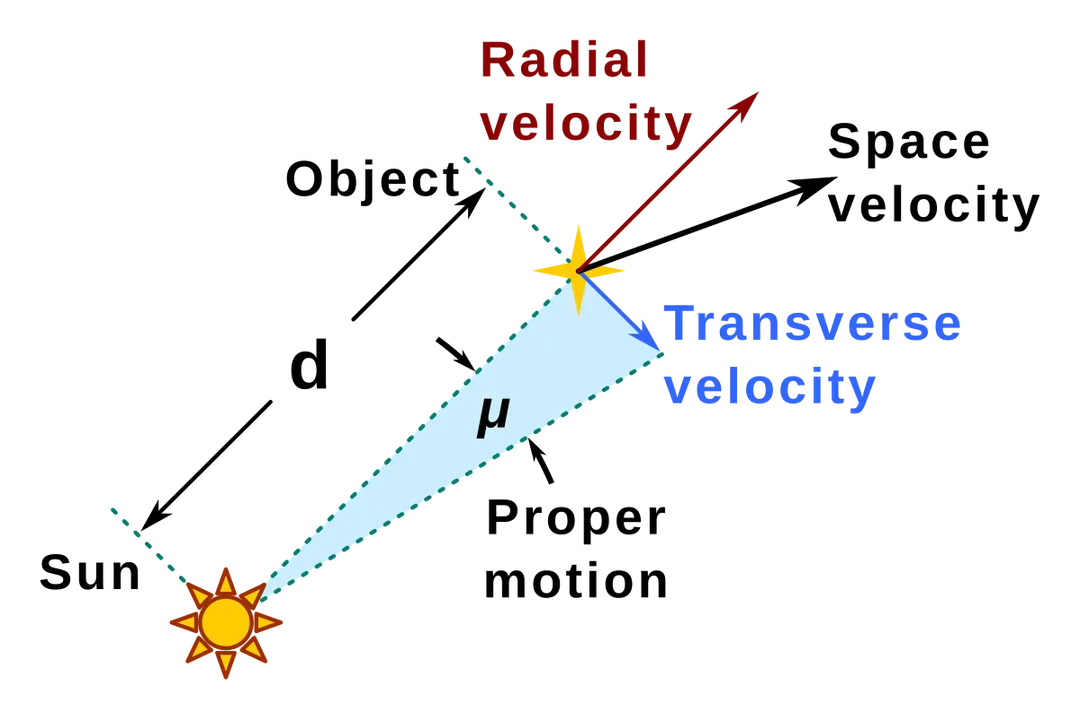
Even if distance were known, significant angular travel must accumulate to rise above measurement noise. This necessitates observation campaigns lasting many years, potentially decades, to achieve reliable results for distant targets.
Related Questions
What is the definition of proper motion?In what units is proper motion quantified?What formula relates tangential velocity ($v_t$), proper motion ($
u$), and distance ($d$)?If a star's distance is doubled, assuming its tangential velocity stays the same, how does its proper motion change?What observational technique is required to determine the distance ($d$) necessary for calculating tangential velocity from proper motion?What measurement baseline is utilized when determining distance via parallax?For very distant stars, how small can the measurable parallax angle ($
u$) become for ground-based techniques?What is the second major hurdle, independent of distance, for measuring the proper motion of a distant star?What key source of error is eliminated by conducting proper motion observations using space telescopes?Which star is famous for possessing one of the largest proper motions known?If the error margin in measuring a star's position on a single photographic plate is $\pm 0.005$ arcseconds, what challenge arises when measuring a tiny proper motion displacement over two decades?