How large can a single convective feature on Betelgeuse be compared to a major solar system boundary?
Answer
Larger than the entire orbit of Jupiter
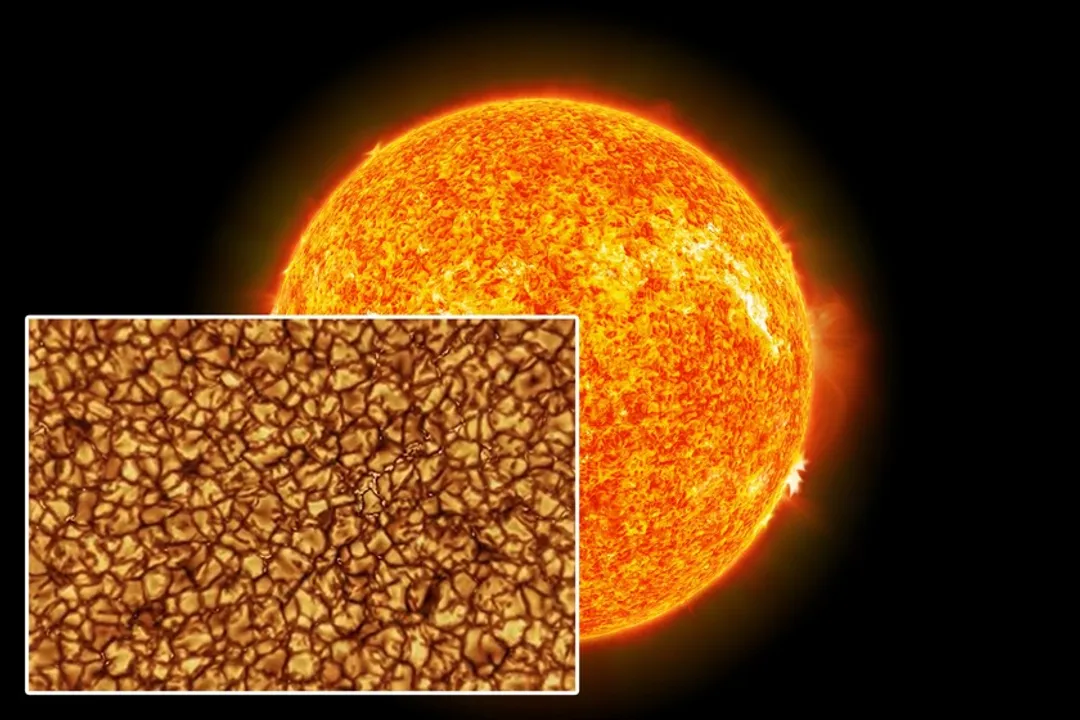
The sheer scale of convection on Betelgeuse far surpasses that observed on our Sun. While a granule on the Sun might span hundreds of miles, the convective features resolved on Betelgeuse—which is predicted to be millions of times the volume of the Sun—are gargantuan. These immense, rising bubbles of gas are so large that a single one can extend beyond the orbital distance of Jupiter. This vast scale difference illustrates that the churning, boiling reality of a red supergiant's surface involves physical structures that dwarf the planetary arrangements of our own solar neighborhood.
#Videos
First Close-up Picture of a Star Outside Our Galaxy - YouTube
Related Questions
What texture characterizes the Sun's visible surface, the photosphere, upon close inspection?What defines a star's 'surface' when considering its wispy, ever-thinning layers of gas?What process suppresses convective flow, causing dark patches known as sunspots to appear on the Sun?What astronomical technique was necessary to resolve the surface details of the red supergiant Betelgeuse?How large can a single convective feature on Betelgeuse be compared to a major solar system boundary?Stars are fundamentally composed of what superheated state of matter, where light is emitted?What visual description characterized Betelgeuse when astronomers captured its first resolved close-up image?For the vast majority of stars not named the Sun or Betelgeuse, how is their surface appearance understood?How many times larger is the angular size subtended by a dime held at arm's length compared to Proxima Centauri as seen from Earth?What mission provided empirical close-up data showing the turbulent plasma surface of our Sun?What are the bright, irregularly shaped patches within the Sun's granular photosphere texture specifically called?