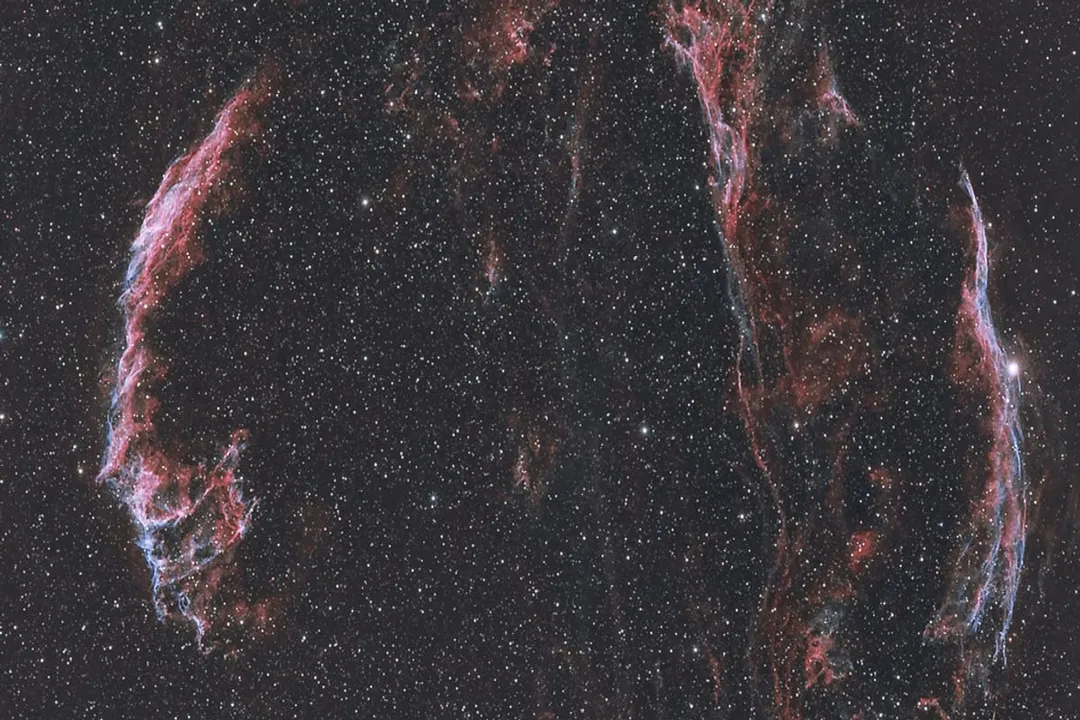
In composite astrophotography images, which emission, often rendered in blue or cyan, showcases the shock-heated gas structures?
Answer
OIII emission
The emission from doubly ionized oxygen, or OIII, is often represented using blue or cyan tones in composite images to highlight the structures heated by the shock front.
Related Questions
Where is the Veil Nebula physically situated within the Milky Way galaxy?Approximately how long ago did the supernova event that created the Veil Nebula occur?What is the approximate minimum diameter of the Veil Nebula remnant?Which designation is associated with the Western Veil Nebula, often called the "Witch's Broom"?Which catalog designation sometimes groups the Eastern Veil Nebula components?Why does the Veil Nebula appear as vibrant, striking colors in deep-sky photographs?What causes the visible light emission observed in the Veil Nebula?In composite astrophotography images, which emission, often rendered in blue or cyan, showcases the shock-heated gas structures?What does the smoother, broad appearance of the Eastern Veil suggest about the surrounding interstellar medium?What is the ideal season for observing the Veil Nebula from the Northern Hemisphere?